
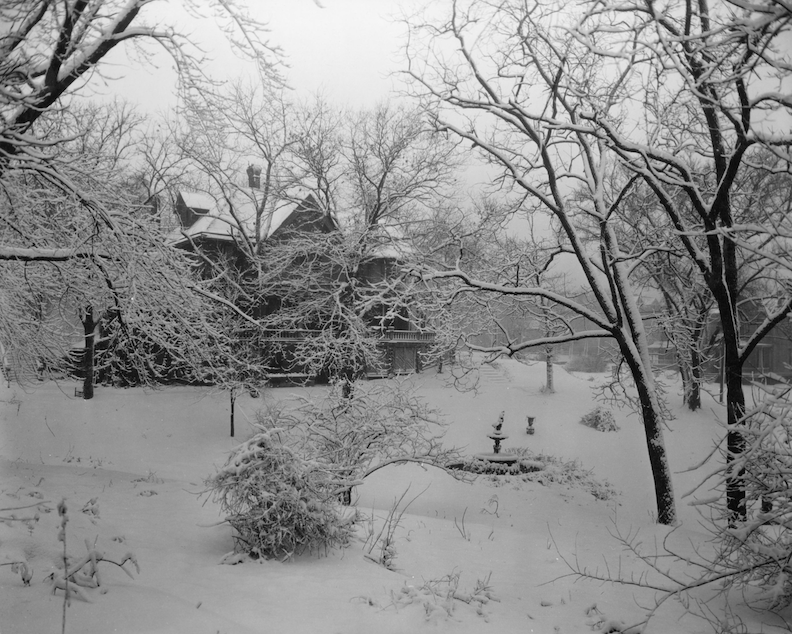
I came across an old, snow veiled photograph that opened a portal to another era, every detail buried in place. A glorious dark residence was concealed from the road by trees and shrubs, cloaked in snow. Hidden but well maintained, there appeared a fountain and statuary. I knew the area spelled out in the photograph’s concise description…however, I will confess, neither location nor householder’s name came together for me.
“A house in the snow with trees around it on 2155 St. Mary’s Avenue, located between 21st and 22nd street.” In February 1924, Omaha photographer Louis Bostwick captured the shot, simply entitled ‘Anna M. Crary.’ Durham Museum.
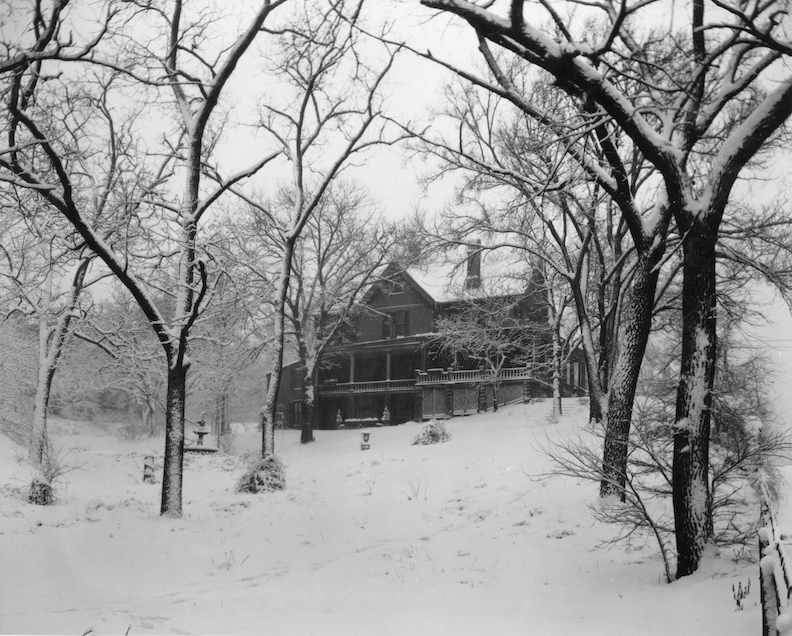
Another beautiful, bewitching angle of 2155 St. Mary’s Avenue, located between 21st and 22nd street. 1924. Bostwick, Louis and Frohardt, Homer. The Durham Museum.
A favorite part of town, I had previously documented the neighborhood in two other investigations and it was featured in my book. Despite this casework, through the icy gaps of foliage and slopes, not much was seen through the apertures. She had been tucked away from my previous surveys and the absence of city specifics captivated me, much the way the homeowner presumably designed their secret surroundings. Shut away in pure, silent solitude.
Interested in the neighborhood and want to know more? Check out my previous investigations for more details:
Mysteries of Omaha: 2226 Howard Street
My Omaha Obsession: Searching for the City, Chapter 5: The Clue to Bircheknolle
At a Glance: This is a tale of wealth, privacy and loyalty in an early Omaha family. It begins and ends at 2155 St. Mary’s Avenue–the juncture of St. Mary’s Avenue–leading towards the future Gold Coast, and Twenty-second Street–which was to become deadlock lane. To describe the house as a “mansion” was one of Omaha’s customary exaggerations although the twenty-seven-room Terrace Hill was undeniably larger than most homes. Its mansion title, in fact, echoed its status of “aristocratic” standing inside a burgeoning town populated with upstarts. Terrace Hill was from a delectable era, perhaps trivial to some, when affluent householders titled their residences and estates with names derived from their surname or the features of the house or grounds. As the years crept by and St. Mary’s Avenue was lowered and widened, Terrace Hill grew increasingly enigmatic, above reproach. It was said Terrace Hill possessed “unparalleled natural beauty compared to any other location in Omaha” and was frequently referred to as “the Italian Garden of Omaha” or “the Garden of Eden.” There, in total seclusion, lived Miss Anna Crary, a maiden auntie, accompanied by her dog, groundskeepers, the birds, and flowers. Enveloped by two acres of woodland and gardens, with the city encroaching upon it, Miss Crary and her estate were effectively insulated from public opinion and city development, rejecting numerous big offers for the property. Rumored to be a wealthy recluse, Miss Crary’s loyalty was to her home, the mansion of distinguished pedigree and good, old-growth bones. Following her death, the mansion was demolished under dismal, puzzling justifications but in keeping of the idiosyncrasies common to those of high breeding.

To linger in the open-concept, high-ceiling, smart-tech minimalism of contemporary times is merely a sign of aesthetic infancy; one must move on, travel back and subsume in the nineteenth century and with any luck, stay there, to fully appreciate the domestic arts of old-growth oak, walnut, pine, chestnut, and maple in Victorian architecture and a complimentary rambling garden. This was exactly the kind of intriguing winter mystery I liked to descent into. I opened a new 2155 St. Mary’s Avenue casefile that very night and parked the Super blocks away. Slowly I ghosted up the once quiet, narrow, tree-lined lane of St. Mary’s Avenue of the 1800s with my camera and notepad. Had I stumbled upon another of Omaha’s Grey Gardens? Be my companion, friends.

The Forest at Twenty-second and St. Mary’s Avenue
The seeds of the Anna Crary Mansion date back to 1863 when the Omaha Famous Redick family first discovered a magnificent resort situated to the west of Downtown Omaha, characterized by a forest on an ascending slope. The vast expanse beyond this thicket of trees, just beyond the crest of the country road, would call successive generations of Omaha to venture further westward. From the outset, the heavy wood at what would later be designated as the southeast corner of Twenty-second and St. Mary’s Avenue served as a sanctuary for the Redick family. (During this period, Twenty-second Street was initially called South Avenue. For the sake of continuity, we shall refer to it as Twenty-second Street.) Their reputed 27-room mansion and extensive grounds were planned to no doubt host enchanting games, exquisite supper music, and dance. Aside from the remote beauty of the thick wood, the area received the societal nod of “exclusive” and in time would be surrounded by very few, but large homes.
The Redick property was situated on the southeast corner of Twenty-second and St. Mary’s Avenue. This entire area of the city was shrouded by a dense canopy of trees; these trees, deemed pre-settlement (Caucasian, that is) were still standing until the 1930s. “The entirety of the northern side of St. Mary’s Avenue, along with the southern side where the Redick residence was located, constituted a forest.”
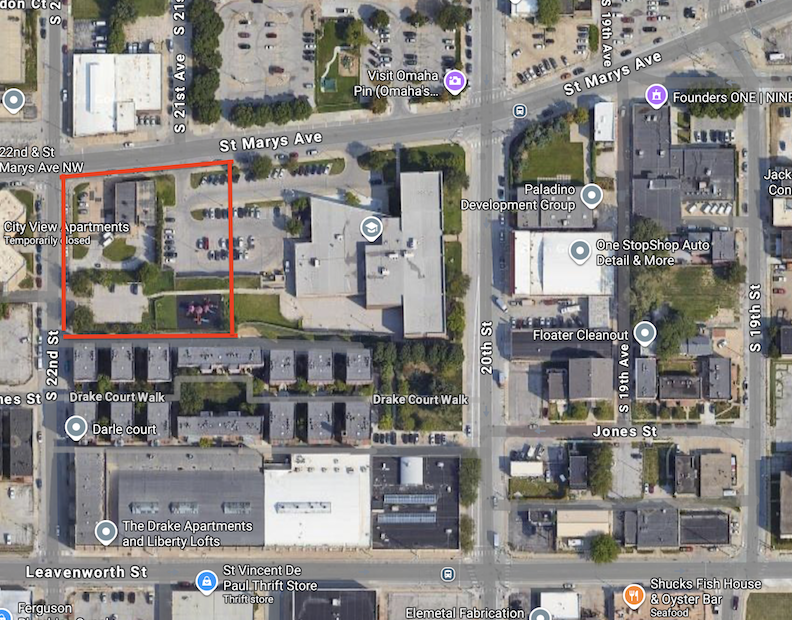
This is an overview of the area surrounding Twenty-second and St. Mary’s Avenue. The upper portion of the photograph is north. Downtown Omaha, to the east, is on the righthand side, out of view. Liberty Elementary School is located at 2021 St. Mary’s Avenue, adjacent to Twentieth Street, on the east end of this block. The Max I Walker Drapery Center stands at 2055 St. Mary’s Avenue, at the western end of the city block. The Omaha Famous dry-cleaning business established this branch in 1949.
I have delineated the Redick-Crary property plot in red. This was formerly a two-acre private property, initially composed of sections from both the Liberty School lot and Max I. Walker’s. I have discovered evidence suggesting that Judge Redick possessed this entire city block, spanning from Twentieth to Twenty-second Street, the family home stationed on the higher, western end. It is noteworthy that he did not plat or “develop” this section of town into his accumulated property holdings, as he did with much of old Omaha by creating additions and lot divisions. This block would have continued in the ambiguous Lands Section Township Range of 22-15-13, had Douglas County School District not created their own Liberty Addition when they acquired the eastern majority of the block. The Max I. Walker lot has never been divided into lots or designated with a plat name.
The setting is unusual, and the sheer size of residence for 1860s Omaha merits consideration, particularly given that the affluent of Omaha had initially settled in the hilly Park Wild region near the river, now referred to as Little Italy. This site is thoroughly examined in my study: Mysteries of Omaha: 1503 Park Wild Avenue. The wealthy families would later extend to Nineteenth Street. From the American Guide Series, Omaha: A Guide to the City and Environs, authored and assembled by the Federal Writers’ Project Works Progress Administration State of Nebraska: Nineteenth Street on Howard was formerly one of the most distinguished residential streets in Omaha. Prominent residents such as George Hoagland, James Woolworth, Charles Turner, and Herman Kountze resided here. Through Larsen and Cottrell’s dense, fascinating book The Gate City: A History of Omaha, I learned that by 1870 the Omaha western-most city limits extended to present-day Thirty-sixth Street.
The U.S. Census of 1860 and survey map of 1866 (below) showed Harrison Johnson, a farmer, his wife Minervia, and their seven children, all under the age of 15 lived in a large house on about Twenty-fourth and St. Mary’s Avenue, with farm land reaching to the south at about Leavenworth. His farm’s eastern most perimeter began at Twenty-second, across from the site of the Redick property. Harrison Johnson’s 1885 Omaha World-Herald obituary referred to him as “A well-known citizen. A man of scholarly tastes and is best known as the author of a History of Nebraska.” In his History of Nebraska, published by Henry Gibson, Herald Printing House, in 1880, Harrison Johnson curiously notes: “The frame residence still standing on the southside of St. Mary’s Avenue, between Twenty-first and Twenty-second streets was built in the fall of 1854, by the author and was occupied by him for fifteen years.” However the following map illuminates that Johnson’s house as of 1866 was on the west end of his farm at Twenty-fourth. As to Harrison’s claim, this suggests that the city had not yet designated the streets with their current numeration, that Mr. Johnson misidentified several streets, or that his residence was situated in the middle of the Redick property, which is difficult to believe. I did enjoy Harrison Johnson’s description of the early Omaha land in this part of town as “long sloping knolls but nowhere, scarcely is the surface so broken as to prevent plowing.” Spoken like a true farmer.
There’s Something about St. Mary’s Avenue
I would learn from the American Guide Series Omaha: A Guide to the City and Environs that Harrison Johnson, called “an early settler,” carved “the trail,” later “a country road” to downtown from this farm. Farmer Johnson’s road would later be renamed St. Mary’s Avenue. According to the 1870 United States Census the nearest neighbors were the Sisters of Mercy Convent, located on the north side of St. Mary’s Avenue between Twenty-second and Twenty-fourth Streets. In October 1864, the nuns arrived in Omaha and established the first convent in Nebraska at this location. Shortly after, they started St. Mary’s Academy, a secondary school. St. Mary’s Avenue, a narrow and inclined thoroughfare (pre-grading), was named in honor of the academy. The site of St. Mary’s Cemetery was on the corner of Twenty-fourth and Howard Streets, now covered by apartment houses and small shops. This St. Mary’s Cemetery was the first Catholic burial ground in Omaha. “It was part of a ten-acre tract of land purchased by Rt. Rev. James M. O’Gorman, vicariate of Nebraska Territory in 1863. It had a natural growth of timber and along its east boundary ran Otoe Creek. The cemetery was abandoned in 1873 due to the encroachment of the city and the bodies were re-interred in Holy Sepulchre Cemetery on Leavenworth.” By 1885 when Harney Street was graded, all trace of the cemetery disappeared.
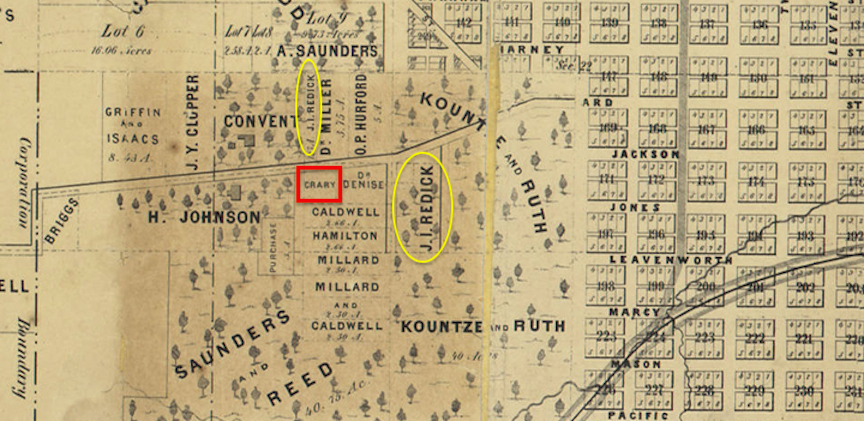
1866 Omaha Map published by Oscar F. Davis, surveyor and real estate agent, 1866. Top of map is North. East is right…etc. Notice the name “H. Johnson” on the middle left hand side, along what would become St. Mary’s Avenue. Note the St. Mary’s convent property to the north. I put a red rectangle around the “Crary” name, the second family to own the mansion site at Twenty-second and St. Mary’s Avenue. I circled the nearby J. I. Redick properties in yellow. Also notice the tree illustrations of the map. Used with permission thanks to the David Rumsey Map Collection.
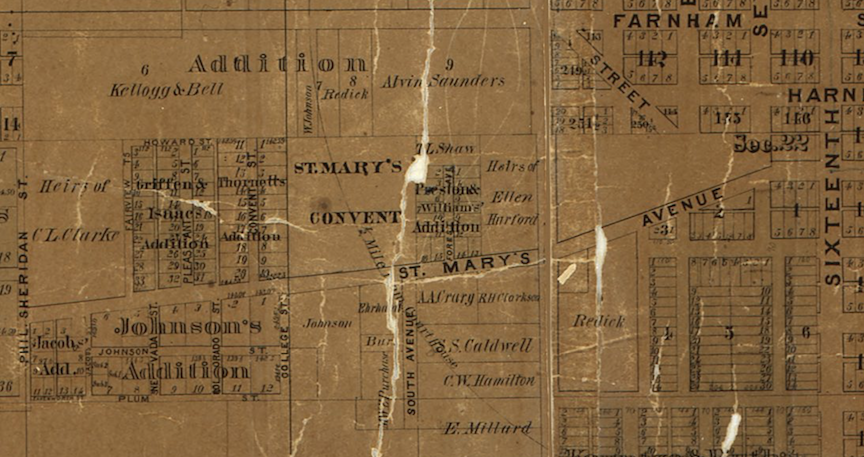
I have fallen in love with a map and want to marry it. Image from the Map of the City of Omaha, 1870. Published by Byron Reed & Co., August Gast & Co., lithographers, St. Louis, Mo., H. F. Greene, draughtsman. Borrowed from the Omaha Public Library.
Illuminated below…
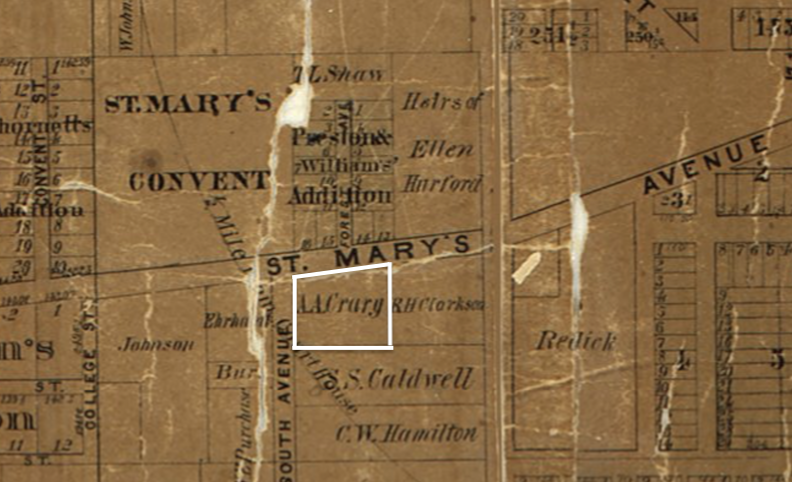
Here we are able to see the St. Mary’s Convent with proximity to the Johnson farm and the Crary property. Map of the City of Omaha, 1870. Published by Byron Reed & Co., August Gast & Co., lithographers, St. Louis, Mo., H. F. Greene, draughtsman. Borrowed from the Omaha Public Library.
By 1880, along with the Union Pacific Railroad, Omaha was served by seven other rail lines and its population had quadrupled. Richard Orr’s book Streetcars of Omaha and Council Bluffs, mentions that by 1889 there was a streetcar route and horse car line along St. Mary’s Avenue. Smile worthy: The St. Mary’s Avenue hill was very steep in the early years; passengers of the horse drawn streetcars frequently had to get off and walk until the cars reached the summit. The hill was graded and cut down in the late 1880’s. I think of Farmer Harrison Johnson’s pursuit to tame this lumpy, perilous thoroughfare of St. Mary’s Avenue. As practical routes go, St. Mary’s Avenue was considered poor, often impassable. The inaccessible terrain described has always given pause. Compared to our straight city grid, St. Mary’s Avenue had a kink and an inherent, perceived difficulty from very early writing. Did the road follow a natural contour? Ley lines, as originally proposed by Alfred Watkins, are not actual roads, but describe conceptual alignments connecting ancient sites. Does St. Mary’s Avenue cross a ley line?
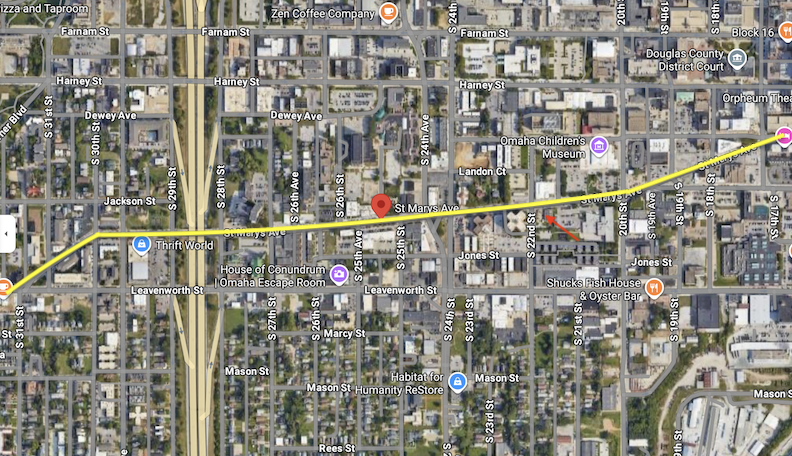
St. Mary’s Avenue begins its peculiar run as an unexplainable divergence off Seventeenth Street. At its western terminus, St. Mary’s Avenue inexplicably converges with Leavenworth—another notably weird street, albeit with a rational basis for its oddity. There exists an energy disruption on St. Mary’s Avenue, (I perceive the experience as akin to nerve damage in the body), corroborated by news articles that outlined the difficulties in managing the natural physical terrain, as well as the human responses to this disruption and associated societal challenges. I am proposing an energetic leak that imparts a disjointed, ungrounded sensation. The area of our focus on St. Mary’s is from Twenty-fourth to Seventeenth but argument could be made for the whole short run. Now friends, is this merely attributed to St. Mary’s Avenue deviation from the tidy city grid, resulting in a disconnected sensation? I acknowledge the absence of empirical evidence supporting the existence of ley lines as tangible, measurable energy conduits, but some of you are familiar with dowsing and metaphysical ground energy studies, and I would appreciate your insights regarding good ol’ St. Mary’s Avenue.
It would make sense that the business owners and wealthy families would want to build on the western most edge of the city, as that has traditionally been the pattern in this town. Move West, away from common density. When the Redicks built their large home, between Sixteenth Street and the Harrison Johnson farm on Twenty-fourth Street, there were no additional residences save from the B. E. B. Kennedy household, a modest cottage situated on Twentieth Street. As the city grew, additions were platted along the St. Mary’s Avenue.
As for the dense wood, that too would be controlled and pruned as the city managed the urban canopy throughout the decades. The subsequent images aim to depict the remnants of the tree line and seclusion along strange St. Mary’s Avenue, albeit long after the Redick-Crary transfer of real estate from the 1860s.
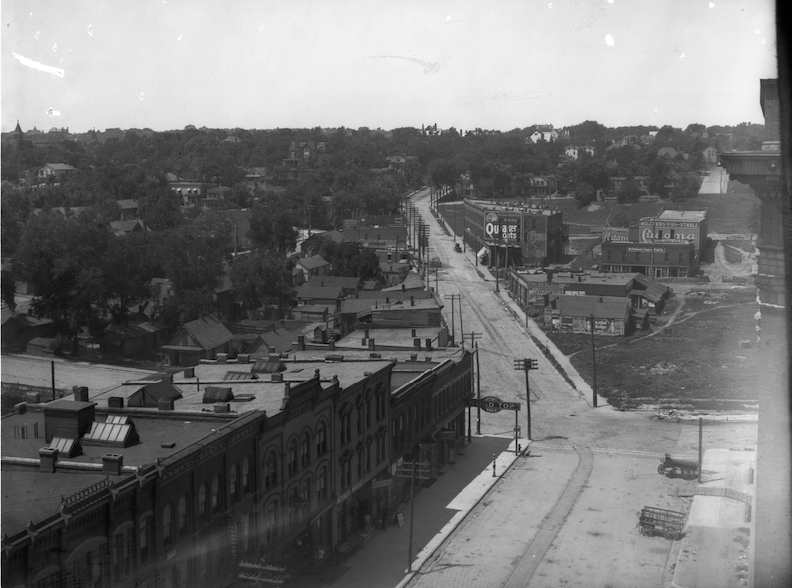
A very interesting photograph. Saint Mary’s Avenue looking west from Seventeenth Street. At this time, Howard Street ended at Seventeenth Street, which is classically Omaha. Assorted “Old West” building viewed along St. Mary’s until, in the distance, there is a jog in the road. A thick wood appears, undeniably announcing one has left Downtown. I have identified this as Twentieth Street. To the west is the Redick-Crary house in the trees, by then, surrounded by all manner of glorious architecture. Circa 1906. Bostwick, Louis (1868-1943) and Frohardt, Homer (1885-1972). The Durham Museum. 1906. Below I have enlarged this portion for your viewing pleasure.
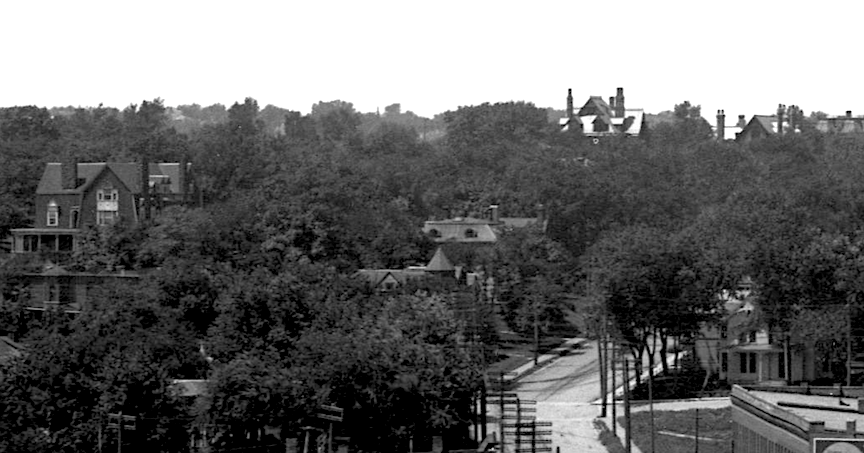
1906. The preceding Durham Museum photograph magnified. A bend in the road, which carries a spiral-feel for some.
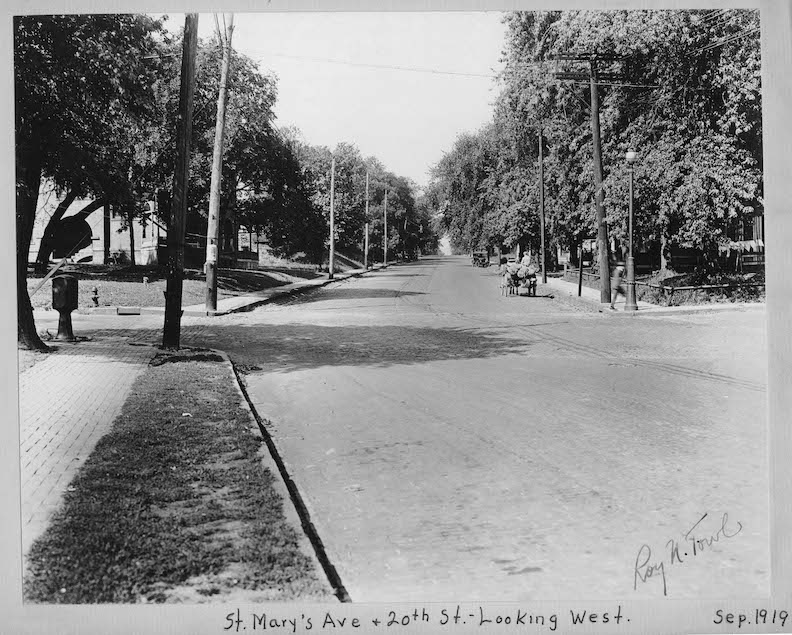
The Kink in the Road. Looking west on St. Mary’s Avenue from Twentieth Street, before the widening project. And yet much wider (and paved with cobblestones) than it had been when the Redick and Crary families lived in the far left distance of the picture frame. The cross street in the distance is Twenty-second Street. A man is driving a horse and wagon up the well-pounded hill. This photograph was given to me by Joe Knapp of the Omaha City Planning department. I suspicion that it was a Louis Bostwick photo however it reads Roy N. Town. September 1919.
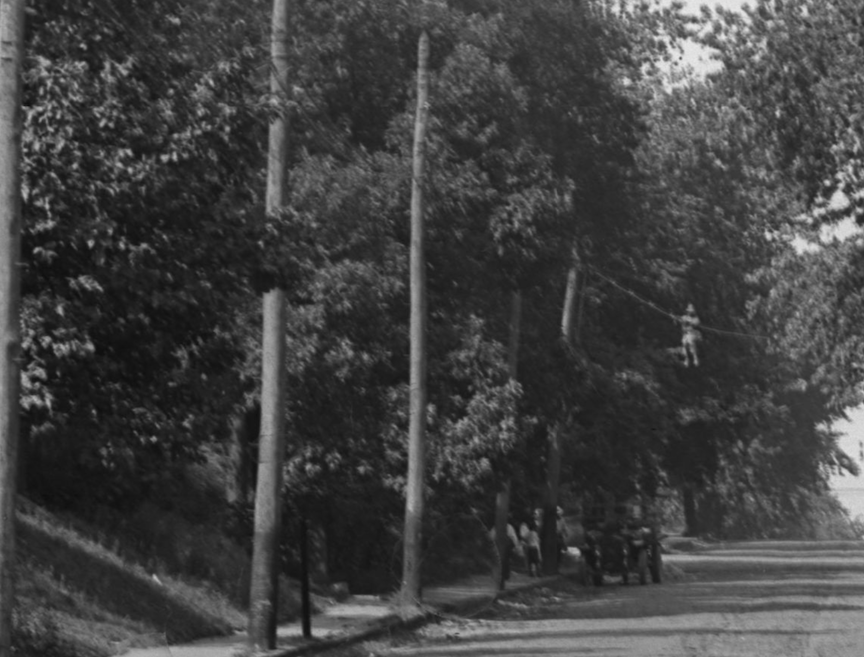
Magnified. The Crary property perimeter is on the left side of the photo. One can observed the incline into the trees. The cross street ahead is Twenty-second. Notice the man up above St. Mary’s holding the cable. Am I seeing things? This image was from Bostwick, Louis (1868-1943) and Frohardt, Homer (1885-1972). The Durham Museum. 1919.
John Irvin Redick
In the autumn of 1856, John Irvin Redick and his wife, Mary E. Higby, came to Omaha in their first year of marriage, possessing two thousand dollars in cash. They swiftly constructed a formidable empire. As fellow sleuths have well observed there are streets, mansions, towers, and many real estate developments that bear the Redick family name in town, and we have examined this early Omahan multiple times in past articles. John I. Redick established his law partnership by the spring of 1857 and he would come to be recognized as one of the most accomplished attorneys of his era.
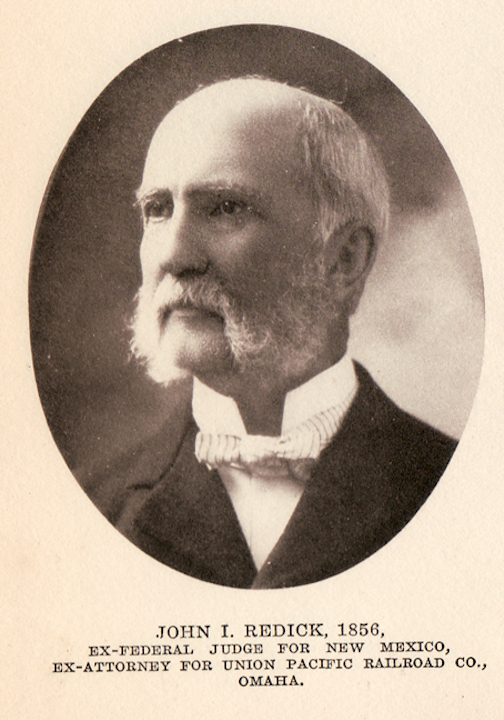
Image scanned from one of my favorites: Nebraskans 1854-1904. Omaha Bee. The Bee publishing co., 1904. “Among those men who figured prominently in the professional, business, financial, public and social life of Omaha during the first half century of the city’s existence, none was any better known than John Irvin Redick.”
By 1860, Redick was elected to the state legislature, but his investments and leadership may have had the most significant influence on our town. Redick’s substantial private enterprises encompassed large real estate holdings, one of the largest private contributors to Omaha city development that I have found beyond the Kountze holdings, political involvement, civic leadership, and prominence in society. John I. Redick would marry three times.
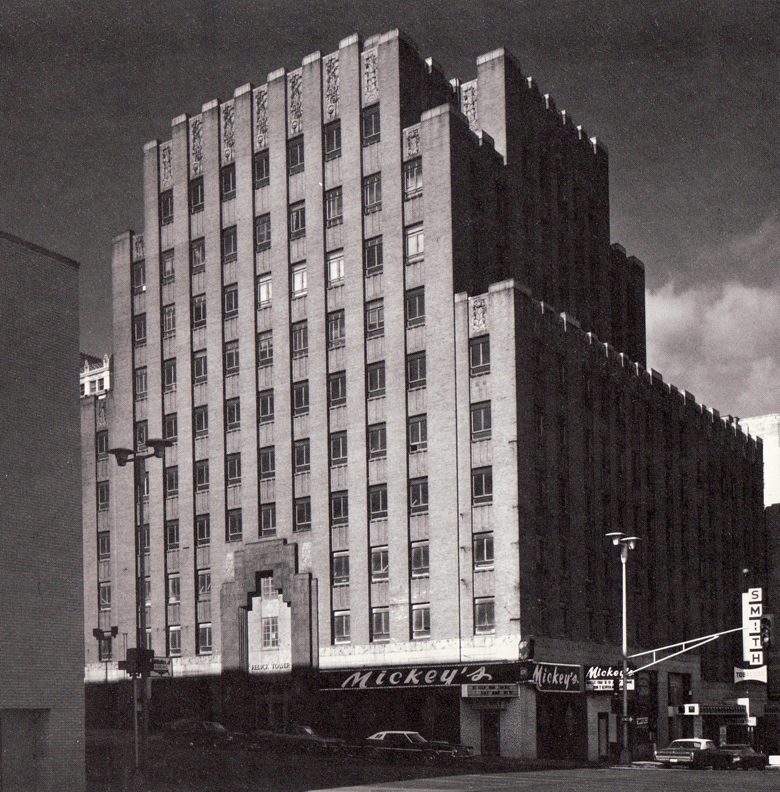
Redick Tower at 1504 Harney Street was built in 1930. I enjoy this photo from 1976, back when the unabashed Mickey’s go-go club could be found on the first floor. Camera faces northwest. Built as a tribute to John Irvin Redick on land that he owned, the building has been home to Hotel Deco since 2011. I scanned this image from one of my favorite books: Omaha City Architecture by Landmarks, Inc and the Junior League of Omaha Inc. (1977)
The expansive residence Redick constructed with his first spouse was located near the southeast intersection of Twenty-second and St. Mary’s Avenue. It is said this large house was constructed in 1863. However, further research would disclose that this period was fraught with difficulties for the pair. The couple had already had seven sons, five of whom died in infancy. Surprisingly the first Mrs. Mary Redick passed away by 1864, allegedly merely one year into the new residence in burgeoning West Omaha. In October 1866, John Redick wedded Mary E. May, the second Mrs. Mary Redick; they later had five sons, all of whom survived to adulthood.
It was under these conditions that the Crary family relocated to Omaha– the very year of Redick’s second marriage. It was reported that soon after, the Crarys acquired the 27-room mansion from the Redicks. To the best of my digging, the Redick mansion was purchased by Mr. Beebe Denison Crary in 1866. More details of the Crary family to come. The Redick-Crary families’ relationship would endure through the decades.
The John Redick family then constructed their new mansion at the intersection of present-day Twenty-fourth and Pratt streets. I assume that this residence symbolized a new beginning with his second wife, following the death of his first wife and five sons. In the early 1870s, Judge Redick acquired yet more land, a quarter section extending west of Twenty-fourth Street, which allowed his mansion to sit centrally on this impressive tract. In this refined residence, John Redick could host the expected gay social gatherings he had envisioned at Twenty-second and St. Mary’s, were it not for the considerable losses he endured. By 1876, he was named U.S. Judge for New Mexico by General Grant and would go on to serve as an attorney for the Union Pacific Railroad in Denver, Colorado; he relocated to Los Angeles and assumed the presidency of the Southern California National Bank. He returned to Omaha in 1889 and lived here until his death. The North Omaha Redick home was razed in 1917.
Next up the Crary family but first…
Lay of the Land
The tranquil West Omaha forest of the 1860s has undergone significant transformations. Let us establish a baseline for 2026.
Again, I show this Google Map overview of the area surrounding Twenty-second and St. Mary’s Avenue just to gather our bearing. The upper portion of the photograph is north. Downtown Omaha, to the east, is on the righthand side, out of view. Liberty Elementary School is located at 2021 St. Mary’s Avenue, adjacent to Twentieth Street, on the east end of this block. The historic Redick-Crary property plot outlined in red was located where the Max I Walker Drapery Center stands at 2055 St. Mary’s Avenue, at the western end of the city block. The Omaha Famous dry-cleaning business established this branch in 1949.
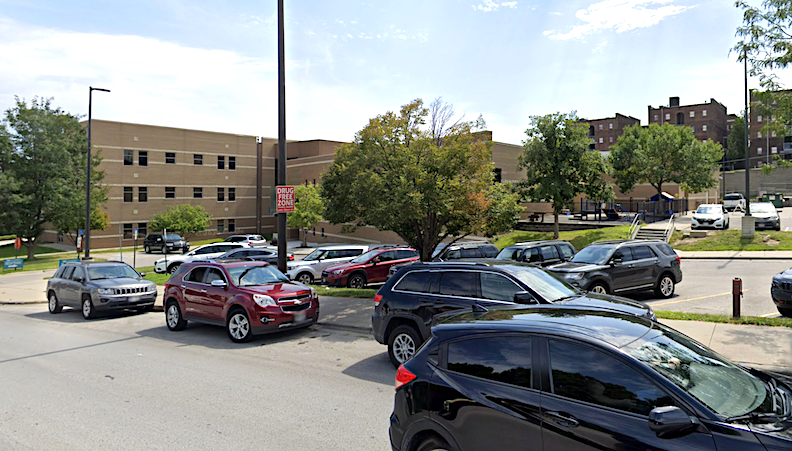
Liberty Elementary School is located at 2021 St. Mary’s Avenue. Northwestern elevation of the large prison-architecture building as viewed from St. Mary’s Avenue. Great school, torturous building design. We view the backside of the Drake Court apartments to the south with formal entrance at Twenty-second and Jones Streets. This complex will come into view later.
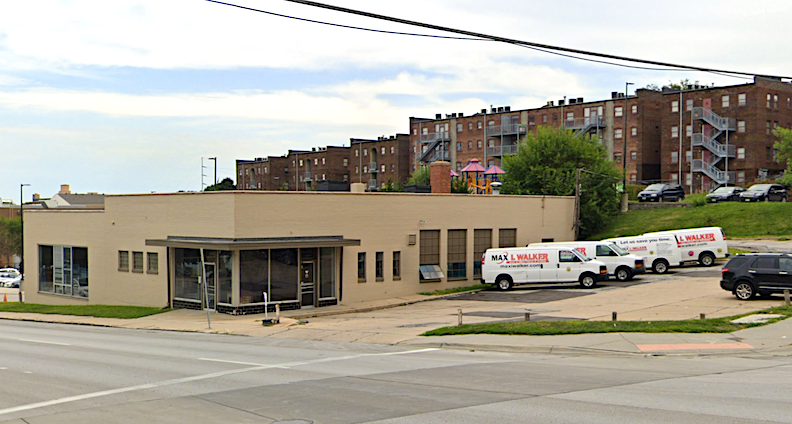
The nondescript tawny, tortilla Max I. Walker Drapery Center at 2055 St. Mary’s Avenue was once a cuter, open-to-the-public, MCM structure. We view the backside of the Drake Court apartments to the south with formal entrance at Twenty-second and Jones Streets. This complex will come into view later.
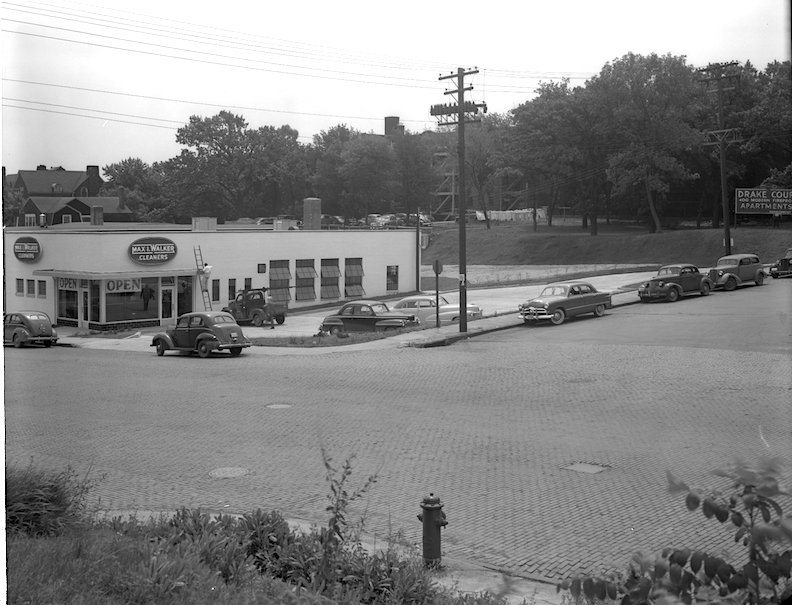
Oh yes….here it is. The Classic. Max I. Walker Cleaners store at Twenty-second and St. Mary’s Avenue on the southeast corner. Bostwick, Louis and Frohardt, Homer. The Durham Museum. 1949. Camera faces southeast.
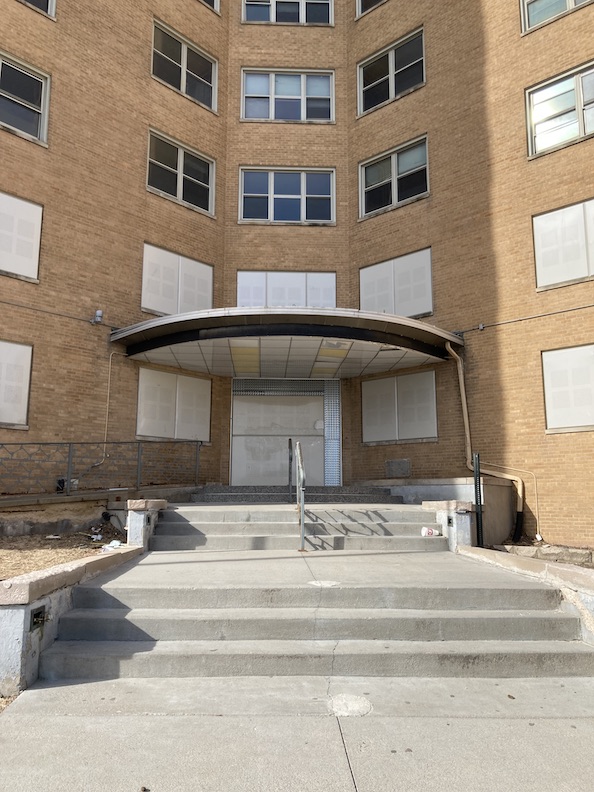
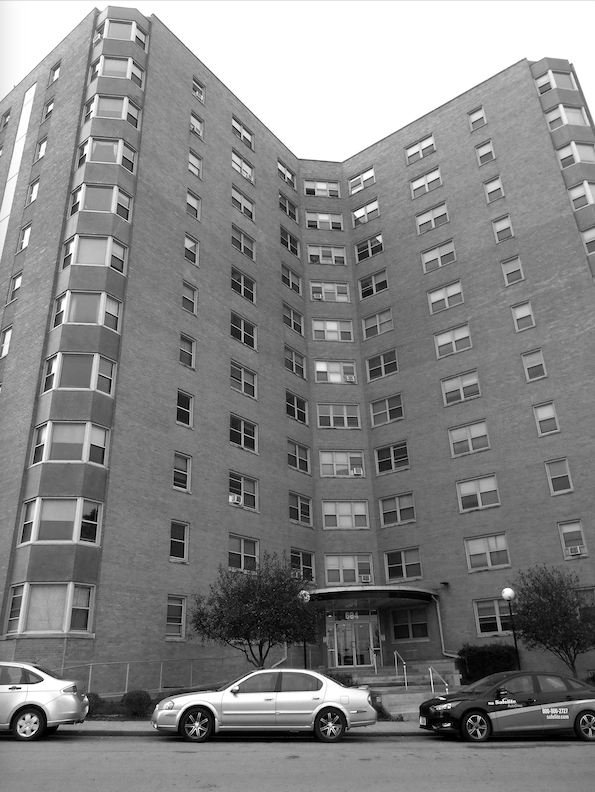
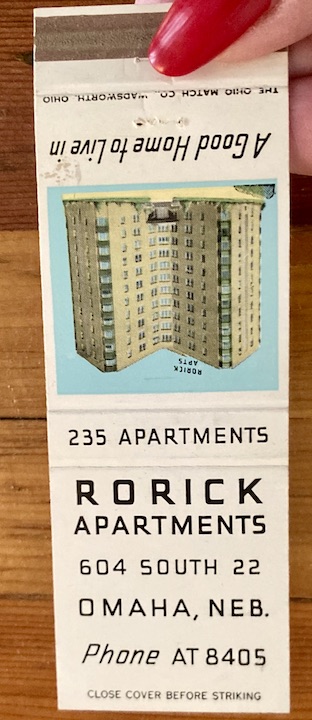
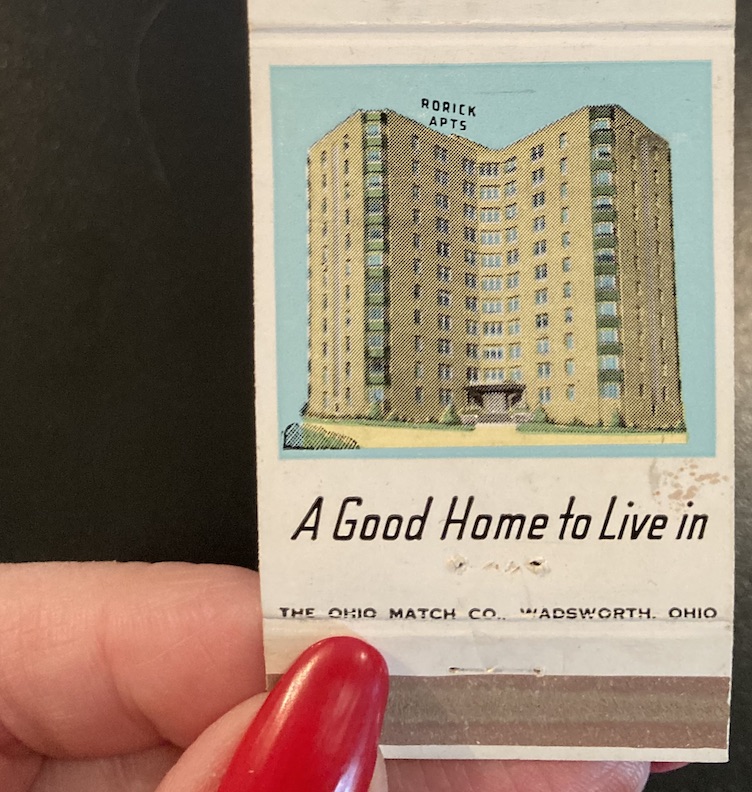
West of Max I. Walker’s building lies the Rorick Apartments, most recently known as City View Apartments, located at 604 South Twenty-second Street (southwest corner of Twenty-second and St. Mary’s Avenue). City View is currently boarded up; I took this east elevation photograph several weeks ago. I have documented this once impressive MCM Rorick high-rise in my book and include the 2017 photo I took for that research. I love my 1950s matchbook– pausing to say every great apartment building deserves the matchbook honor!–so I decided to incorporate it into our investigation today. It reads “235 Apartments” and “A Good Home to Live in.”
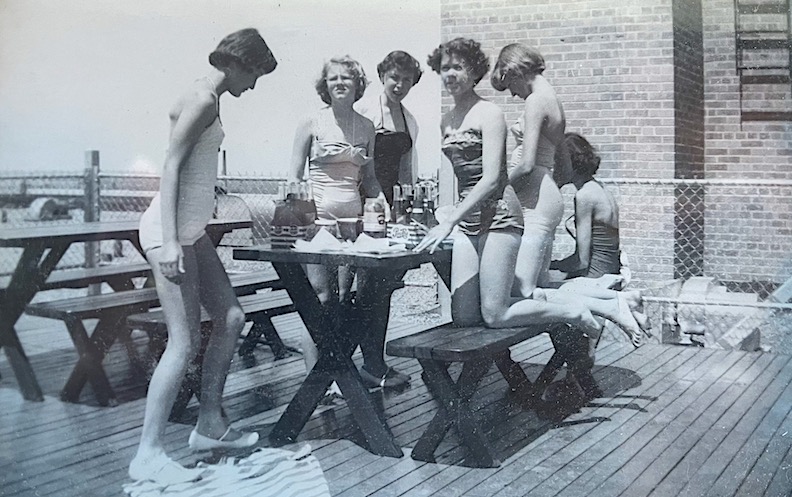
I had written of the violence and issues at the Rorick over the last thirty plus years but it wasn’t always this way. Donna Butler Heppermann, my girlfriend’s mother, resided in the Rorick apartment building with her mother when it was first built. We met to discuss her experience there shortly after the book’s release. Donna affirmed that the Rorick was a charming and chic apartment complex in its prime. She shared stories and interior photos with me. The Rorick was once very cool and distinctly Mid-century Modern—Donna’s photographs evoked the apartment sets from The Courtship of Eddie’s Father, starring a young Ronny Howard and Glenn Ford. Chris Heppermann, Donna’s daughter shared a wonderful snapshot when Donna celebrated her birthday on the rooftop terrace of the Rorick. An exceptional view! She is seen second from the left. Photograph from the Donna Butler Heppermann collection.
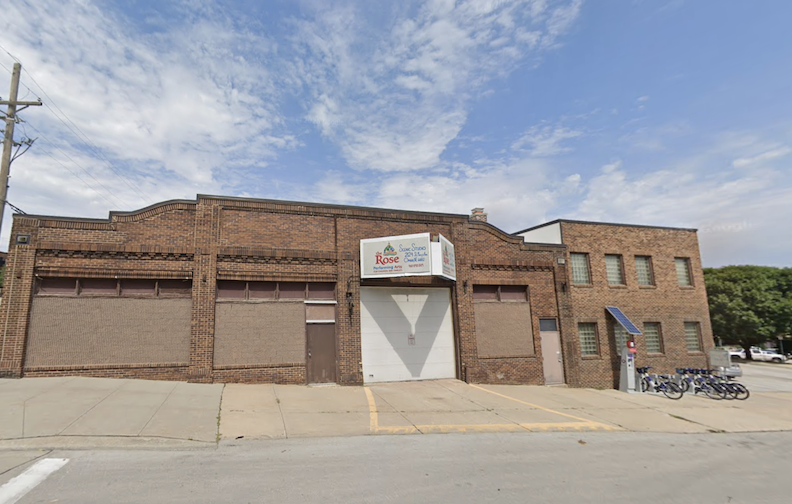
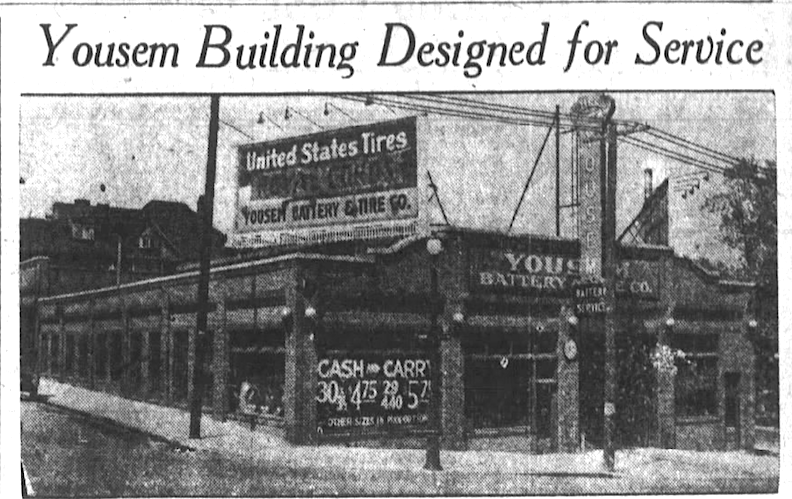
A brick building that I am obsessed with and planning to fully investigate is the mysterious prop shop right across the road from our focus today. The Rose Theater (at 2001 Farnam Street) operates a dedicated prop and scenic construction facility, known as The Rose Scene Shop, located at 2124 Saint Mary’s Avenue (northeast corner of Twenty-second and St. Mary’s.) This magical facility also supports the Omaha Theater Company by building sets and props for their productions. This was originally the old Yousem Battery and Tire Company. This fine structure was “built especially to service motor cars,” according to the Omaha Sunday Bee-News of the 1920s. Latter photograph borrowed from that article.
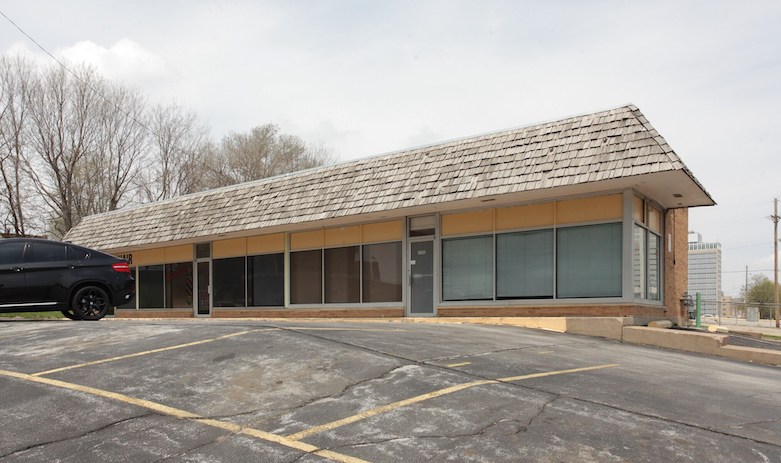
On the northwest corner is another Mid-century modern gem at 2204 St. Mary’s Avenue. Built in 1957, this building has always fascinated me! It was initially a laundromat, which makes sense in observation. This building was always the Midwest Hair Replacement Center in my day and before that was a men’s toupee store for decades. Amazing. This 2204 corner lot will come up again further into our investigation. Photograph borrowed from Loopnet.
The Footprint and Photographic Forensics of 2155 St. Mary’s Avenue
Okay friends, let’s gather round and compare a 2026 map to a 1890 Sanborn map.
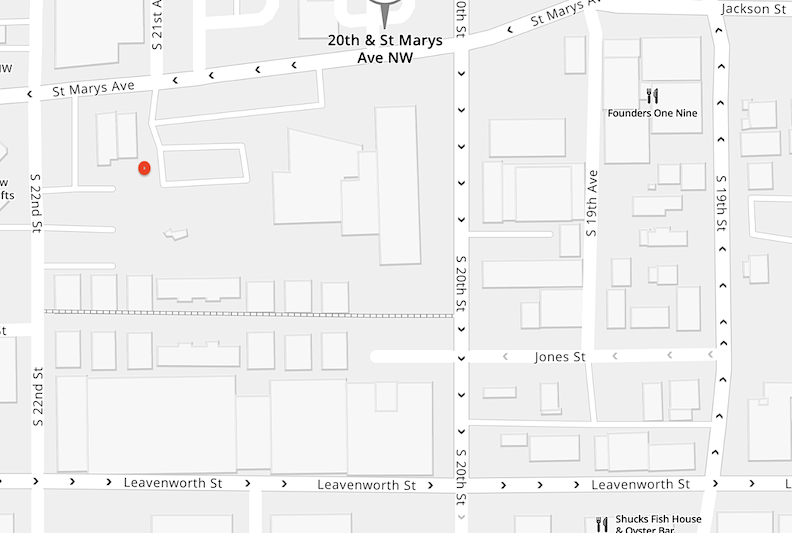
2026 current map of area. Top of image is north. Bottom of image is south. Red dot is on the once Redick-Crary land, next to Max I. Walker building.
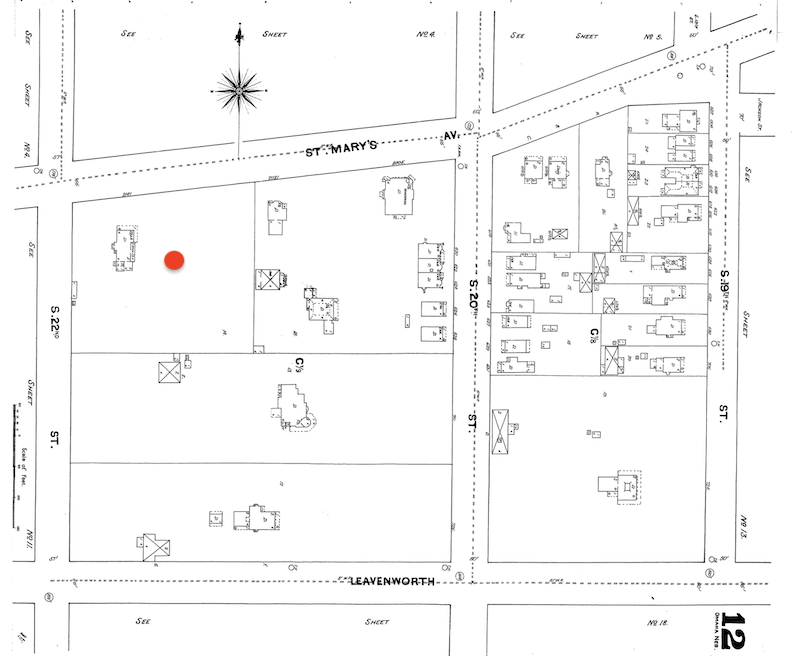
1890 Sanborn Map. Top of drawing is north, St. Mary’s Avenue. Bottom of drawing is south, Leavenworth Street. Red dot designates the two-acre Redick-Crary land. Historic Sanborn Map lent by Trina Westman and Shelley McCafferty of Omaha City Planning Department.
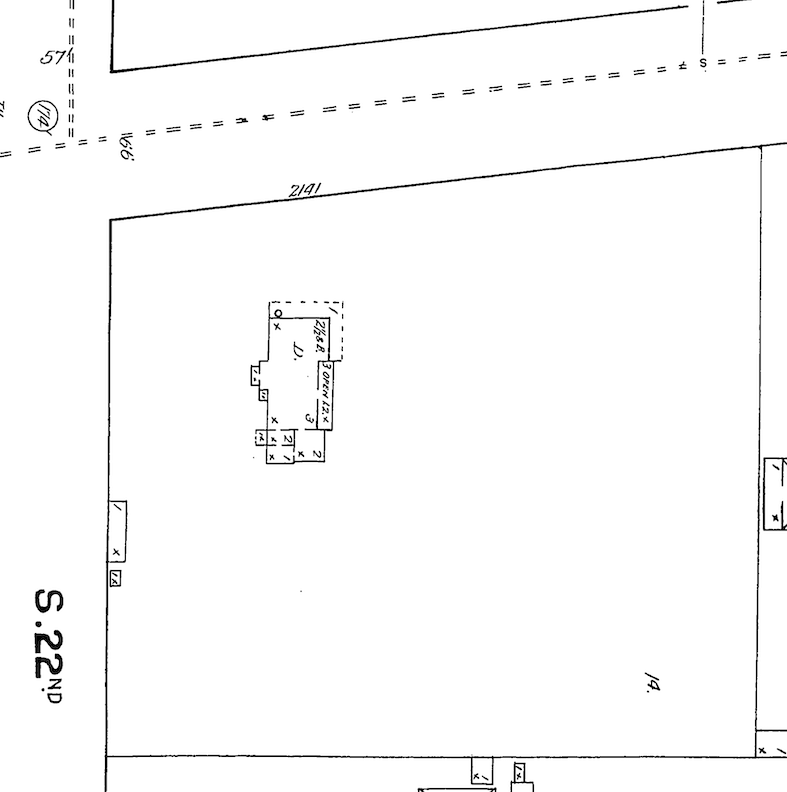
1890 Sanborn Map magnified on the footprint of the 2155 St. Mary’s Avenue property. Top of photo is north. Note the home’s wrap around porch is oriented to the north and east. “D” means domestic dwelling. “1” means one floor. “3” signified three floors. The squares and rectangles on the south side are additions of one and two floors. The address of 2155 St. Mary’s Avenue strongly hints the front elevation faces north, formal entrance faces St. Mary’s Avenue. Which would mean this small porch entrance on the westside (facing Twenty-second) is a side door. I believe the elongated rectangle abutting South Twenty-second, is a stable or carriage house.
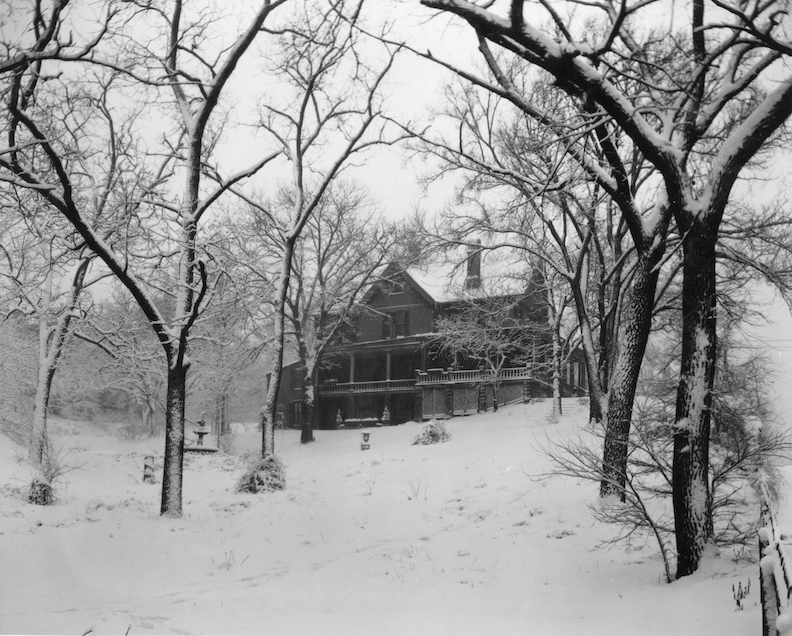
If we line this great photograph up with the Sanborn Map dimensions, I come to the conclusion that the right side of this photo faces north; this would mean that St. Mary’s Avenue borders this formal porch with front-facing gable. 1924. Bostwick, Louis and Frohardt, Homer. The Durham Museum.
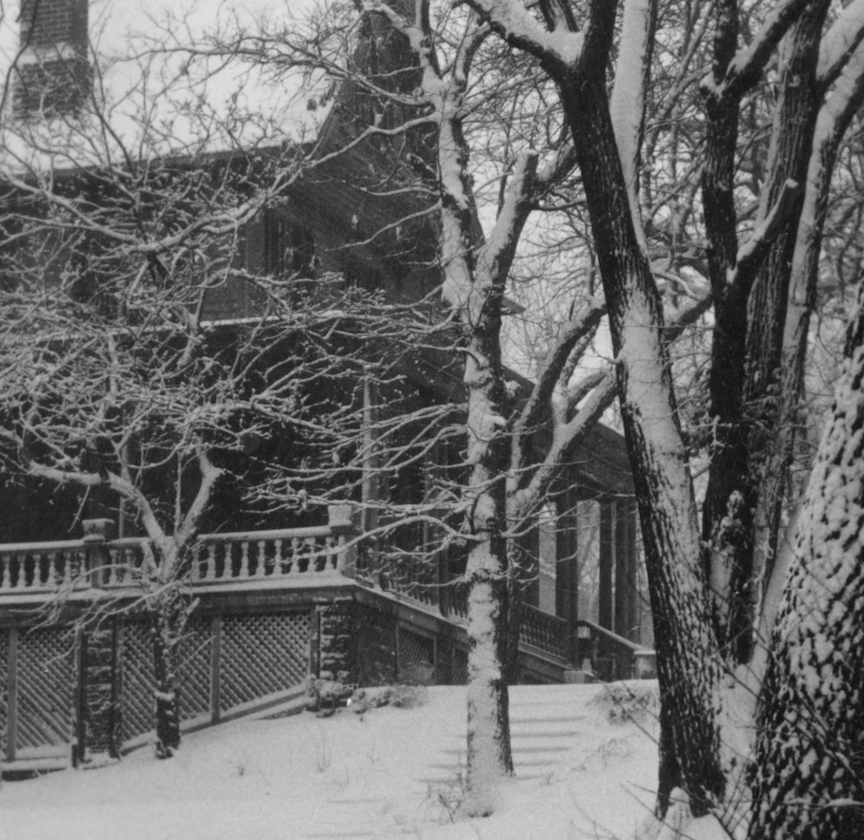
Through the trees, I believe this is the front elevation, facing St. Mary’s Avenue. Handrail is seen leading down steps from the large front, wrap around porch. Columns of the porch are noted; front gabled house; shutters; gingerbread on third story; spindlework railing on porch; stone masonry basement support columns.
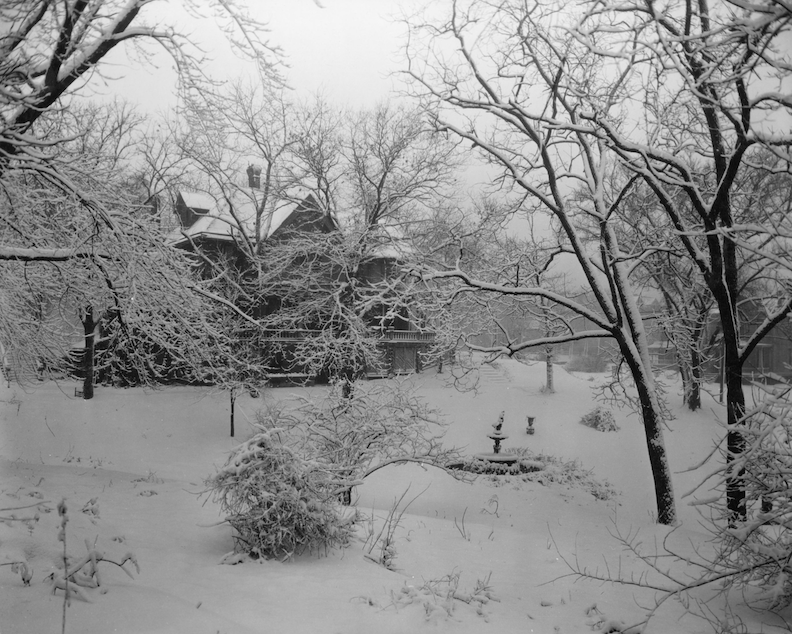
This view is from the middle of the property, facing northwest. That would mean the home in the distance is across St. Mary’s Avenue to the north.
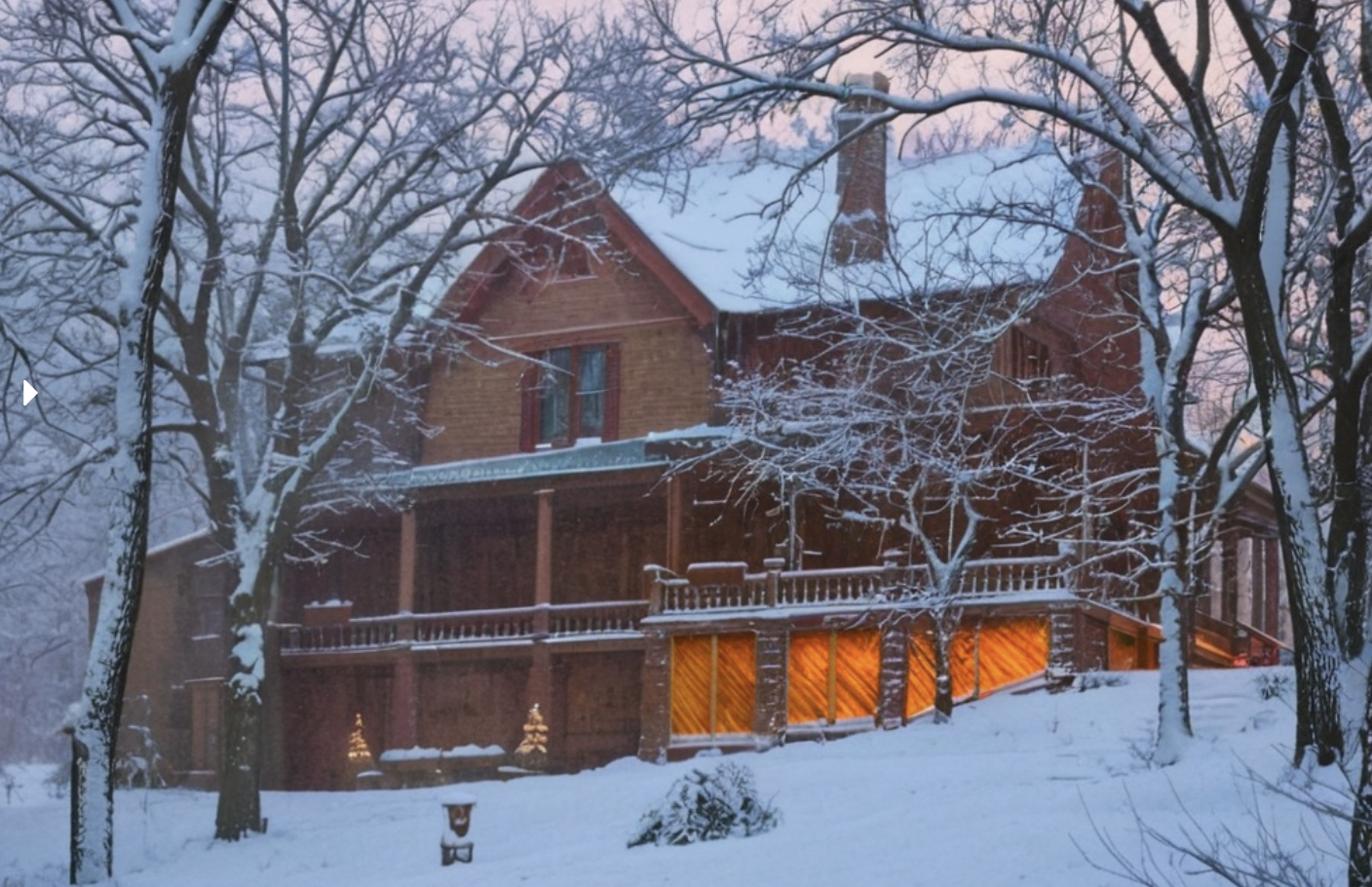
Colorizing for fun–not at all accurate but it can help us “see” different things.
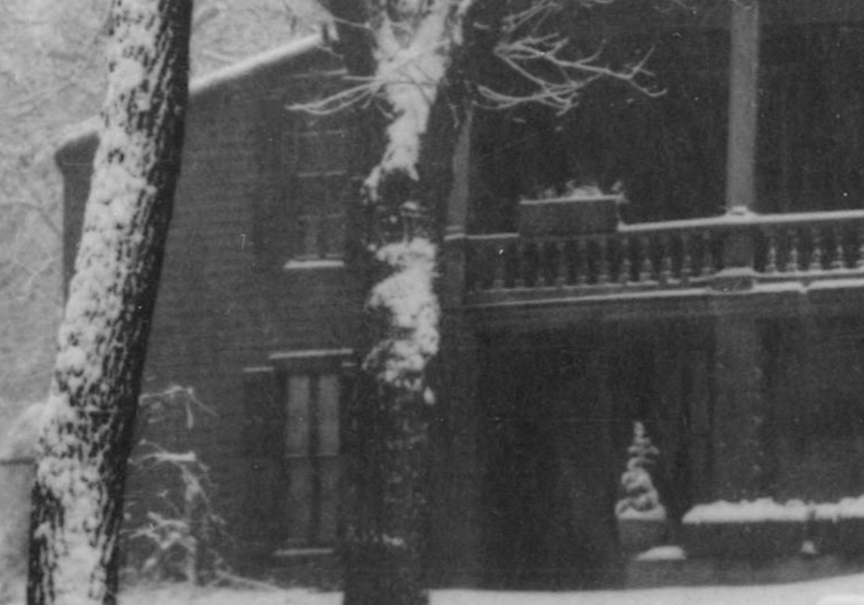
The additions at rear of house through the snow.
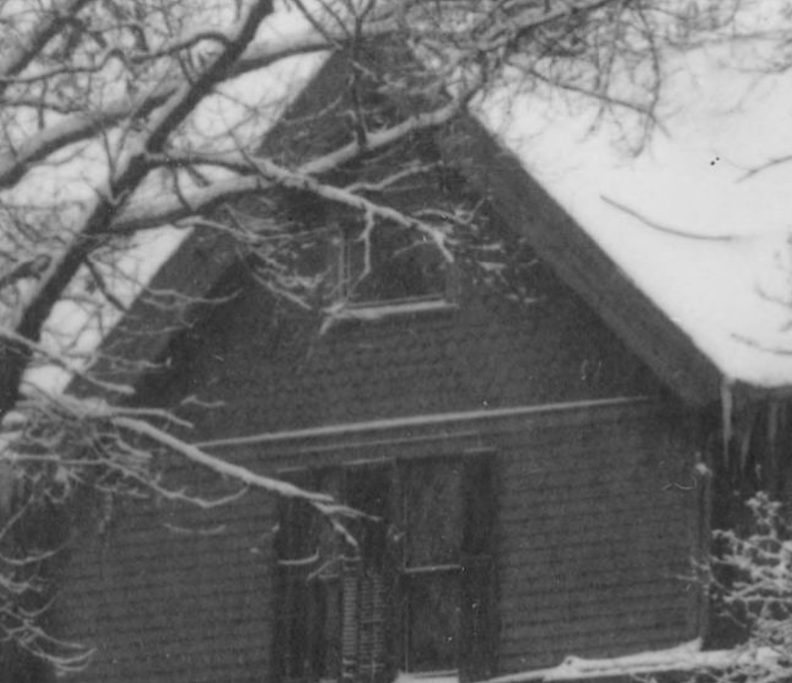
Third story gingerbread shingling. Am I the only one dreaming to see a figure in the windows? I longed to see all sides of the house.
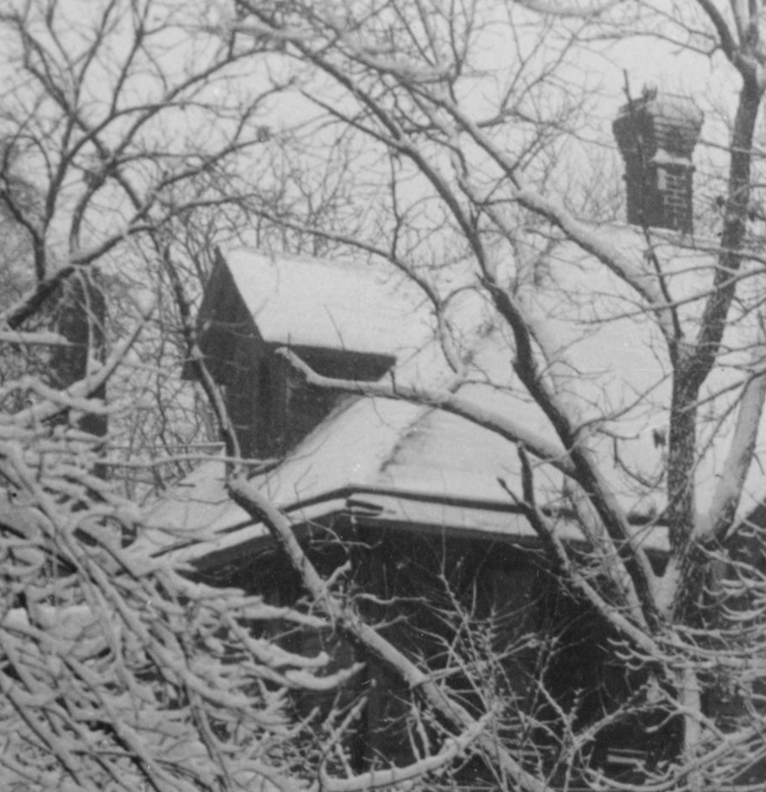
A high pitched dormer window, facing south. Two chimneys seen.
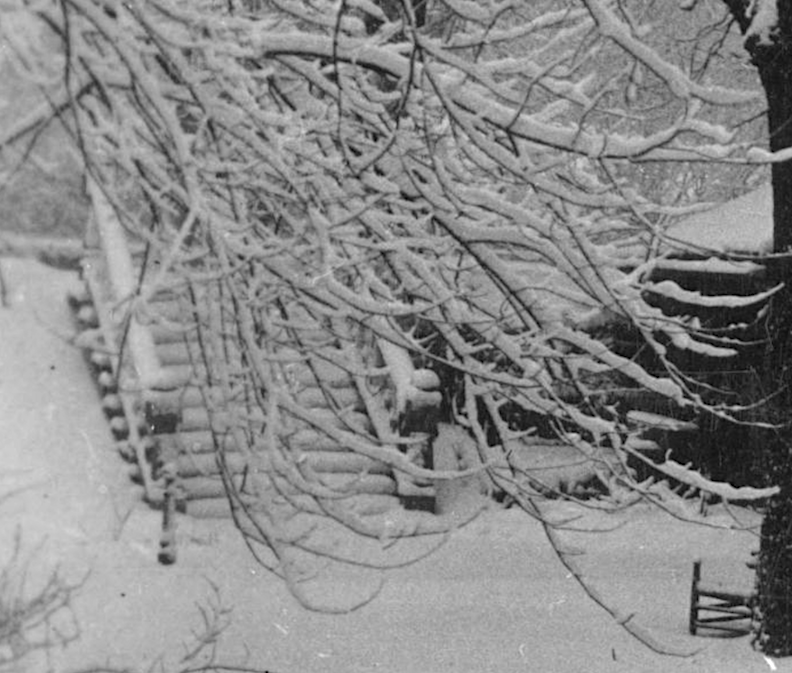
Back stairs in conjunction with 1890 Sanborn Map, suggest a stable, later carriage house, later garage was one-story and possibly situated at a higher elevation.
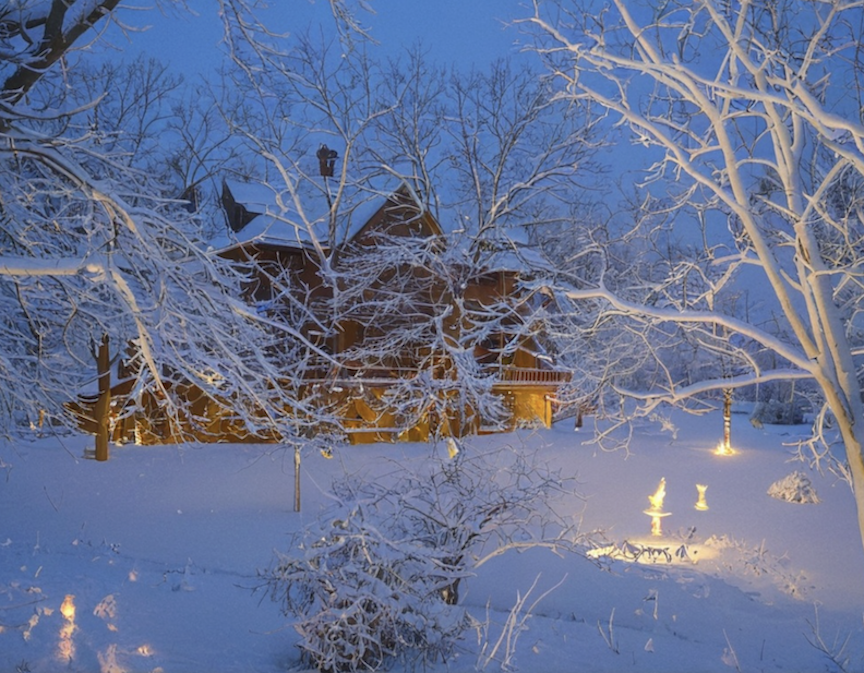
Another dream photo. Colorization is not historically accurate. The modern uplighting gives pause. I can hear this snow garden.
The 27-room mansion that would come to be known as Terrace Hill was said to be the same as originally constructed by Mr. Redick, with just minor modifications. The columns of the eastern porch and the storm windows interestingly originated from the former Capitol building, which was located on the current site of Central High School (Twentieth and Dodge Streets.) The previous territory Capitol building and grounds were donated to the city in 1869 for educational purposes following the government’s relocation to Lincoln. The origin and circumstances of Judge Redick’s acquisition of this architectural salvage remain unclear; were these alterations that the Crary family made? It would make more sense with the timeline.
Obsessive Sidenote: Upon further examination of the original Capitol, it appears that Redick or Crary’s architectural scraps were saved from the second territorial Capitol building solely due to their geographical context. I had never read of an older Territory Capitol structure, constructed in 1854 near the intersection of West Ninth at Douglas and Farnam Streets but sure enough, the Durham Museum owns the illustrations/photographs. This initial building appeared to be of wood frame. This would mean that the Capitol building I had always heard of was actually the second Capitol site. Harrison Johnson’s book History of Nebraska, published by Henry Gibson, Herald Printing House, (1880) contests this assertion, stating that the former Territorial Capitol was consistently located on what was known as Capitol Hill, which is currently the site of Central High School. He characterized the substantial, attractive brick building as having been finished in 1858, adequately in advance for the Legislature. Lincoln was designated as the capital in 1867, and this initial structure was donated in 1870 for use as a high school building, later torn down. Unfortunately I do not have time to hammer this one out tonight.
The 2155 St. Mary’s Avenue mansion columns were later replaced with stone by the Crarys. It was noted that Miss Anna Crary preserved the original historic Capitol columns, as she did with all significant items. More of my suspicions related to this later. The storm windows from the Capitol building were still utilized on the Crary residence until the day it was torn down.
At first examination, I did not know the home was definitively from the late 1800s, however she was undeniably of another time. Somewhat posh yet slightly a smidge of utilitarianism, it resembled a hunting lodge in numerous aspects, with an element of eeriness. Because of my familiarity with the area, it was evident 2155 St. Mary’s Avenue was no longer standing. What could I discern from the photograph? The structure was a simple rectangle with additions, columns, ornate detailing, gingerbread embellishments, a steep roof, wrap-around porch, gables, a dormer window, at least two or three chimneys. Three levels with an additional fourth level–a seemingly full walk-out basement. I had never encountered that previously in a residence of this vintage.
We had a verified construction date from 1863. Our previous casework familiarity hinted that 2155 St. Mary’s Avenue was a Victorian house. The analysis of the photographs categorically classified this residence as Queen Anne, however, the Queen Anne style is believed to have not emerged until around the mid-1870s. Soooo, this structure could be described as some sort of heavy, vertical, eclectic, vernacular Victorian folk, Queen Anne adjacent. Virginia Savage McAlester’s A Field Guide to American Houses indicates that all the Star Quality hallmark features of a Queen Anne style are evident: a steeply pitched roof of irregular form, a prominent front-facing gable, decorative shingles, various elements to prevent a flat-walled aesthetic, spindlework, free classical columns, patterned masonry, and a full-width porch, typically one story in height, extending along one or both side walls. 2155 St. Mary’s Avenue was either within the range of an eclectic Victorian or a precursor to the Queen Anne. I would not underestimate the Redicks’ acquaintance with several proficient architects.
However, it was under the Crary family’s possesion, specifically Miss Anna Crary’s ownership, that 2155 St. Mary’s Avenue gained an additional layer of Omaha lore—that of a distinguished Mystery Property in the Woods–the highest attainable honor, in My Omaha Obsession’s estimation.
The Beebe Denison Crarys
In trying to draw out Beebe Denison Crary, I would utilize information obtained from archival newspapers and genealogical websites, as well as Omaha: The Gate City and Douglas County, Nebraska by Arthur Cooper Wakeley (published in 1917 by S. J. Clarke Publishing Co. of Chicago), along with data from several United States Censuses. I discovered storylines that initially appeared to be discrepancies; eventually, the Crary mythology either demonstrated his capacity for diversification or were just inaccurate accounts. Based on available information, he seems to be the inspiration for the character in the Dos Equis ad, The Most Interesting Man in the World.
A native of Knox, Albany, New York, Beebe Denison Crary graduated from Union College “on completion of a thorough course in law” in the early 1840s. After graduation, Crary assumed the role of principal at Johnstown Academy in New York and at the same time established a law office in New York City, where he practiced until throat complications compelled him to abandon his profession. It is thought that these throat troubles motivated his pursuit in business opportunities in the west. It was in New York that Mr. Crary married Miss Anna “Annie” Alida Littlejohn of the Colonel John Littlejohn, Jrs, a prominent, educated, Episcopalian, “sterling old New York family.” Mrs. Annie Crary was said to be a woman of remarkable intellectuality and a devout Episcopalian.
At some point, our Mr. Crary acquired the titles “Colonel Crary” and “B. D.” We will use these names interchangeably. Evidence indicates that Crary served as the terminal agent for the Rock Island Railroad throughout its development from LaSalle, Illinois, to eastern Iowa. During the period of 1847 to 1863, the Crarys had five children: Charles, Eleanor Mary “Ella,” Anna, Nathan Newkirk “Nate,” and William Henry Crary. Prior to his tenure with the Rock Island Railroad, the Crarys evidently resided in Allegan, Michigan, where their first two children were born; I am unable to account for this period.
Before he moved to Omaha, I found B. D. Crary, of Davenport, Iowa joining the ranks of the Kountze Brothers in the Omaha and Platte Valley Bridge Company where he became a director of the firm in March of 1863. He lived in and around Davenport and Omaha before bringing his family to Omaha in 1866. “Soon after his arrival here Mr. Crary purchased the John I. Redick home on St. Mary’s avenue, the house being surrounded by more than two acres of ground, a notable place by reason of the beauty of the spacious lawn and the fine old trees which are still standing upon it.” Middle child, Anna Crary, reported remembering “coming to Omaha with her parents in a stagecoach before the days of the railroad” when she was young and that “the old mansion, which once stood far outside the city limits.”
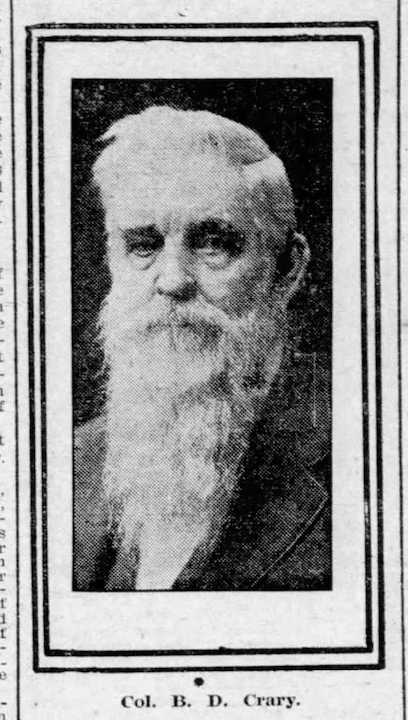
Colonel B. D. Crary in his later years.
It is said Colonel Crary selected Omaha for homebase because “intended to engage in building the Union Pacific railroad but it was too early for that work, so he began in freighting.” Since he was previously associated with August and Herman Kountze of the Kountze Brothers, (whom we thoroughly studied in our Park Wild examination), Crary is purported to have transported $60,000 in gold for the Kountze brothers from Omaha to Fort Collins, Colorado, in order to establish the Colorado National Bank. Allegedly Crary’s freighting outfit was “often attacked by Indians and outlaws.” At a certain point in his journey with the $60,000 in gold, he abandoned the coach due to “some lawless fellows” and commenced riding a solo horse with the bags of gold on his person. The Crary-Kountze names were significantly linked until the end of their lives. It was the Colonel who located all of the land for Kountze Brothers in Texas.
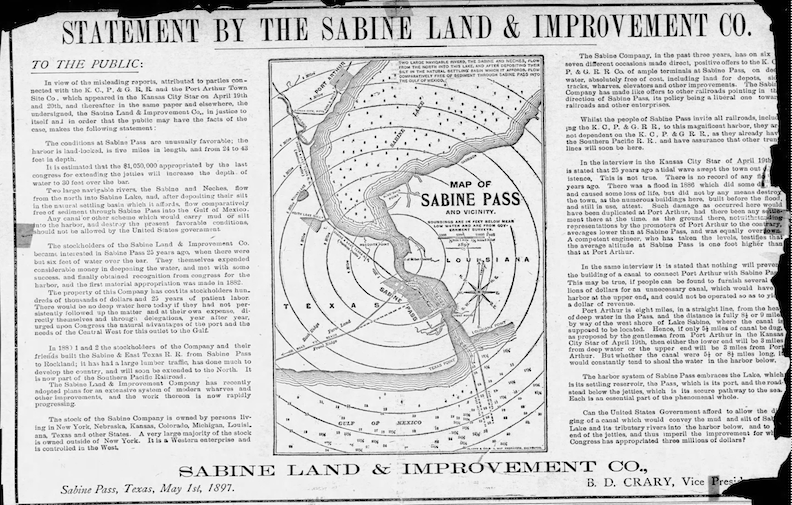
Omaha Bee News. 1897. Notice lower right hand corner. As for reporting in Omaha, it is oft said that in 1872 Mr. Crary went to Texas on behalf of the Kountzes. He was for many years the confidential agent for the Kountze brothers in their Texas investments particularly the Sabine Pass company and their timber interests. B. D. Crary became vice president of the Sabine Land And Improvement Company; stockholders of this company were “interested” in the Sabine Pass in Texas.
“He also held government contracts with General Coe and Levi Carter.” Crary secured a contract to supply ties for the Union Pacific Railroad Company during the construction of the railway. He operated a substantial business known as the Texas Tram Lumber Company in Texas, where he was one of the owners. For approximately thirty years, he divided his time between managing his affairs in that state and residing in Omaha, which he consistently regarded as his home throughout this duration.
Meanwhile, the Beaumont, Texas library possesses volumes detailing the history of their esteemed city, including the “Beebe Denison Crary Collection.” The Colonel is reported to have originally arrived in the East Texas region around 1869. “He first came as a banking representative, but became interested in the area’s railroads.” Additionally, there was reference to the Sabine and East Texas railroad with other municipal initiatives. There is no reference to Omaha, Nebraska, or the family the Colonel left behind in these archives, which I thought peculiar yet highly probable for the times. It would not be shocking to find a whole colorful life lived in Beaumont, unbeknownst to Omahans.
Domestic Affairs
During the 1860s, the Crarys’ 27-room “mansion” was among the finest private dwellings in the city. The handsome residence was arranged with the finest furnishings and carpets. One might envision entering the large hall, a parlor with lofty ceilings, sliding doors that retreated withing the walls, a gentleman’s library, the dining room, a spacious kitchen, complete with a pantry and a pastry area. The cellar featuring a cement floor, perhaps partitioned into sections: the coal room, the supply room, and the furnace room. Multiple bedrooms and suites located on the second story, along with the baths. The third level designated for domestic staff and a playroom. The residence consistently included a minimum of two pianos. The family hired a cook a “capable” girl for housework, a laundress, and a groundskeeper; eventually, as the garden gained recognition, Mrs. Crary would engage several “competent men” for the grounds. This small retinue of servants freed Mrs. Crary to cultivate her own interests which will be laid out shortly.
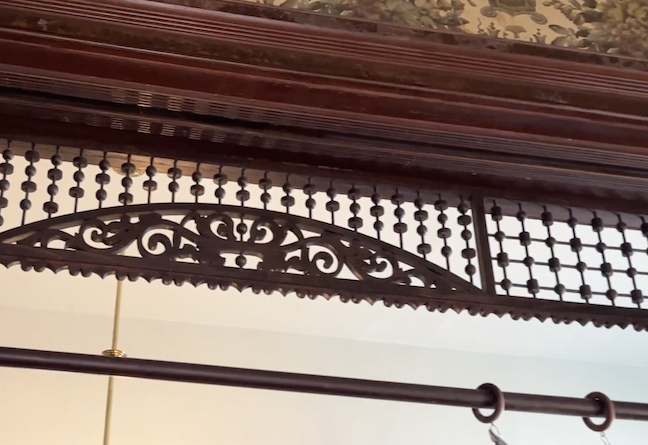
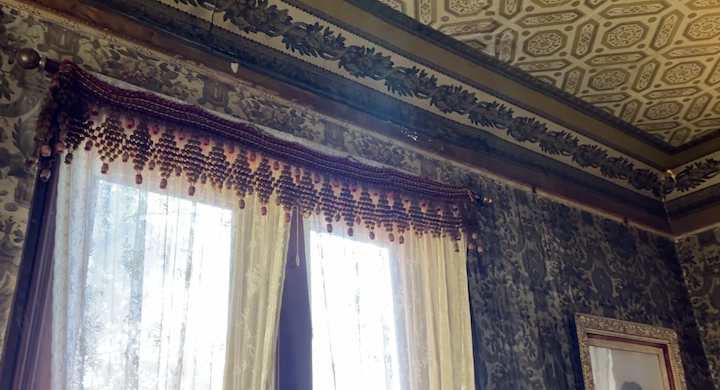
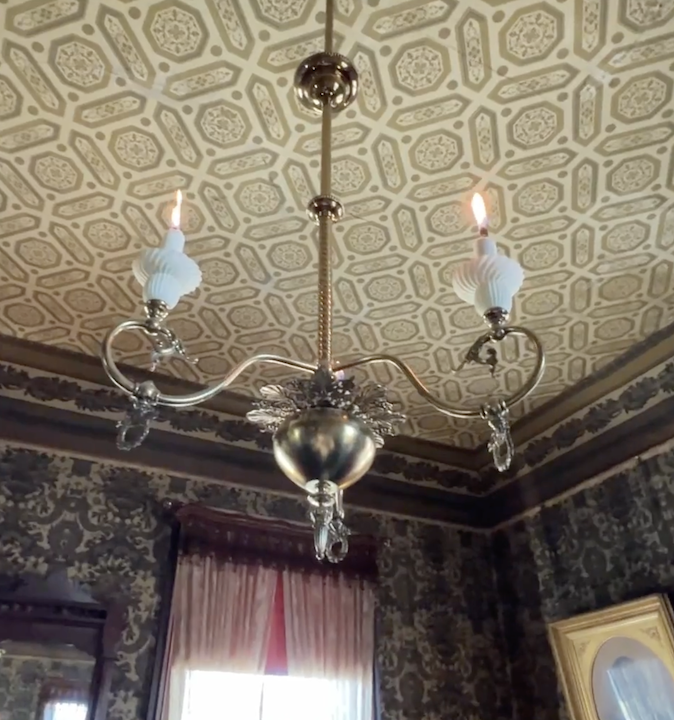
I am presumptuously including these images from an 1870s American home, which retains all original elements, including the beaded valance, wallpapers, stick and ball doorway arch, and functional gaselier. I am uncertain of the specific manner in which the Crarys decorated their large residence.
Eventually, Omaha would witness the construction of many fine houses, significantly more opulent, expansive, and definitely more expensive by the 1890s. It might be inferred that the 1863 Crary house appeared antiquated or simple as time progressed. However, I saw that the earlier-shared snowy Crary photographs maintained a timeless elegance and in many ways, the following mansions look dated by comparison. (Of course I LOVE and would enthusiastically relocate into any of these dream homes.) Below are the kinds of residences going up around Omaha in the following decades.
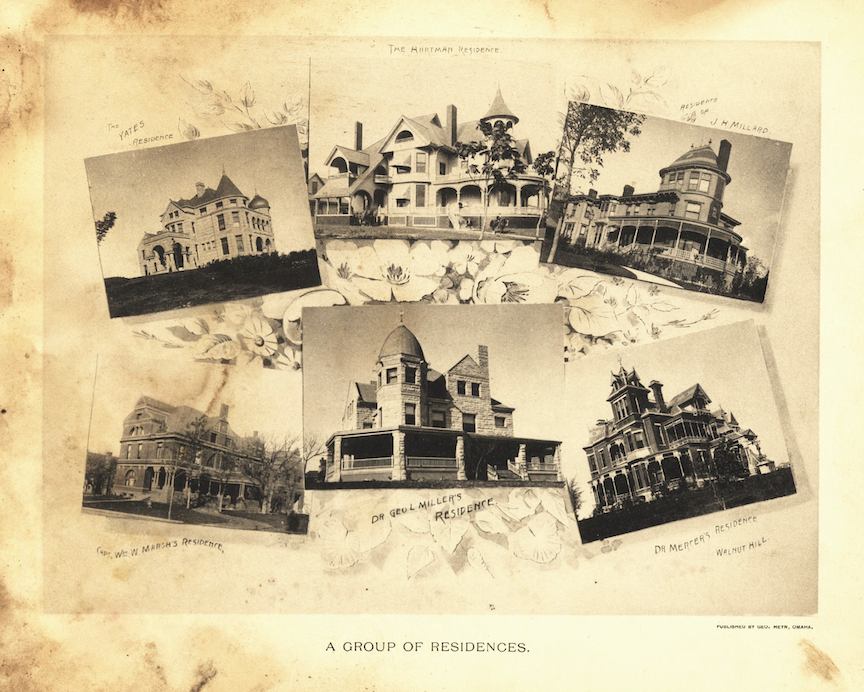
Views of six residences of prominent Omaha citizens. Top left: residence of Henry W. Yates, 3120 Davenport Street; top middle: Christian Hartman, 3411 Farnam Street; top right: residence of J. H. Millard, 2406 Harney Street, northwest corner of 24th and Harney Streets; bottom right: Dr. Mercer’s residence, Walnut Hill, 3920 Cuming Street; bottom middle: Dr. George L. Miller’s residence, Seymour Park (present Ralston); Capt. William W. Marsh’s residence, 804 Pine Street. Photographer: George Heyn. Omaha Public Library. 1889-1892.
When they moved to Omaha, the five Crary children were aged between 19 and 3 years. Daughters Ella (15) and Anna (14) commenced their education in Omaha at the emerging girls’ academy known as Brownell Hall at Tenth and Worthington. This restricted institution was established for girls of the Episcopalian faith and subsequently evolved into Brownell Talbot College Preparatory School at 400 Happy Hollow Blvd. Mrs. Annie Crary played a significant role in establishing the early Episcopalian community in Omaha.
The Crary children, as guided by their mother, whom we shall refer to as Mrs. Annie, were socially engaged in Omaha high society. Regarding the Crary residence: “Company was the order of the day. Hospitality was the slogan and royally well was it exemplified.” Over the years, it was easy to identify all the children invited to posh parties and elite gatherings. This would manifest in who they dated, their marriages, and social status, with the exception of the middle child, Anna. Young Anna, the central figure of this narrative, received an accolade for her exquisite crochet craftsmanship at the Douglas County Fair in 1867. Her early loves included crochet, handcrafts, and piano playing, which she pursued over her quiet life. Despite her attendance at all the right parties throughout her early adolescence, I never again found her referenced in the gay soirees of high society, other than from her numerous extended holidays to far away places, which were conveniently covered in the Polite Personalities column.
At the time of the 1870 United States Census, B. D. Crary was 51, wife Annie was 44 and our Anna Crary was 16. The family had two servants living with them: 18-year-old Louis Olson, an “out of door servant” and another 17 year old male with the last name of Johnson.
One thing I was quick to notice, the Colonel was not long to be found in Omaha after establishing the firm in Beaumont, Texas. Only so much can be connected when studying historical clues but it became evident that B. D. mailed the funds home, and thereafter, Mrs. Crary oversaw all affairs. The Colonel officially lived in Beaumont around the 1872-73 time period and would return to Omaha once a year. When sons Charles and Nate got older, they relocated to Beaumont to engage in business with their father.
Mrs. Crary’s Garden
It was in the 1860s that Mrs. Annie began design and enhancement of the land, reportedly measuring two to three acres. Can we infer that her enthusiasm for planning and gardening intensified when her husband moved to another state? Ten to one. I believe it is healthy to have a project. Mrs. Crary’s location emerged in the public eye as one of the most picturesque areas in Omaha, well-shaded by large oak trees and with gentle inclines from the street to a position where her elegant mansion could have afforded a magnificent perspective of the city, were it not for the lush foliage.
“The beautifying of the ground, as if their natural beauty could be improved upon was said to have been directed by Mrs. Crary;” yet, the “historical beauty” of the grounds remained intact due to the efforts and expertise of decades of groundsmen, often living on site. “Terrace Hill possessed unparalleled natural beauty compared to any other location in Omaha” and was frequently called the “Italian Garden” of the city. Although the home remained mostly unchanged since its construction by Mr. Redick, the grounds, initially encompassing a city block and then reduced to half a block, underwent a transformation under the direction of Mrs. Crary. “The beautiful lawn with its fountains and flowers and the rich landscape with arbors and its terraces rising one above the other, fading away into a dark green background of foliage and trees, is a most refreshing sight on a hot summer’s day and one long to be remembered. The passer-by frequently stops here to rest in the shade.” If we know anything about gardens, we know that they evolve over time and only become more mature. Terrace Hill’s land under Mrs. Annie’s vision became the Garden of Eden. The term “veritable bower” was also lodged in reference to the “noble trees,” pre-settlement being a tranquil retreat for a “choir of birds.” The lush landscape was a hypnotic painting of dense, layered foliage.
As to the layout, hopefully these phrases add effective drool-worthy description: The house was known to all Omaha, despite the optimal view being merely a glimpse through the foliage. That is truly the best kind of peek. She was called “an arresting beauty.” The mansion was situated on a hill that commands a 300-foot-wide yard extending a whole block. There was a bronze fountain situated in the heart of a ravine-like wooded lawn encircled by stone sculpture, establishing it as a landmark on St. Mary’s Avenue. Shaded by lofty trees, “the Aristocratic Crary Residence” provided a measure of solace to strangers passing who were apparently allowed to stop, sit and linger in the private pleasure gardens. I am not sure of the regulated conditions that allowed public access. Due to its pristine natural characteristics, there was a period when coyotes inhabited the yard.
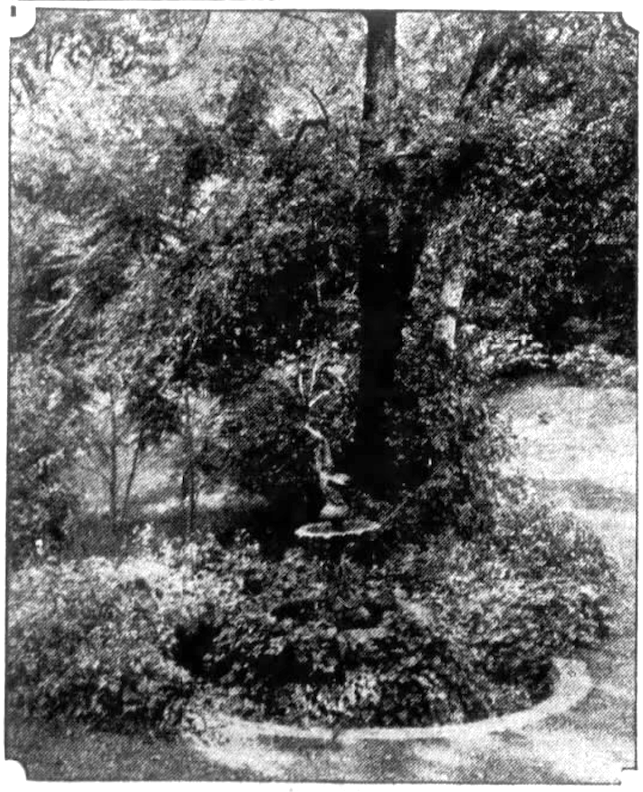
Crary bronze fountain as revealed in the Omaha Bee-News. I only wish I had more photographs of this secret-public garden.
The Trouble with St. Mary’s Avenue
In 1873, Colonel. Crary presented a petition to the City Council, accompanied by “many citizens,” requesting the opening of Twentieth Street from Dodge to Leavenworth and the enhancement of a local road “running past the powder house.” I hope someone smarter than I can tell us what that the powder house was. Colonel Crary articulated, “The road was almost impossible for a team with any load at all to drive over the road without being stuck in the mud or meeting with a mashup.”
By 1874, Mrs. Crary, represented by her attorney Mr. Kennedy, initiated a damages lawsuit concerning St. Mary’s Avenue, from the opening of the avenue through the grounds (people’s private property, with emphasis on the Crary’s land) in 1873. Two lines of contention emerged from residents along St. Mary’s: open claims for damages resulting from a grade alteration on a roadway created seven years prior (1867) and for the land appropriated by the city for St. Mary’s Avenue. Omaha Famous Mr. Hanscom was, purportedly, behind the grading. Shortly thereafter, the City Council enacted an ordinance allocating $950 to compensate for the damages on St. Mary’s Avenue. A. J. Hanscom and Mayor Chase offered the funds to Mr. Kennedy and Mrs. Crary, both of whom declined, and notice of an appeal to the courts was given.” This case went on for years. There was also the case of “a drunken farmer” who “ran his team up St. Mary’s Avenue” and collided with Mrs. Crary’s phaeton (a four-wheeled, open horse-drawn carriage), who was thrown out and somewhat seriously injured.
Family Lines
During the 1880 U.S. Census, the Colonel was recorded as a lumber dealer for the railroad, Mrs. Annie was 54 years old, daughter Anna was 26 and unemployed, while sons Ned (23) and William (17) resided at home. The Official Register of the United States Employees of 1881 indicated that Anna M. Crary would have her sole employment throughout her lifespan during that year (that I could find). I questioned whether Anna’s future unemployment reflected current societal trends (was she urged by a family member to resign?) or if an event had occurred that curtailed her employment. Her coverage in the Omaha Society pages appeared to have ceased, and she was no longer featured in the Smart Set. Perhaps it was her own mind to walk away. I trust you understand that I do not believe this is a universal life aim for everyone, even in those times. In the following years all of the children would leave the family home but Anna.
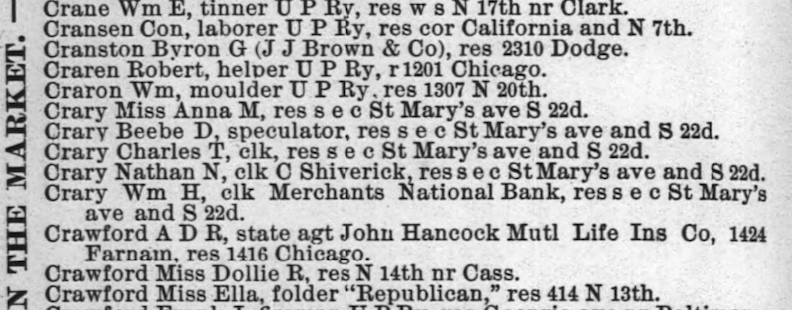
The 1883 Omaha City Directory, always interesting, displayed the Crary boys living in the family home with sister Anna and father Beebe.
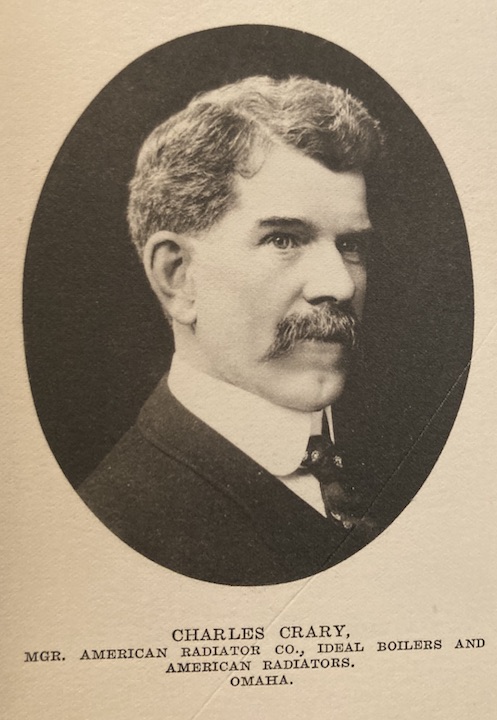
Eldest son: Charles T. Crary (1849-1933) as seen in one of my favorite books: Nebraskans 1854-1904. (Omaha Bee., Omaha, Neb.: The Bee publishing co., 1904.) Charles had long moved out of the family house; he would later move to Texas and work with his father and brother Nate. Charles was never married that I could find and lived the rest of his life in Texas.
Second oldest, Eleanor Mary “Ella” Crary had been an elementary school teacher until she married Charles Henry Shiverick. Shiverick mentioned elsewhere in our investigations had an Omaha furniture business named Charles Shiverick & Company, considered one of the earliest furniture dealers in Omaha. As Omaha is ever tangled, an interesting article of 1889 showed the relationship of Crary, Redick and Shiverick. The Ella and Charles Shivericks would have a very prosperous family line that extended far beyond Omaha. Of note, after his death, Ella resided at the Blackstone Hotel.
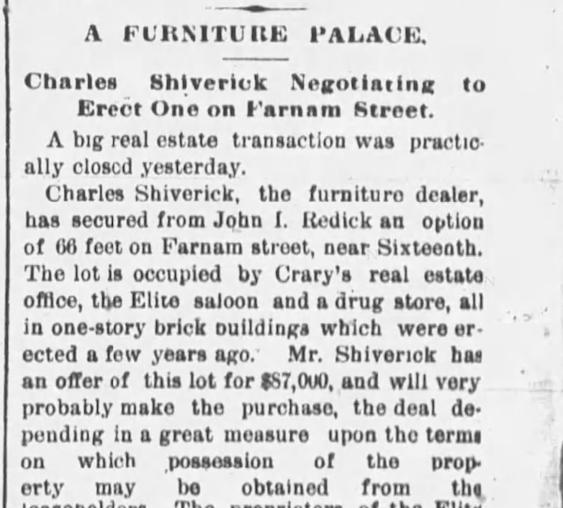
The Omaha Evening-Bee. October of 1889.
Nathan “Nate” Newkirk Crary would become a “popular Omaha businessman and favorite society leader” who moved to Beaumont, Texas to join his brother and father in business. When in Beaumont, he married Edna Bery Swindell. They were the parents of at least one daughter. He lived the remainder of his life in Texas.
Youngest William Henry Crary was one Omaha’s earliest real estate men. “Since early manhood, was identified with real estate activities; for many years he was active in Ak-Sar-Ben and was prominent in the social life of the city.” I did find articles of his business as early as the 1880s. The youngest Crary married Sally H. Lowe Crary, daughter of General W. W. Lowe. He had daughter Sally and son Jack. The family made Omaha their home until William’s sudden death in 1923, at the age of 59.
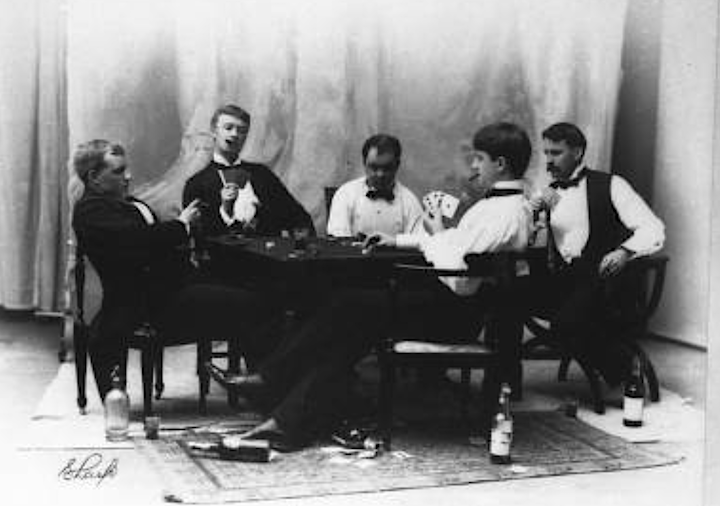
Five men playing cards with William Crary on the far right. (Left to right: Arthur Guiou, Col. William Doane, Clarke Redick, Charles Howe, and William Crary) “Sharp” is written on the photo. Bostwick, Louis and Frohardt, Homer. The Durham Museum.
If any Crary family members have photographs to include in this article, please make contact.
Domestic help came and went from the home. Belle Kippen, a young, attractive, and seemingly innocent individual, had served as a servant girl for the Crarys. Over a span of three months in 1875, she was employed by a dozen affluent Omaha households, from each of whom she pilfered something. She was labeled “a young kleptomaniac” and incarcerated after stealing a gold-mounted shell pin from Mrs. Crary, in addition to diamond jewelry and apparel. The very dress she wore to court had been stolen from a girl named Teste.
A High Toned Neighbor
To the west of the Crary residence, the location historically recognized as the Rorick Apartment building site, had become the residence of the James Woolworth family. Woolworth constructed his residence, Cortlandt, in 1880, situated at the southwest intersection of Twenty-second Street (South Avenue) and St. Mary’s Avenue. The history of this illustrious corner and mansion is a central theme in my book; for brevity, I shall not elaborate on it here. But let us just hint the placement of the home atop this hill, marked the social ascension. It is my estimation that this Woolworth house in conjunction with the Crary mansion would begin to transform this into Omaha’s new tony neighborhood. I’ve got to assume these families were long acquainted through their small Episcopalian community.
Sidenote–For those monitoring our earlier maps, the Woolworth corner seems to have constituted a segment of the Harrison Johnson property. Prior to the Woolworth family’s acquisition of this expansive parcel, the Crarys were recognized for collecting their winter stock of nuts from this fertile area, “where hazelbrush flourished abundantly.”
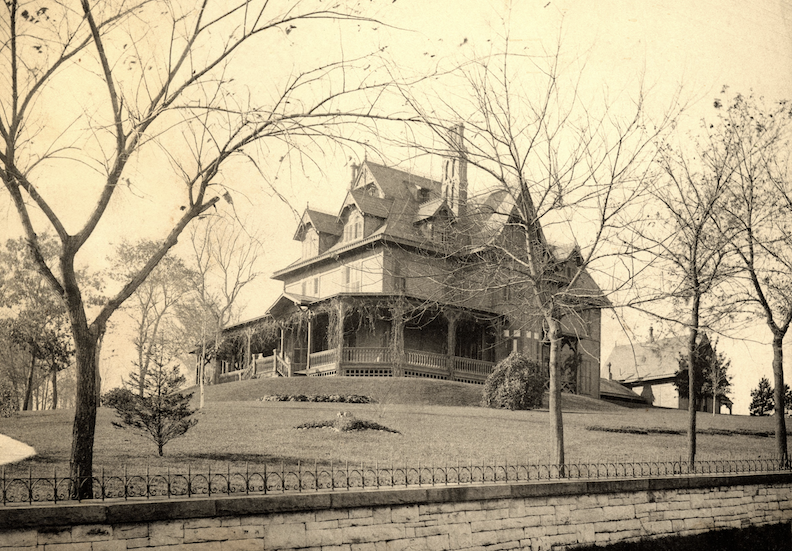
The residence of James Woolworth, 2211 St. Mary’s Avenue, is seen from the street, set on a hillock behind a low stone wall topped with ironwork. Photographer: George Heyn. Omaha Public Library. 1889-1892.
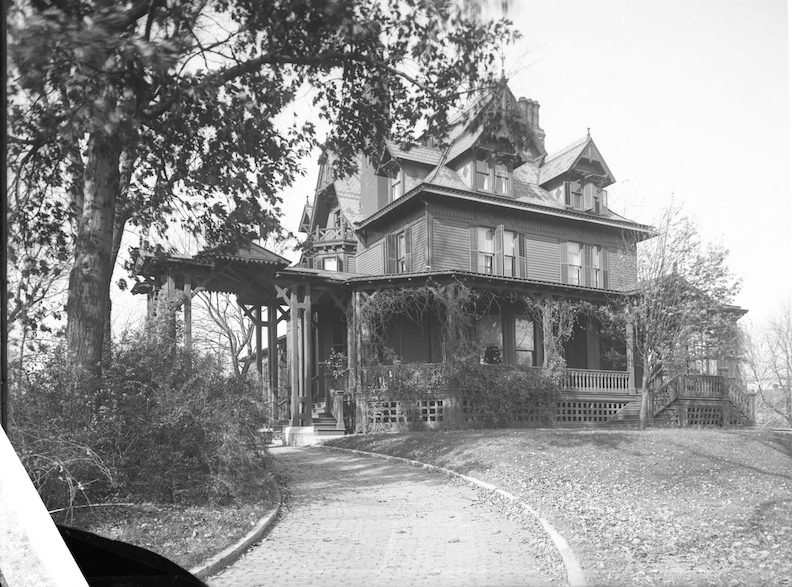
Different delicious angles of the wonderful James Woolworth mansion. 2211 St. Mary’s Avenue. Bostwick, Louis (1868-1943) and Frohardt, Homer (1885-1972). The Durham Museum. 1910.
We are indebted to the Woolworth family for the following photograph and to the Omaha Public Library for its preservation and custodianship for our benefit. Presumably “Judge” Woolworth captured this shot in 1881, from his elegant wraparound porch, oriented towards downtown to the east. The Crary property would be to the east, across Twenty-second Street. This photograph gives us an excellent view on the rough, rural character and somewhat mixed-bag nature of scrappy Omaha during that period…and continues so.
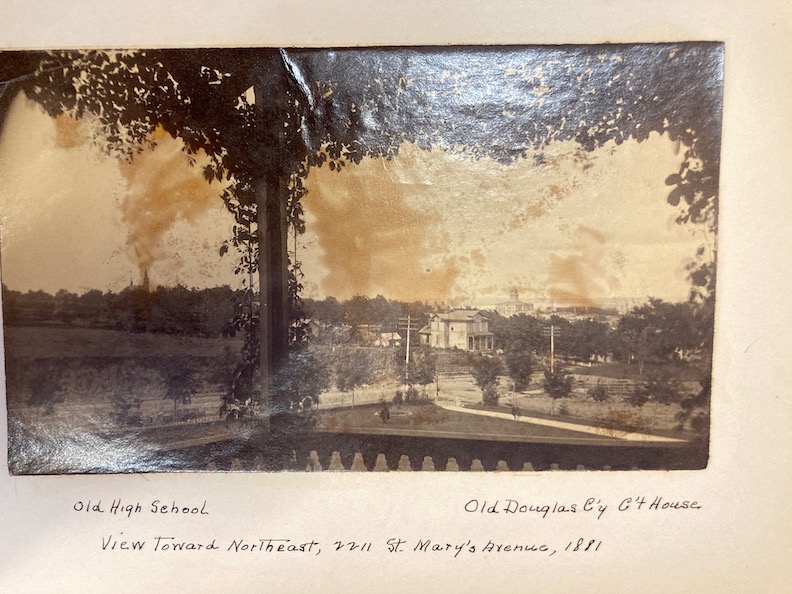
Omaha Public Library archives. 1881. Isn’t this wonderful?
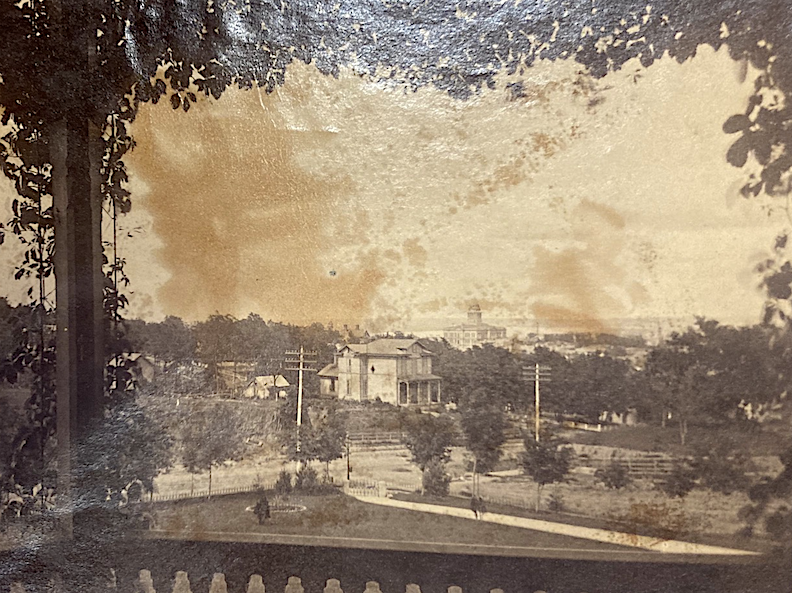
Amplified country. 1881.
James Woolworth would later build a dreamy, perfect dollhouse for his favorite girl, Meliora Woolworth Fairfield. The Fairfield house, the Nightmare Before Christmas Tudor style was the stuff of dreams and covered thoroughly in Meliora’s own words in my earlier investigation: What Miss Woolworth Wrote.
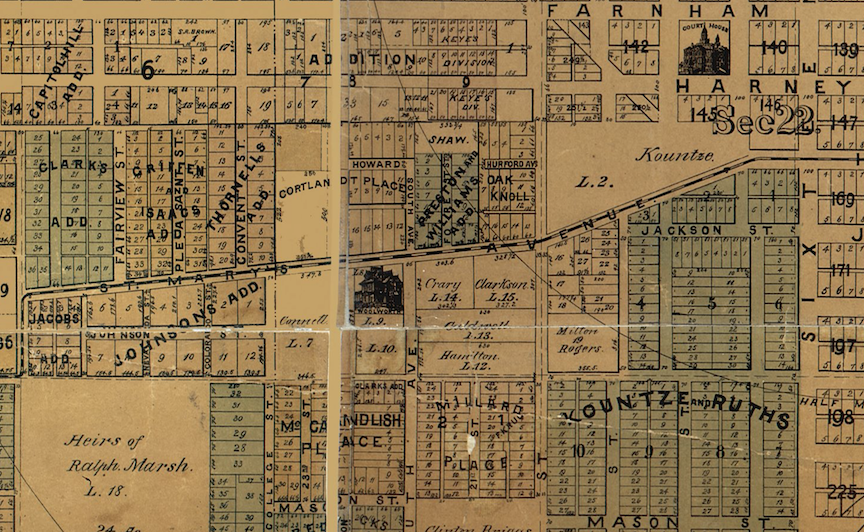
Lovely Map of the City of Omaha, 1883. Published by George P. Bemis’ real estate agency, compiled under direction of Andrew Rosewater, City Engineer. Drawn by Jacob Hauck. Borrowed from Omaha Public Library.
Let’s zoom in here.
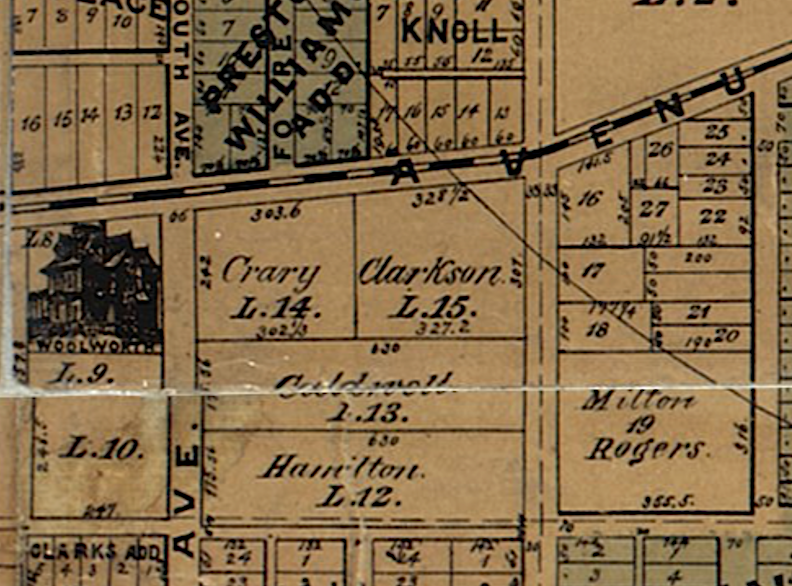
Close-up on the Crary and Woolworth depictions from 1883. Published by George P. Bemis’ real estate agency, compiled under direction of Andrew Rosewater, City Engineer. Drawn by Jacob Hauck, Borrowed from Omaha Public Library.
In 1887, local newspapers revealed that “the old Convent grounds on St. Mary’s Avenue between Twenty-second and Twenty-fourth streets” was platted and put on the market. “Persons wanting lots of the fine residences should call early…” This marketing would bring many incredible homes to Omaha. Sadly, only one of these impressive family homes remains. In July of 1905, the building of Mrs. Kimball’s residence was announced. Still standing in high style, the Mary Rogers Kimball house was constructed at 2236 St. Mary’s Avenue, designed by her son, Thomas Rogers Kimball. His gorgeous house was constructed around the same period and was located just west at 2450 St. Mary’s Avenue. I have addressed these properties in my previous studies but, fellow snooper Marta Dawes has done a great job writing and researching, so allow me to link to her wonderful site’s article on these Kimball homes and surrounding structures: Grave Yards of Omaha.
In 1888, Mrs. Annie Crary submitted a building permit for enhancements to the Crary family residence, amounting to $1,000, which equates to approximately $34,000 in 2026 purchasing power. Perhaps an architectural sprucing was necessary in light of new posh societal shoulder brushings and/or was this when the stone pillars were installed?
From there I discovered Attorney W. J. Connell joined in the construction of his substantial residence at 623 South Twenty-fourth (Twenty-fourth and St. Mary’s Avenue) in 1888.
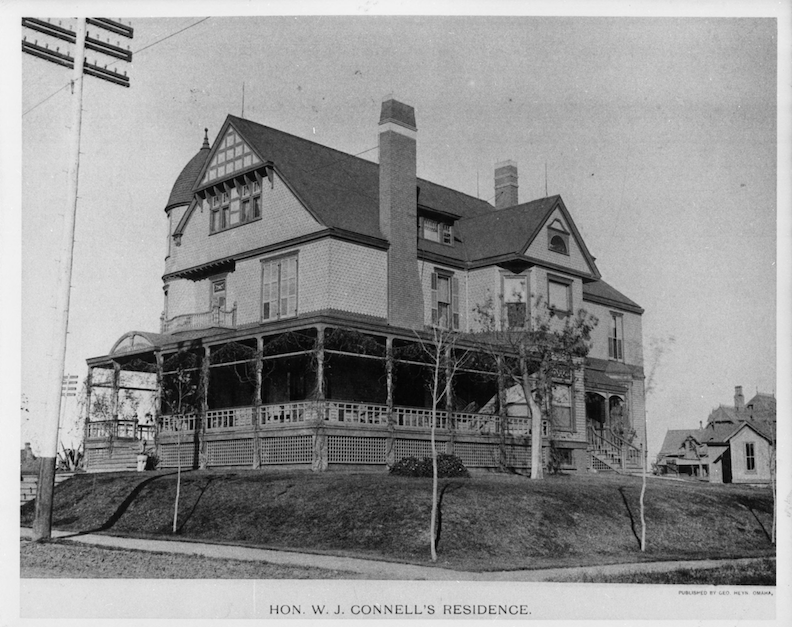
The home of W. J. Connell at 623 South 24th Street. A very large three story house. Ca. 1890-1895. Bostwick, Louis (1868-1943) and Frohardt, Homer (1885-1972). Durham Museum.
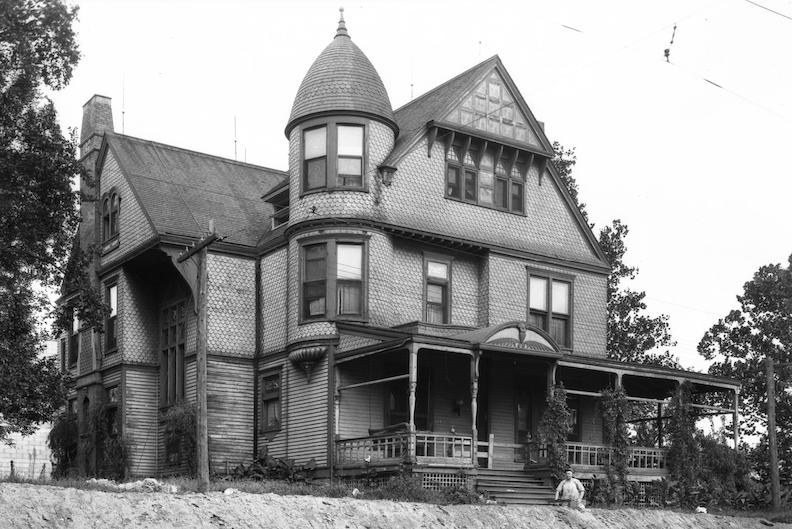
Another view of the home of W.J. Connell, attorney, at 623 South 24th Street. Bostwick, Louis (1868-1943) and Frohardt, Homer (1885-1972). Durham Museum. 1921.
In 1889, Frank Murphy began construction on his $25,000 mansion located at the northwest corner of St. Mary’s Avenue and Twenty-second Street. Frank Murphy and his sister, Mrs. Cumming, “took possession of their handsome new house” in October 1891.
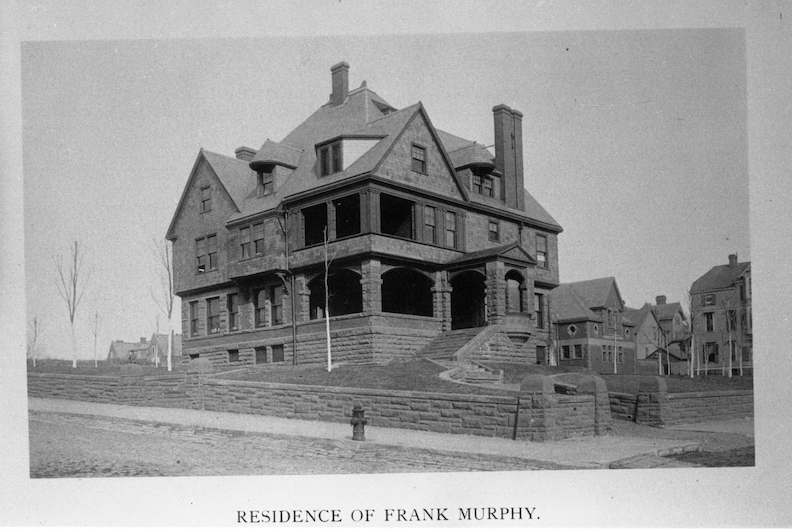
Fascinating home of Frank Murphy, mislabeled address at the Durham Museum, but truly was at the northwest corner of St. Mary’s Avenue and Twenty-second Street. Ca. 1909. Bostwick, Louis (1868-1943) and Frohardt, Homer (1885-1972). The Durham Museum. The front door and walk face Twenty-second Street.
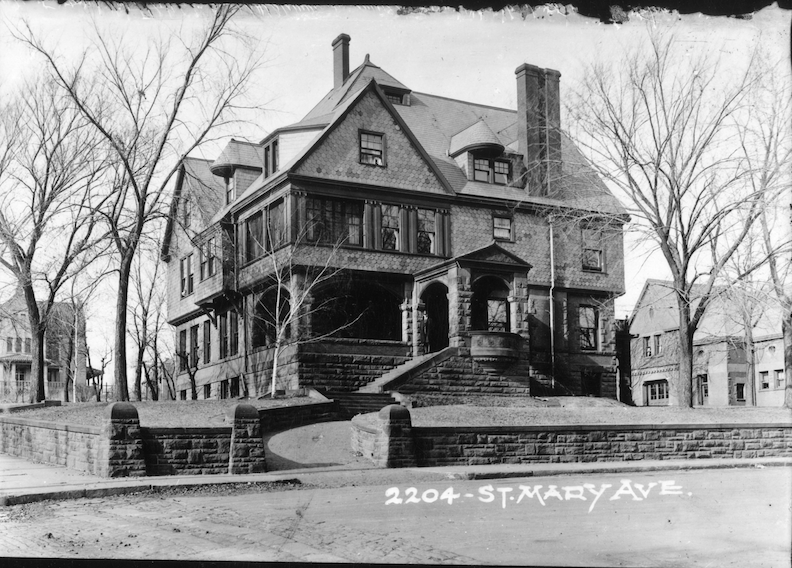
Exterior view of Frank Murphy home 2204 St. Mary’s Avenue. Bostwick, Louis (1868-1943) and Frohardt, Homer (1885-1972). The Durham Museum. 1909. With front entrance facing Twenty-second Street, the Mrs. Mary Rogers Kimball house is viewed in the distance to the west, on St. Mary’s Avenue.
I wrote of the Frank Murphy house in my book. I add this visual clue here because I was absolutely delighted to have found a remnant of the once grand home back in 2015. The beautiful stone foundation fence around the property was a costly investment but one that will last longer than all of us.
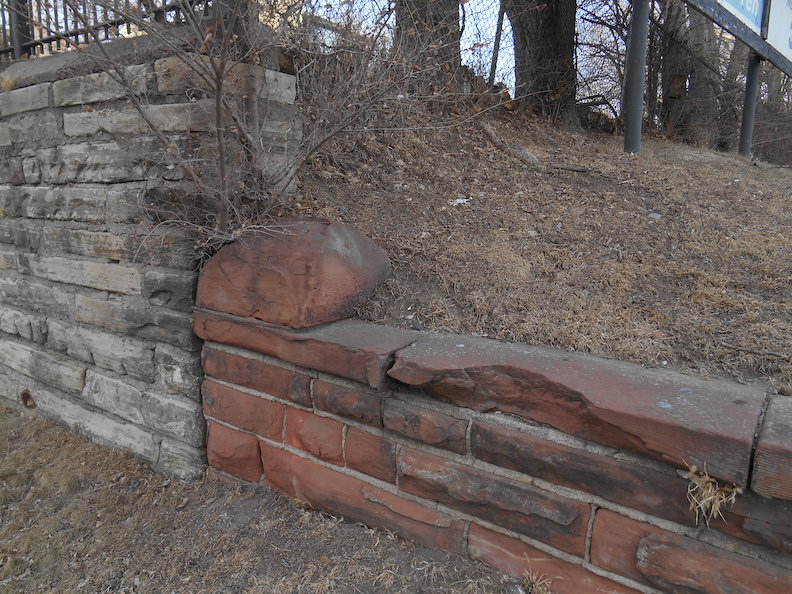
To die for. The Frank Murphy stone support wall abuts another property foundation.
Aside from their beauty and the visual community fostered by this architectural density, my belief is that this assembly of well-heeled, influential neighbors appeared to assist Mrs. Annie Crary in her efforts to get St. Mary’s Avenue in tip-top shape and address related difficulties. The Crary, Woolworth, Connell, Murphy families, along with the Sisters of Mercy, possessed the collective influence to have St. Mary’s Avenue paved. I was to find St. Mary’s Avenue would require constant attention over the years and continues as one of those strange, challenged Omaha thoroughfares.
Death of Mrs. Crary
In November of 1894 it was announced Mrs. Annie Crary, “one of the oldest settlers here, is ill at her home at St. Mary’s and Twenty-second and is not expected to recover. Her husband is in Texas.” The Colonel arrived back in Omaha and spent the last two months of his wife’s life in the family residence. Mrs. Crary passed away in 1895 at the age of 67 in the family residence due to fatty degeneration of the heart.
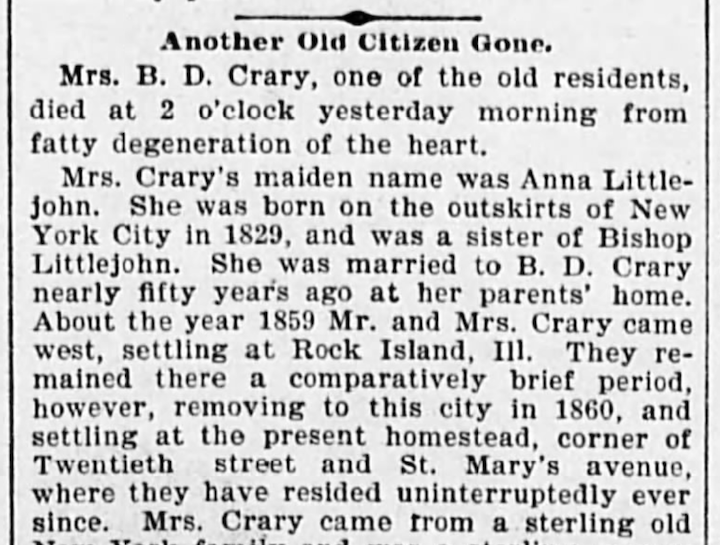
Omaha Daily Bee. 1895.
Following her mother’s death, daughter Anna Crary assumed the role of head of household. She lived alone in Terrace Hill. No occupation; home paid for; no mortgage. After the mother’s death, I could find no mention of the fashionable Terrace Hill family affairs in Omaha’s Social Spectator. It was under her ownership that Miss Anna began to wholly devote her time to the upkeep of the place, and it was said she “treasured this above all things.” She herself articulated her loyalty to the property, and upon her death, there was insinuation of Anna’s lifelong need to maintain the interior, furniture and doodads of the house in accordance with her upbringing. I wondered to myself if the Crary mansion was museum-like or accumulator-like? The latter was suggested by the sister as a family trait in a round-about way. At the time of the 1900 U. S. Federal Census, Anna Crary was 44 years of age. “A friend once advised (Anna), if ever she should marry, to wed an orphan. ‘I never met an orphan,’ Miss Anna Crary commented. This piqued my interest (and be assured, I do not believe that everyone has the life goal to marry!) Suggestions that an affluent woman wed an orphan implied a kind of safeguarding wealth and assets or even a means of avoiding in-law conflicts? Or possibly it disclosed additional insights about Miss Anna’s character, having confronted difficulties herself, felt like an orphan or witnessed things within the Crary family? During her solitary decades in the residence, Miss Anna was reported to have stated, “Leave your relations alone and for mercy’s sake, don’t have any business dealings with them.” And perhaps even more telling, “I’d give more for one of those old trees which has stood by me through thick and then than I would for some people.” Her solitary years in the family home were marked by her own quiet pursuits; she shunned garden parties and any form of social ascension. She remained unaffected by her siblings’ elite social status, and Anna appeared to slip into a refuge of eccentricity.
The Passions of Anna Crary
It is believed that in 1885, Miss Anna Crary began her charming, generous tradition of hosting a group of tiny friends for an afternoon Easter egg hunt in the spacious grounds of her family estate. She was publicly credited for decades as the originator of this ritual in Omaha. Long before the other wealthy families offered public invitations to their private Easter egg hunts and long before companies or groups held Easter egg hunts for the community children, there existed Anna Crary’s gathering. The egg hunt and rolling tournament was established for Anna’s nieces, nephews, and their acquaintances.
“The annual Easter egg hunt given by Miss Anna Crary in the spacious grounds of her home at Twenty-second and St. Mary’s Avenue. One of the oldest of Omaha’s more pretentious homes. the Crary house has been the scene of many functions that are memorable in the social history of the city.”
As the decades rolled by, many wee ones were the children of parents who had also known the joy of Miss Crary’s hospitality. Two hundred or more eggs would be prepared, gorgeously decorated, and hidden about the grounds and residence. Said one early reporting: “They will search through the big rambling grounds of this old pioneer home, explore the wooded places, and invade the tangled shrubbery to return with baskets full of bright colored eggs.”
The following photos and images are from the Omaha Bee-News and cover the years of 1909-1912.
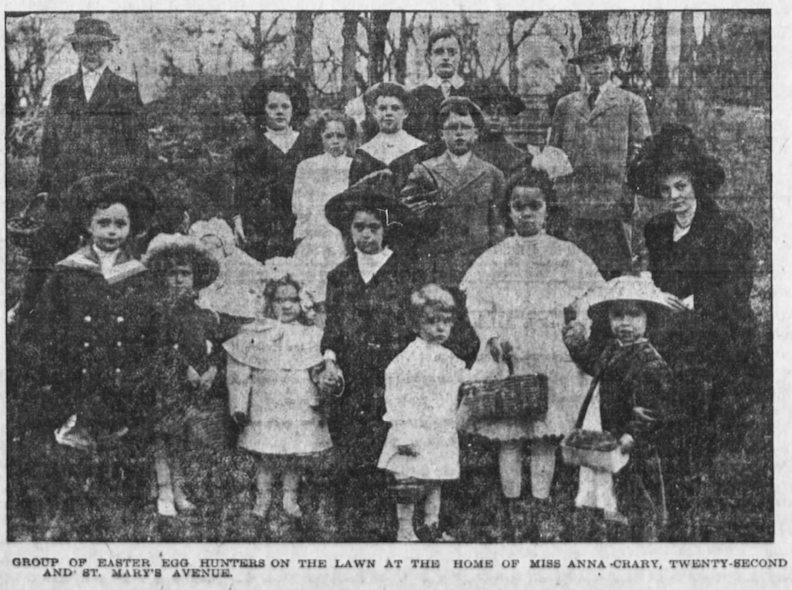
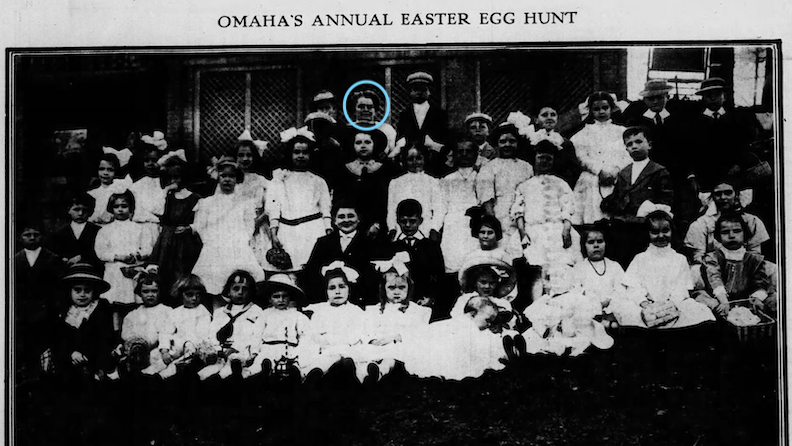
Now introducing Miss Anna Crary! Circled in blue, I was glad to finally see her.
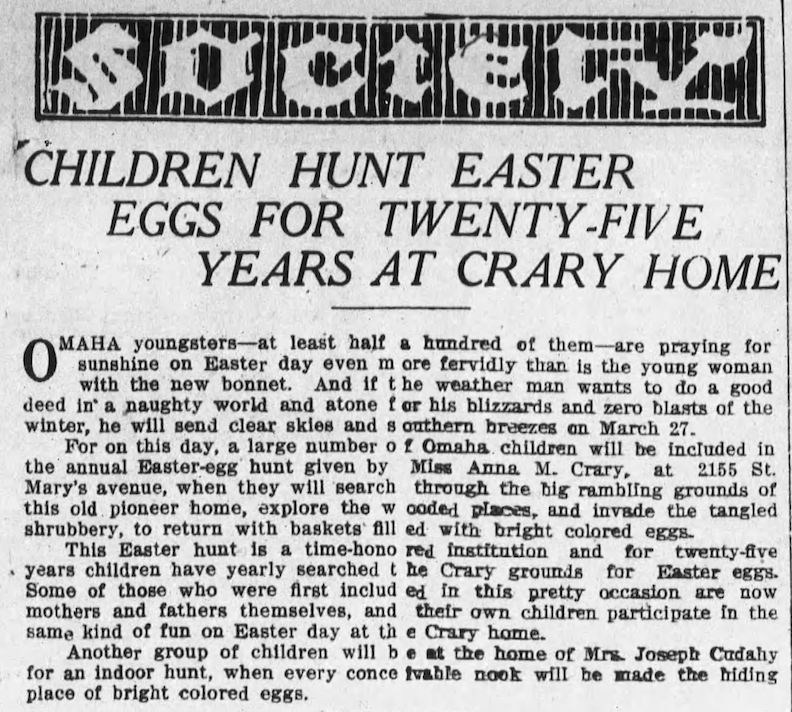
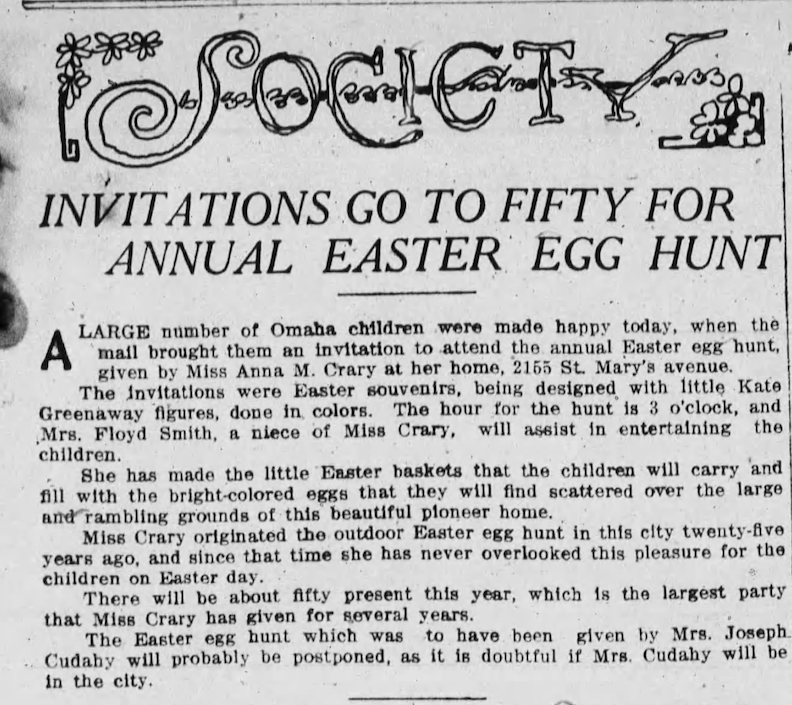
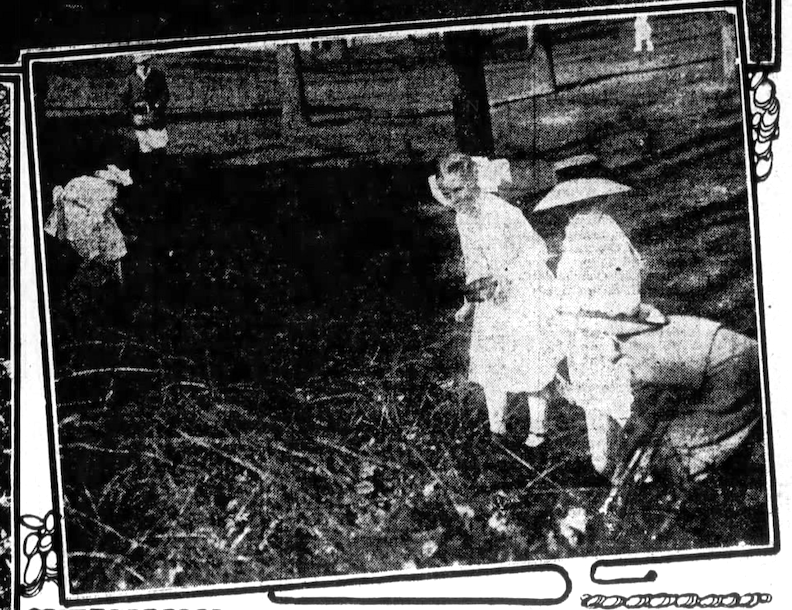

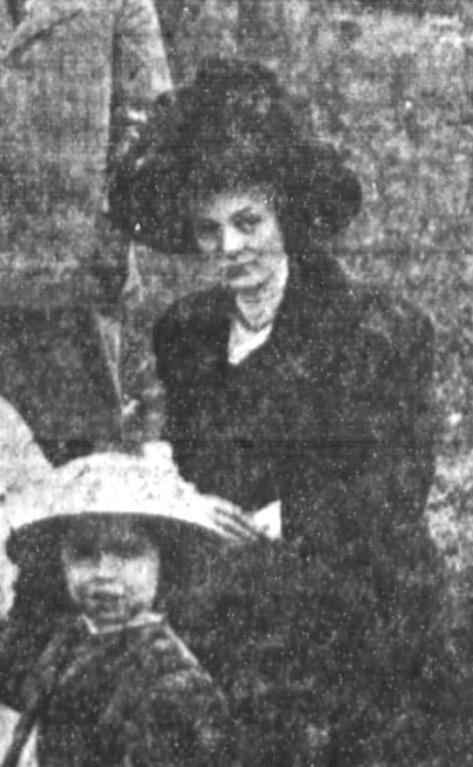
And just whom might this gorgeous creature be? Her sister or a sister in law?
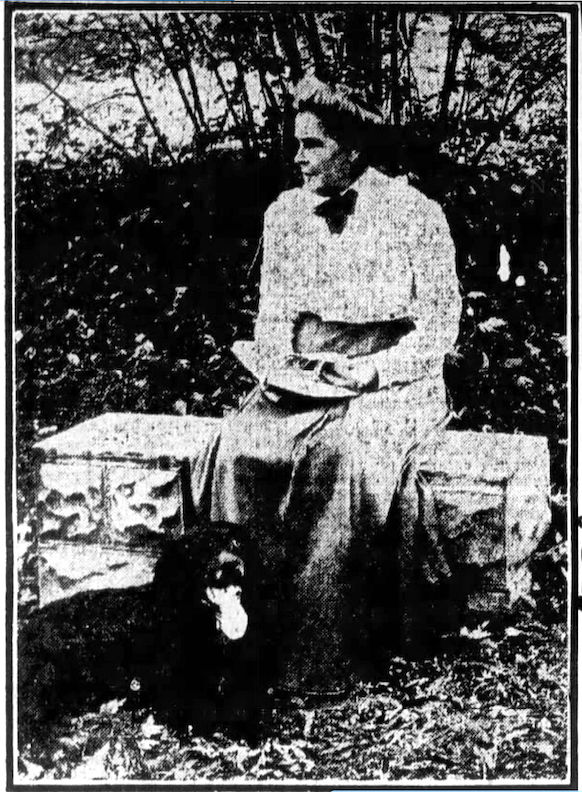
Here is Anna with her book and her dog during the Easter Egg Hunt of 1911. It made me feel bittersweet to see her on the fringes, taking it all in.
Miss Anna was described as navigating the city “with all the certainty and purpose of a younger woman.” She reportedly dined nightly at the Y.W.C.A. From the 1890s until the 1970s, dining at the Y.W.C.A./Y. M. C. A. was a common, economical, and often communal activity, especially in large city “Y” branches that functioned as residential hotels. “These cafeterias were known for serving home-style meals, such as chicken croquettes with mashed potatoes and yellow gravy, often in nostalgic, mural-filled settings.” It sounded like Bishop’s Buffet! Miss Anna seemed to possess friends; nonetheless, she was not on the social circuit. “She was good to many, both the living and the dead. It was custom for years to visit Forest Lawn Cemetery and many graves of citizens long departed have been decorated with flowers which she brought from the beautiful gardens about the Crary home.”
Miss Anna was primarily recognized for her affection for flowers and birds. The Crary grounds during the summer season, despite the clamor of city traffic and the pall of industrial smoke, exhibited “arresting beauty.” Miss Anna frequently tended to her plants in the garden and was often seen from passersby. Domesticated squirrels and blue jays fed from her palm while other birds navigated around her within close proximity.
In time the residence was allowed concealment by a towering hedge emitting a potent aroma of honeysuckle. Had the local children observed the fat cats in the tall grass? The illumination in the second-floor window throughout the night? Where the flowering privet ran wild deliberately. “No ruthless hand here is permitted to destroy a flower, a shrub or a tree and here, too, the squirrel and the birds find their city of refuge.” Other than her groundsmen and the occasional rental offer of a “cool, airy rooms, beautiful grounds; kitchen privilege; hot and cold water.”
Death of the Colonel
Before proceeding too much further, I must note that Beebe Denison Crary passed away while working and residing in Beaumont, Texas, in April 1907. He outlived his wife by twelve years, dying at the remarkable age of eighty-nine. “At the end of his life, for six or seven years, he was an advisor while younger men did the active work. He far outlived his associates of the early days, among whom were August and Herman Kountze, General Coe and Levi Carter. The body will be interred in Forest Lawn cemetery beside that of Mrs. Crary.” As I had mentioned previously, the Beaumont, Texas library have volumes dedicated to the Colonel as he was considered upper echelon to East Texas. It was all a mystery back in little Omaha.
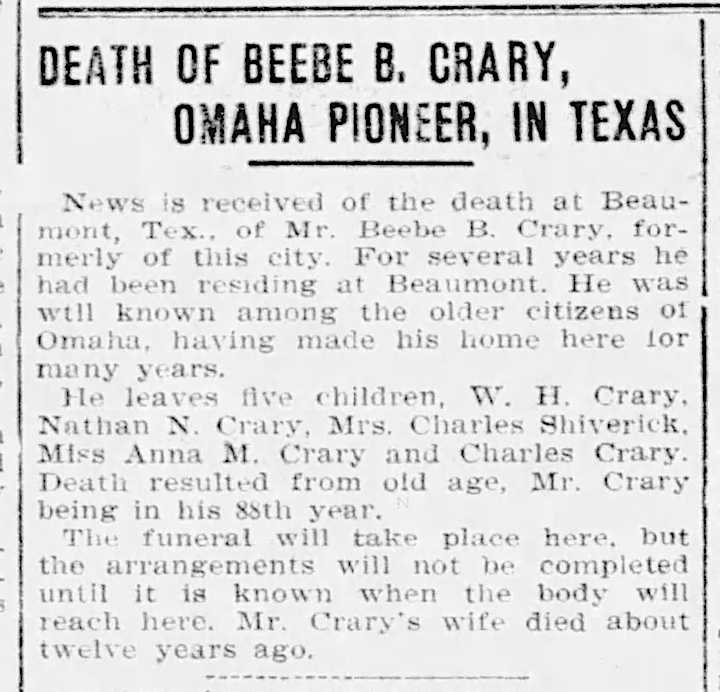
Evening World-Herald. April 1907.
The death of Father Crary initiated the distribution of his estate, together with Mrs. Annie’s holdings. The Examiner disclosed that a petition was submitted in county court, asserting that Mother Crary did not create a will and, additionally, that she has no personal property for administration. Oddly, as an aside, I found Mrs. Annie’s name on house and lots for tax purposes since the family first acquired it. With both parents deceased, the assets were allocated in due time, and by March 1908, the numerous parcels in Omaha were distributed between the adult Crary children.
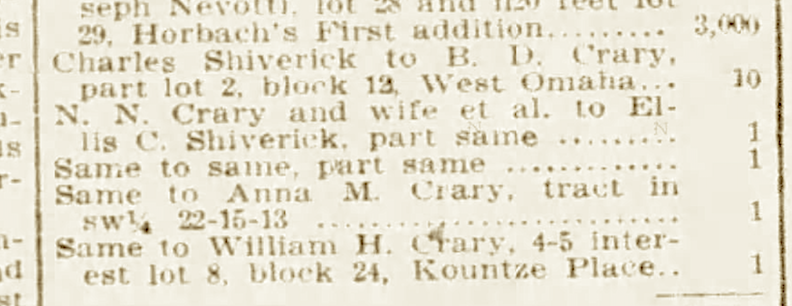
Omaha World-Herald. 1908.
I was pleased to see that Terrace Hill was officially given to Miss Anna. I observed that when the larger property was registered under Mrs. Crary’s name, it encompassed tax lots 14 and 57 of section 22-15-13. In later years articles indicated the existence of the residential lot alongside many parcels constituting the Crary estate.
The Caldwell Case
In these years the vicinity between Twentieth and Twenty-second, from St. Mary’s Avenue to Leavenworth, “formed one of the most beautiful resident portions of our city.” Three prominent bankers had constructed large houses with spacious grounds surrounding the Crary house. This only served to preserve the prosperous residential character of the block for solid decades and elevate the Crary’s Terrace Hill; a status and comfort level that could be swiftly be revoked by a death and subsequent a sale.
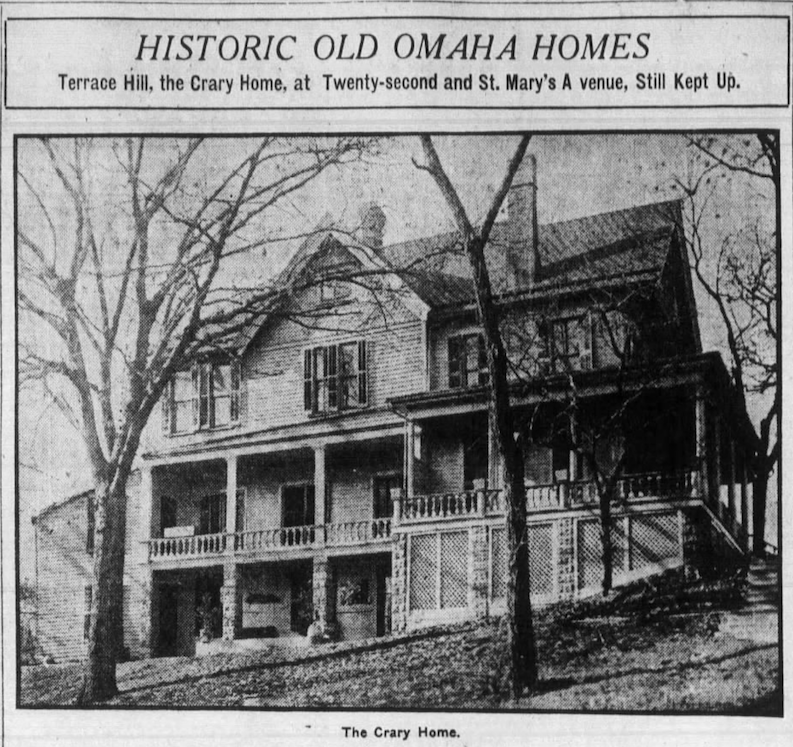
Soon after the Crary mansion finally received its well deserved close up, news would hit that reconfigured the whole area. The Omaha Daily News. 1914.
Banker F. H. Davis developed his expansive residence at 628 South Twentieth Street, situated equidistantly between St. Mary’s Avenue and Leavenworth. Banker Victor B. Caldwell constructed his family’s mansion at 630 South Twentieth, making him the closest neighbor to the David family. “These homes are set in a thickly wooded tract and are some distance from the surrounding streets.” The rear of the Victor B. Caldwell mansion and his carriage house was located near the intersection of Twenty-first and St. Mary’s Avenue. Upon Banker Caldwell’s death the house which boasted an interior of mahogany was sold by his estate, along with the adjacent two and one-half acres extending from Twentieth to Twenty-second Street.
Another banker Charles W. Hamilton had arrived in Omaha in 1856 and was featured in many early Omaha books. Hamilton had a large estate fronting Leavenworth and was south of the Caldwell house. The Hamilton house was said to have been built to the south between the Caldwell house and Leavenworth.
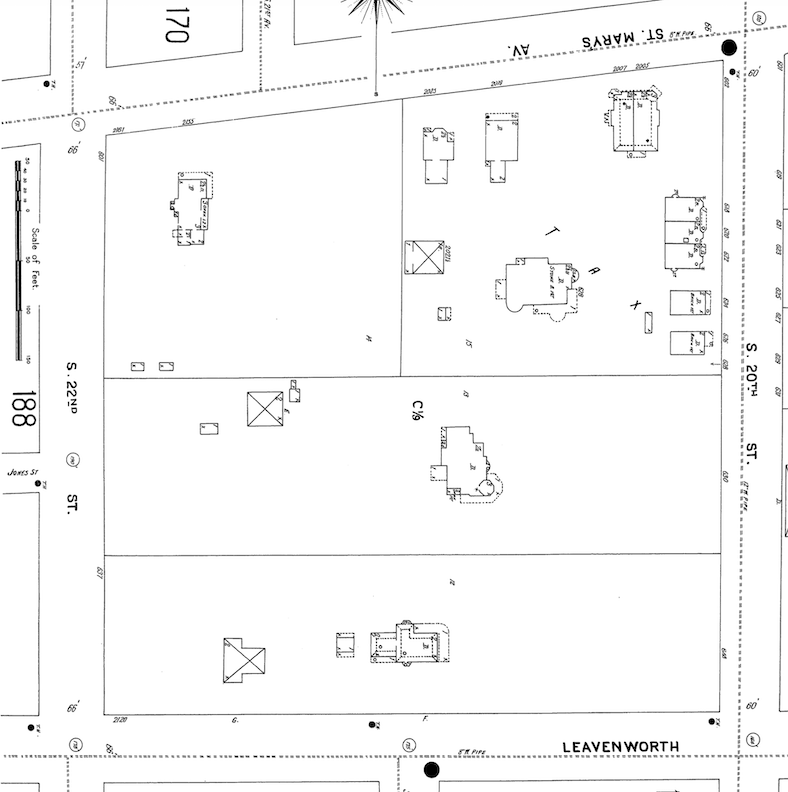
1901 Sanborn Map. Top of drawing is north, St. Mary’s Avenue. Bottom of drawing is south, Leavenworth Street. Crary land is seen in the southeast corner of St. Mary’s Avenue and South Twenty-second. Historic Sanborn Map lent by Trina Westman and Shelley McCafferty of Omaha City Planning Department. The massive homes to the south would disappear in the years to follow.
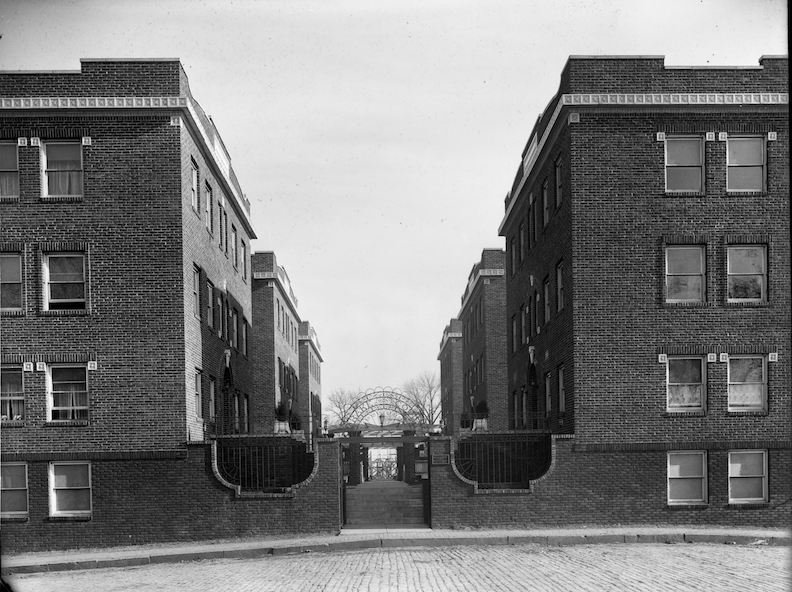
Drake Construction Company. The Drake Court Apartments and central courtyard at 22nd and Jones. 1918. Bostwick, Louis (1868-1943) and Frohardt, Homer (1885-1972). The Durham Museum.
Local newspapers announced in March 1916, Mrs. Nellie H. Caldwell, widow of Victor S. Caldwell, and her brother-in-law, S. Sam Caldwell, sold the Victor Caldwell mansion and grounds to W. B. Drake for the Drake Brothers Realty and Construction Company for $40,000. The property comprised a substantial frame house and two and a half acres of predominantly wooded ground, running from Twentieth to Twenty-second Street, situated between Leavenworth and St. Mary’s Avenue. The Hamilton estate, located south of Leavenworth Street, was adjacent to the F. H. Davis residence and the Anna Crary residence, which were situated to the north on St. Mary’s. “The Caldwell property is in the middle of the tract. Its street number is 630 South Twentieth. Drake Brothers, it is presumed intend to use both frontage of the Caldwell property to build several apartments, Los Angeles fashion.”
Drake Court was the name adopted by the Drake Realty Construction Co for its development of the tract, two and a half acres, midway between Leavenworth and St. Mary’s and running from Twentieth to Twenty-second. 10 apartment houses on each side facing north and south around a courtyard.
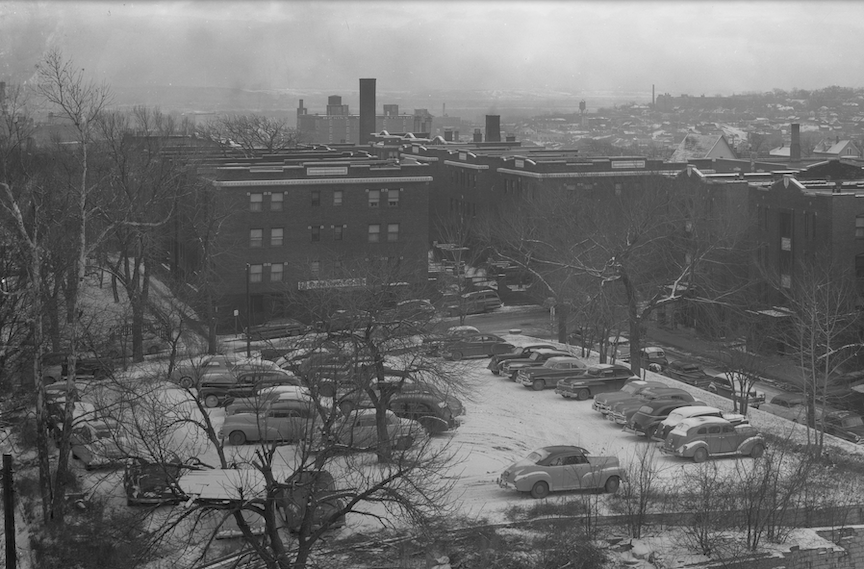
The Drake Court Apartments and courtyard near 22nd and Jones Street. Camera looking southeast from 23rd and St. Mary’s Avenue. Bostwick, Louis (1868-1943) and Frohardt, Homer (1885-1972). The Durham Museum. 1953-03-19. Notice just north of the Drake would have been the Crary land–magnified below.
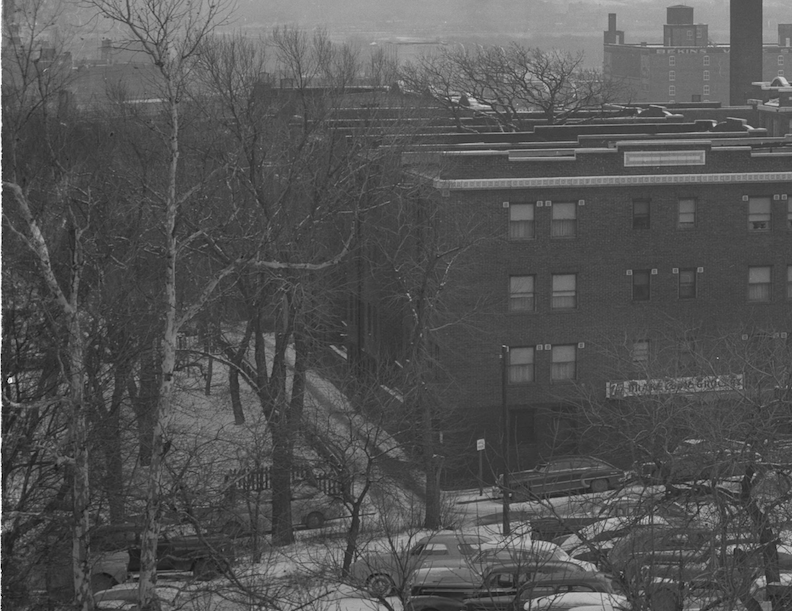
Previous photograph magnified. This treed area to the north of the Drake Court apartments originally was the Crary estate. Bostwick, Louis (1868-1943) and Frohardt, Homer (1885-1972). The Durham Museum. 1953-03-19.
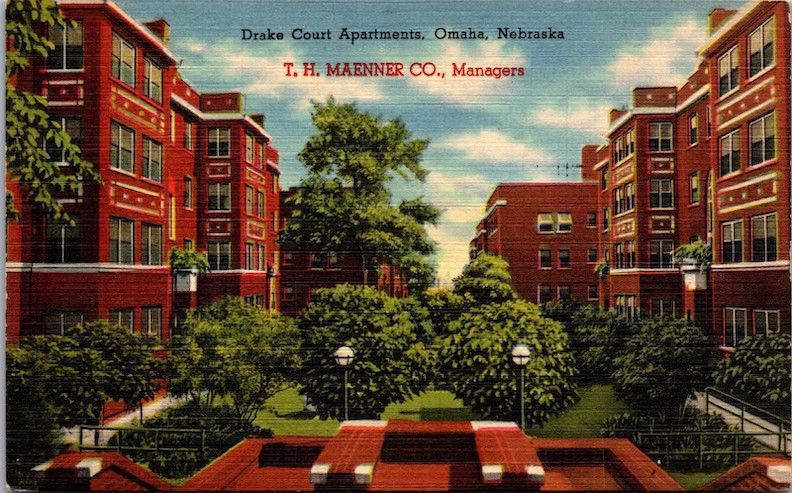
Wonderful colorized 1940s Drake Court Apartments postcard. If you can’t get matchbook made for marketing, get a lovely postcard.
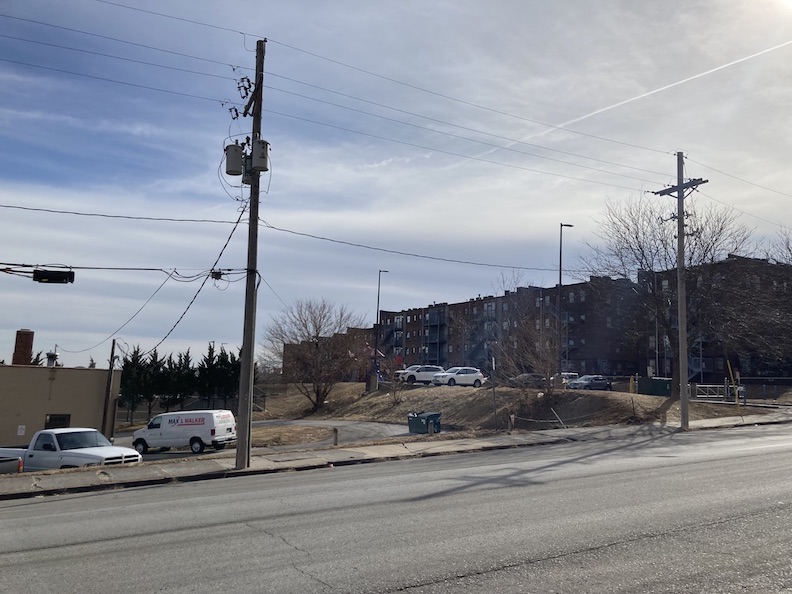
The rear view of the Drake Court Apartments on a cold, cold day. I was standing on Twenty-second, south of St. Mary’s Avenue at a southern angle.
Similar to the Rorick Apartment complex in recent decades, the Drake Court flats and the adjacent Jones Street apartments experienced significant deterioration. Violence, narcotics, criminal networks. The beautiful historic buildings suffered much as the people within their walls did. I remember punk friends renting in the Drake Court in the mid-1980s and it was quite the perilous experience weaving through the courtyard strewn with every element of threat just to get into the small party. My friend, Kevin Woodard, still recalls walking along the sidewalk on summer nights, where what seemed like a hellish painting come to life appeared before him at the nightmarish gates. My dear friend Dereck Higgins recalls instances from visiting his father’s residence in the Drake Court apartments, where he witnessed trails of fresh blood in the hallway. Honestly the layouts of the Drake Court apartments were among my favorites. I had consistently rented in the once elegant, run-down flats from the early 1900s to the early 1930s, and the Drake offered the worn sophistication I sought in residential living. That being said, as a young female, I never felt secure living in a dead-end zone, despite my admiration for its literary and aesthetic qualities. On that note the stunningly dire side road T-intersection of the Jones Street apartment row right at the Twenty-second Street Drake Court gates does not resemble Omaha at all. This whole district exemplifies the efficiency and aesthetics in dream-worthy apartment building that numerous proponents of high density advocate. I can see what the initial plan was here. It was a solid, stylish stack-up like in the bigger cities. However some have called this T-intersection Omaha’s Formal Entry to Hell. I am of the belief that city planning did not anticipate the drugs of the last forty years. This cut-off area, with little to no surveillance, and low rents fostered a hideaway open-air drug and prostitution market–a tucked in pocket that the city turned a blind eye to because it was so self-contained. I have so many photos of this area over the years but because this is not an investigation on the “T” I will just share a few. Here are some from 2015.
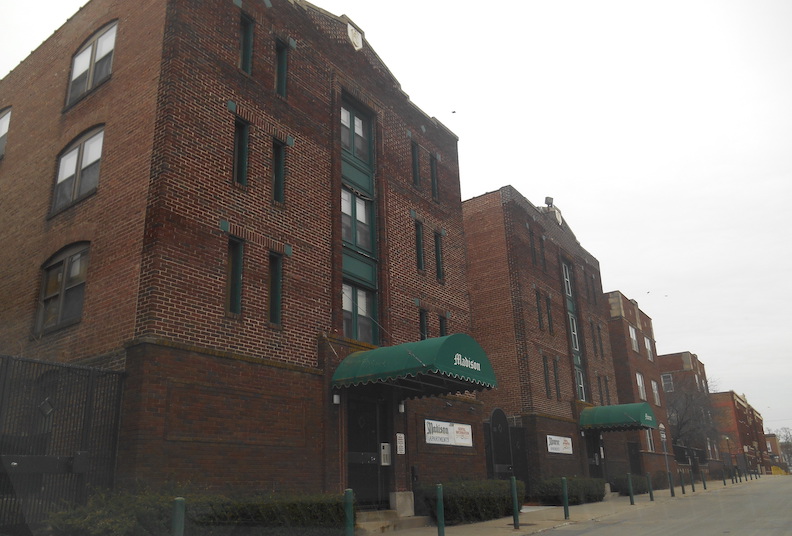
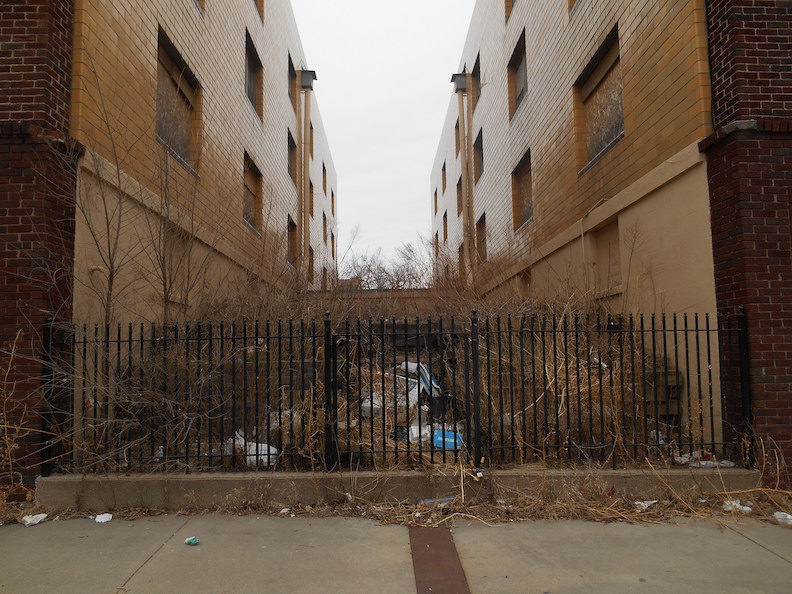
I love these caramel colored glazed tiles.
Behind That Curtain
In September 1907 the City Council resolved that the street railway company should remove the old track lines on St. Mary’s Avenue between Twenty-second and Twenty-sixth streets. They began the removal of lovely cobblestones in preparation for full asphalt installation.
Omaha Daily Bee. June of 1921: “The St. Mary’s Avenue grading district between Sixteenth street and Twenty-fourth avenue is beginning to look like a new part of the city. Near Twenty-second street the old Crary house, the old residence of the late Judge Woolworth and the Fairfield home, all on the south side of the street, are now on a high embankment close to the edge of the new street. On the opposite side of the street the old home of the late Frank Murphy, founder of the Merchants National Bank, is on another embankment.”
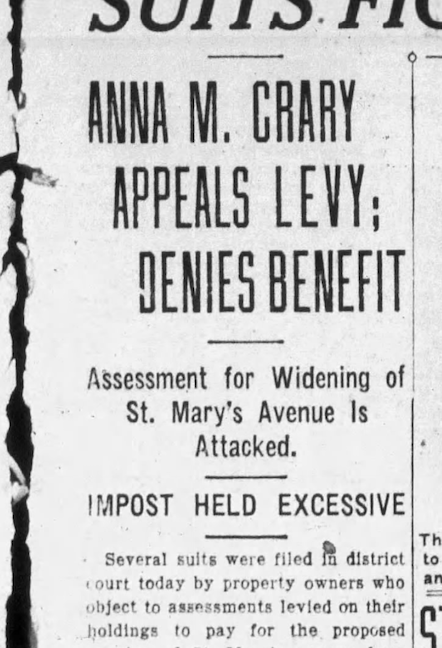
The Omaha Daily News. August of 1925.
By August 1925, multiple lawsuits were initiated by property owners contesting the assessments imposed on their properties to finance the proposed extension of St. Mary’s Avenue from Twenty-seventh Street to Thirty-first. I assume this was written incorrectly and they intended to refer to the Twentieth or Twenty-second to Thirty-first. “Miss Anna M. Crary owner of several lots on Twenty-second street and St. Mary’s Avenue and one of the holdouts who have refused to sell their homes for commercial purposes is to be assessed $2,464, she says. Her property consists of a large frame house which has served as her home for fifty years and several lots for which princely sums have been offered by realtors. Miss Crary however has refused all offers although taxes on the property mount year by year.”
This was the initial news report that informed me about Miss Anna being solicited to sell by commercial interests. With homes being torn down on the north side of St. Mary’s for commercial buildings and the north side of Leavenworth for business and apartment buildings, Miss Anna was surely feeling the squeeze and the passing of time. For more on the upbuild and commercialization of this area, check out: Mysteries of Omaha: 2226 Howard Street
The Reclusive Maiden Aunt
As the town crept in around Miss Anna, I found evidence that she was apt to having men live in the home, perhaps for safety and company. She began running advertisements for “refined gentlemen” for her “furnished front rooms” in the 1917 time period. In the early to mid 1920s to also appeared to have nephews living with her off and on. As to the disparaging titles of “recluse” and “hermit,” these were newspaper labels for her, and I really didn’t find that to be true. It is true that Miss Anna was not married but she certainly wasn’t hidden away. She had a telephone and two radios, one in the living room and one in her bedroom. Friends were known to call on her and take her out to dinner, however her general solitude was compared to that of a lighthouse keeper. Her alert mind sized up the world “as she sees it parade pass her front porch.”
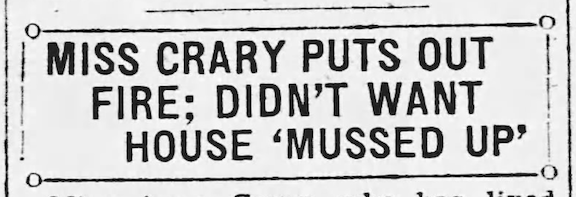
Omaha World-Herald. April of 1924.
There was a big to-do about Miss Anna having fought a house fire by herself in April of 1924. I include it in our investigation because it is rather telling of her nature. She simply did not call the fire department because, “She didn’t want them to ‘muss up’ her home.” By refilling a pitcher of water, she extinguished the fire by herself, rather than let the fire department into her beautiful old home. Another example of grit was in October of 1926 when Miss Anna fell and broke her hip at Twenty-fourth and Farnam Streets. It is said she empathically refused to be taken to a hospital. Although physicians announced she could not live, Anna staged a remarkable recovery. While bedridden she crocheted several dozen wash clothes and three rag rugs in addition to much needlework. By November of 1927 the Omaha Evening Bee News announced for all to read that “Miss Anna Crary Walks Downtown after being confined to her home for a years with a broken hip.” She was often seen walking downtown! Other reports stated the fall “partly crippled her and she has seldom left the place.” Of course conditions change over time. By then the location where the Crary mansion stood was considered a business district or thoroughfare leading to further developments in the west.
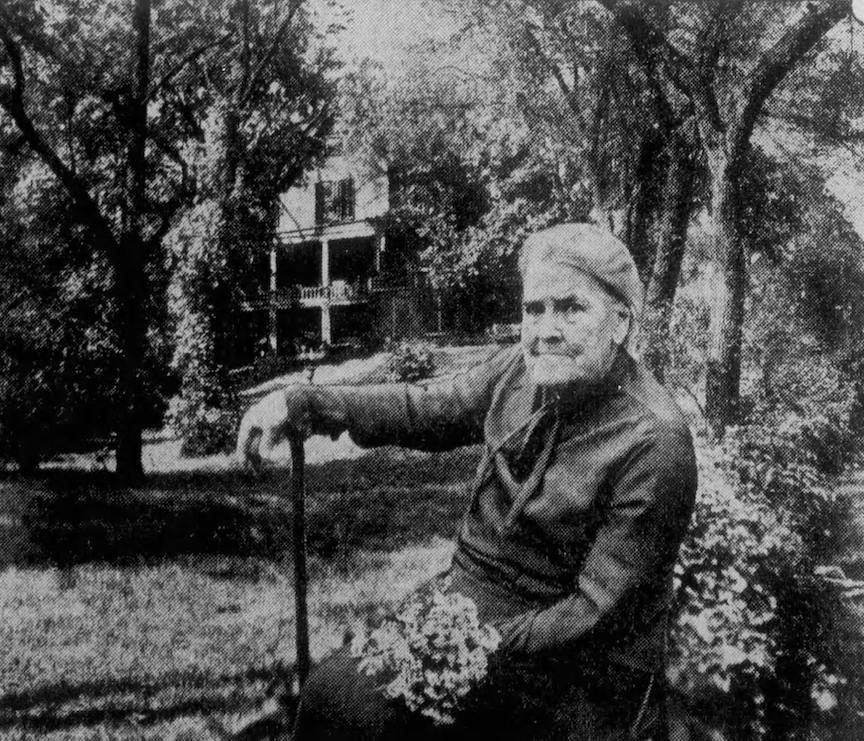
The Omaha Evening Bee News. 1929. Finally I could see the woman and her glorious mystery gardens. I wanted more of the lush Grey Gardens. Miss Anna said, “I go to church in my own yard. The birds are my choir and the only thing I don’t have, that the church does have, is the collection.”
Of intrigue, in January of 1929, Miss Anna sold a portion of the SE corner of her property.
“She watches from morning until night the stream of automobiles up and down St. Mary’s Avenue. But she doesn’t care for an automobile of her own.” There was also hinting that in her more than 60 years in the “veritable Garden of Eden” that Miss Anna longed to remain in the place she loved “until she is summoned to death.” I prepared myself, as should you.
Death Comes to Miss Anna
After a weeklong battle with pneumonia, during which she was cared for by two nurses, Anna Crary passed away in her family mansion, fulfilling her desire to die there. She died on the Eve of the Eve, December 23, 1931. There was no mention of family encircling her bedside and let me alert you, if you don’t already know, the papers were very specific back then.
“Death Arrives after 67 Years at St. Mary’s Avenue Mansion,” reported the headlines. The inquisitive would learn more in the forthcoming year. Miss Anna preserved an ambiance in the home reminiscent of a bygone era. Some rooms, including her mother’s, were decorated as they were many years prior. Anna died in the “Mother’s room,” which she may have long regarded as her own bedroom. At 77 years old, Anna Crary refused to move or sell her ancestral home, dismissing numerous big offers for the property, having witnessed her venerable mansion and gardens stand the test of time and serve her into the beyond.
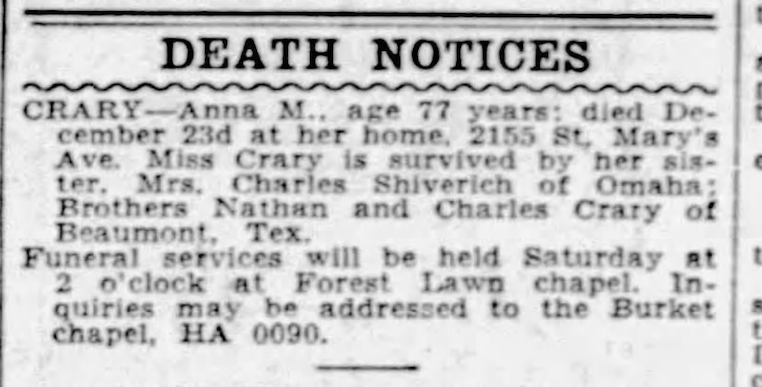
Omaha World-Herald. December 26, 1931.
A passage I just love: “Another link between Omaha and the pioneer days was snapped when Anna Crary passed away on Wednesday night.(…) She saw the village grow into a city and its spreading life reach and then pass far beyond, until her home was farther from the residential district than it had been at the start.”
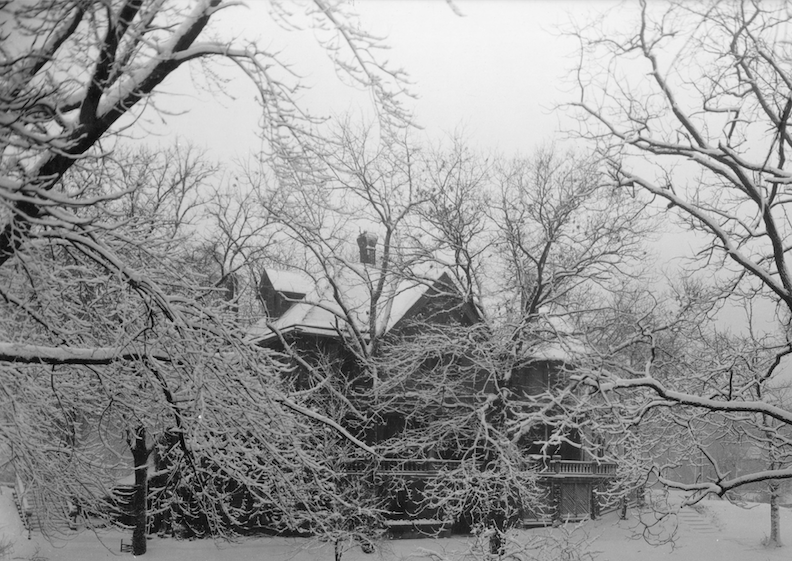
Anna Crary’s 2155 St. Mary’s Avenue, located between 21st and 22nd street. 1924. Bostwick, Louis and Frohardt, Homer. The Durham Museum.
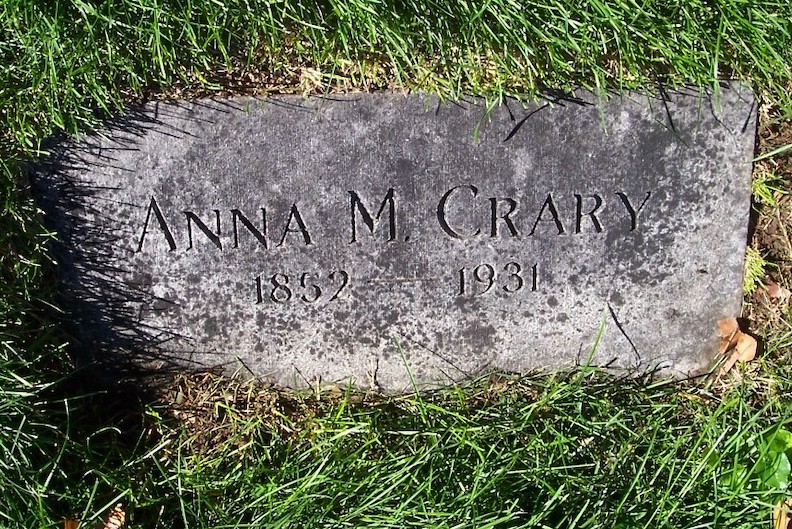
Forest Lawn. Photograph by Don Watkins. If we notice the birth date of 1852–this would mean that Anna had shaved a few years off of her age over time. I questioned her birthdate during the examination for this article. From censuses and family genealogy, I hammered out that Anna was fourteen years old when the family arrived by stagecoach; yet, through interviews over the decades, her age of arrival to town was subsequently reported as ten and later as a tiny child. I don’t blame her and in fact it is very common…just things I notice when traveling through time as a nitpicky researcher.
The Strange
In 1932, it was disclosed that Miss Anna Crary bequeathed $50,000 to her nephews, nieces, and siblings. $50,000 in 1931 is roughly comparable to $1,069,907.89 purchasing power in 2026. This was a substantial sum, one we would have anticipated, yet it was also oddly affirming that Anna was taken care of in her father’s will, by her mother, or perhaps another guardian? Then the mystery problem of the house, the furnishings and the large property. Mrs. Ella Shiverick, Anna’s sister, (who, by the by, was residing in the Blackstone Hotel) declared that a public auction would take place. Omaha Snoops read with bated breath of the Crary Household Furnishings Necessary to Equip the 27 Room Residence that would go on the auction block. Sister Ella expressed numerous peculiar and ambiguous statements to follow.
Numerous family heirlooms and pieces had been claimed by relatives, and a significant portion had been divided. The magnificent fountain located in the central area of the ravine-like woodland lawn would be removed and dismantled, as the stone statue above it, “a notable landmark on St. Mary’s Avenue,” was deemed “hazardous to children permitted to play in the yard.” The statuary would not be sold at auction but would be retained within a branch of the family.
“We decided on this sale because the house is too big for any further use and too old. Many of the most valuable things already are scattered about the family. This place was once full of treasures, for ours was always a family of accumulators.”
“It has not been decided what will be done with the mansion after the sale (auction.) Mrs. Shiverick says a caretaker will be kept on the premises until the family reaches the decision. ‘But you can say positively the property will not be sold,’ she said.” Why, I asked the sky? “The house was too big for any further use and too old.” The Woolworth mansion and the Murphy mansion were repurposed as hospitals, nursing accommodations, and a residential spa. Fraternities were buying up these mansions. I was reading between the lines and detected that no one in the family wanted to rehabilitate the home for sale nor did anybody wish to witness another inhabitant residing there; they were reluctant to reveal familial history to an inquisitive and intrusive public interested in real estate. Were there other reasons I hadn’t thought of? And who was this caretaker?
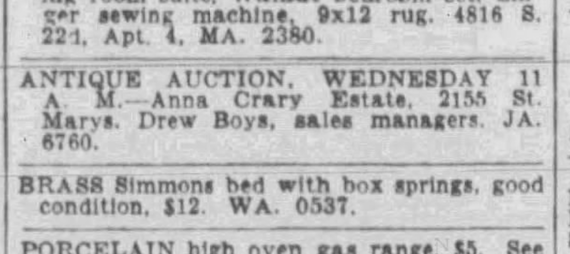
Omaha Sunday Bee News. 1932.
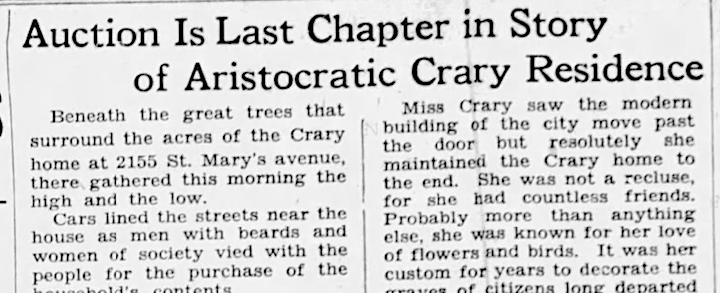
Omaha World-Herald. June of 1932.
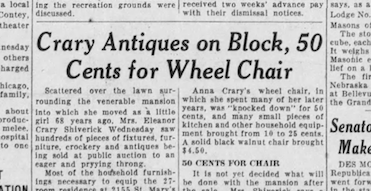
Omaha Evening Bee News. June 1932.
Hundreds of people came to the Terrace Hill garden with a rambling frame house. Automobiles were said to encircle the block. The Omaha Famous Drew Boys conducted the sale, featuring “rare antiques, mahogany and Birdseye maple, silver plate, bric-a-brac, paintings and all the countless things that 67 years of Crary residence in the 27-room house had collected.” Omahans noted the odd sight of Miss Anna’s sister on the veranda, overlooking St. Mary’s Avenue. “Mrs. Shiverick sat on guard, for no one was allowed in the old house, with one exception, Miss May L. Copeland, retired Central High School teacher, who is an old friend of the family.”
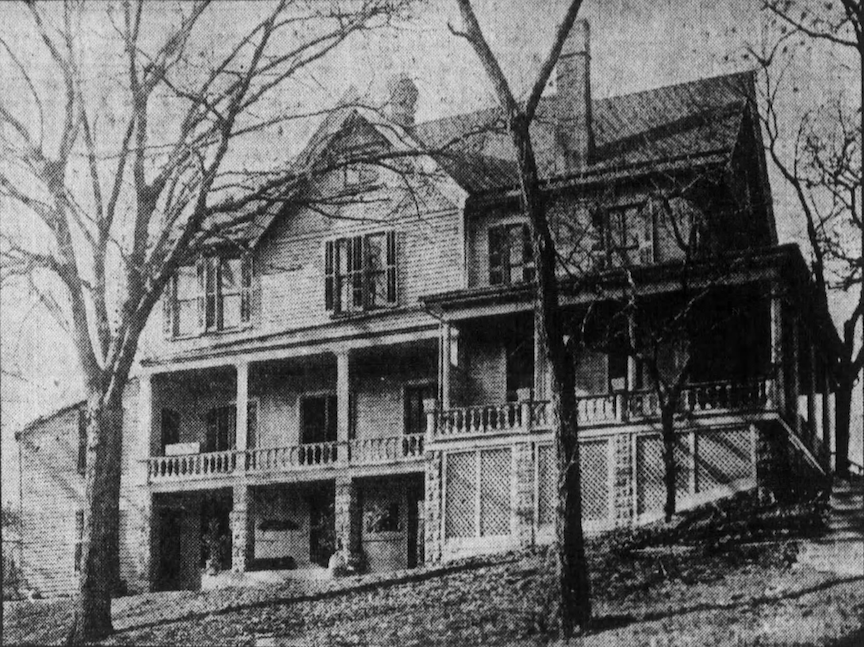
I can just see her on the porch now.
History Razed
In April of 1933 the Crary house was demolished. “One of the few remaining landmarks of pioneer Omaha,” workers were described dismantling the large, three-story building. Floyd M. Smith, great-nephew to Miss Anna and administrator of her estate, was overseeing the demolition of the house, stating “the family mansion has been handed over to wreckers this week.”Aside from electric lighting and plumbing, the house was surprisingly something of a time capsule since its construction. The workers could see that Miss Anna prepared all her meals using a coal stove. “The furniture was mostly old-fashioned mahogany and walnut,” implied that things were left willy-nilly, abandoned in the house, which made me sad. “The workmen came across old newspapers and magazine in one of the rooms. Among the papers was an 1889 Omaha Bee News.” John Todd, who serDreved Miss Crary for several years and had been the caretaker since her death, stood by observing the huge mansion collapse. He stated that Miss Crary frequently sent him to the market to procure pecans and cakes for the squirrels, and she dedicated around an hour each day to feeding them.
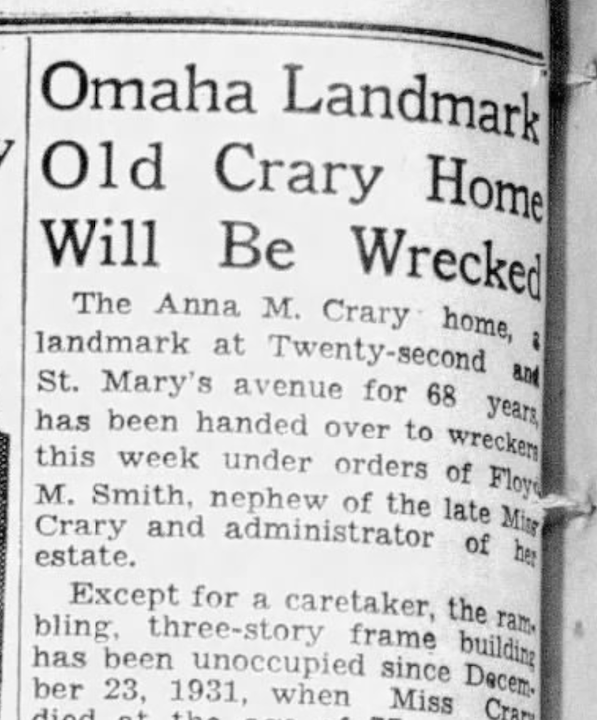
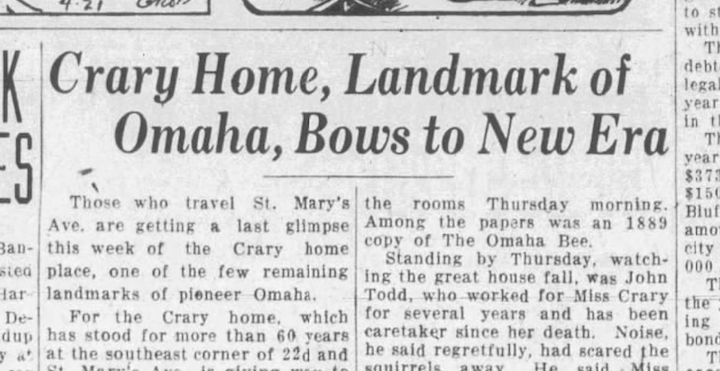
Omaha World-Herald and Omaha Bee News.
SIDE STORY for PEOPLE WHO LIKE SIDE STORIES
In August of 1932, past Miss Anna’s death the Omaha Evening Bee-News reported a fox had moved to the city from his country home and took up new residence under the once Crary home. The fox was rooted out by the Nebraska Humane Society and given to the Riverview Park zoo. Riverview would become the Henry Doorly Zoo. I have an incredible story about the caretaker in the hopper.
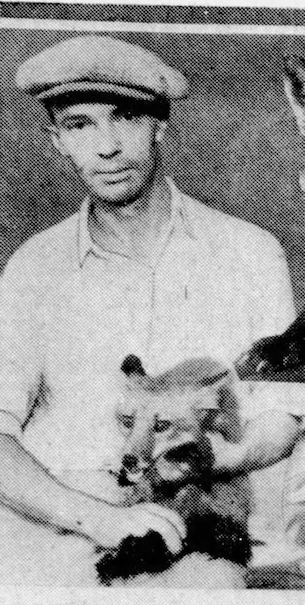
The Omaha World-Herald posted this great photog of Walter B. Wyrick and Reynard the fox.
“For more than 67 years the old Crary home has stood at 2155 St. Mary’s Avenue. Last December Miss Anna, who had lived there alone for years, died. The house has been untenanted ever since, save by the ghosts of memory and of late, by Reynard the Fox. Beneath the porch of the old 27 room mansion Reynard has lived in peace and contentment all summer. Residents of Drake Court began to catch glimpse of him. An old house, with queer reflections in the windows, a slinking form and memories of ‘Dracula’ began to work on certain nerves.”
The Even Stranger
The Crary land was sold in 1934. I assumed the house was gone and the slate was bare until a news article from May of 1934 in the Omaha Sunday Bee News: “Unobserved by the thousands of motorists passing daily by the doorstep, Mr. and Mrs. John Todd are all that remains of the life that was once the Crary estate at 2155 St. Mary’s Avenue.” The caretaker and his wife still lived there?
Floyd M. Smith, Jr., the estate administrator, had proposed that Mr. Todd use rooms in the mansion in exchange for overseeing the grounds. The year prior when the house was sold to demolition contractors, they permitted the Todds to retain two small chambers in the stone foundation on the condition that they safeguard the timbers and bricks from theft. Only the emaciated specter of the foundation and Mr. and Mrs. Todd, aged 68 and 58, respectively, remained. “Todd, who limps badly due to a smashed leg, the result of an injury 36 years ago and his wife, with hands and arms paralyzed, eke out an existence in their barren rooms. Occasional aid from the county or the federal emergency relief administration amounts to $1.25 per week in groceries. Water, when rain is light, is carried from neighboring filling stations or apartments. Light is hard to get for coal oil costs money. The FERA supplies coal for the winter. The Todds have two daughters, both of whom are married. One lives in Omaha and has eight children. The other lives in Des Moines and has five children.”
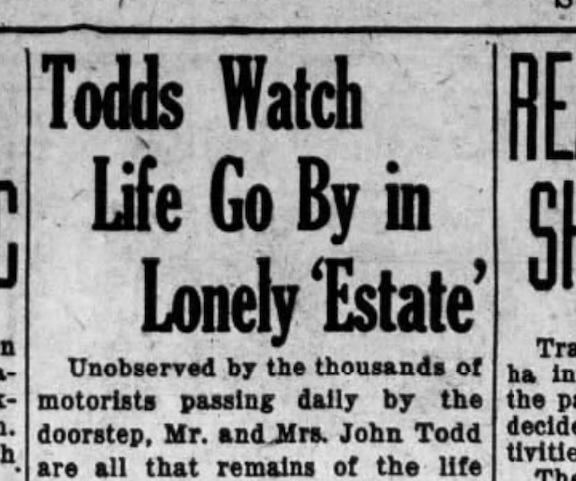
Omaha Sunday Bee News. May 1934.
I could hardly believe what I was reading. The wrecking crew allowed the Todds to live in two rooms of the stone foundation. It was a desperate, desperate situation of the Great Depression. The peculiar nature of the situation evoked memories of the 1945 film The Enchanted Cottage, which revolves around a small “cottage,” a remnant of a wing of a once large, luxurious estate on the New England coast following a fire. A makeshift roof, our cold winters–was all I could think. Not long after, a runaway truck struck and injured Mr. Todd, which surely complicated his already difficult life. Despite its alarming nature, the stone foundation “shelter house” illuminated my observations upon discovering the 1934 Sanborn Map. The residual footprint, being a tiny remnant of the former Crary Mansion, was undoubtedly reduced in scale.
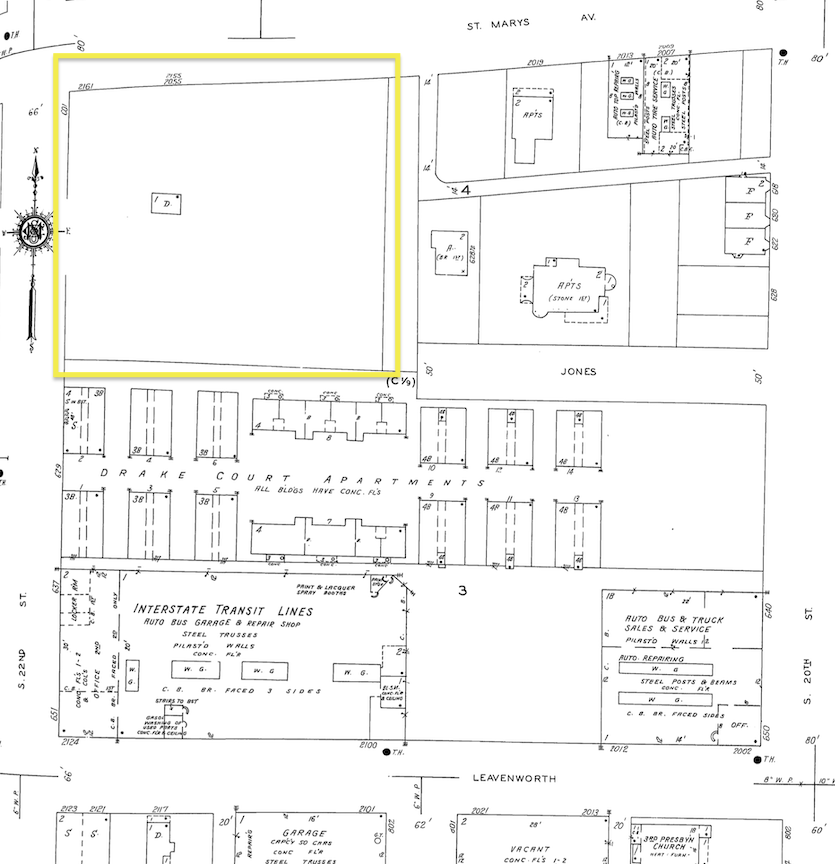
1934 Sanborn Map. Top of drawing is north, St. Mary’s Avenue. Bottom of drawing is south, Leavenworth Street. Crary land is seen in the southeast corner of St. Mary’s Avenue and South Twenty-second. 2155 St. Mary’s Avenue, once the Crary mansion site is outlined in yellow. Historic Sanborn Map lent by Trina Westman and Shelley McCafferty of Omaha City Planning Department. Note the footprint of the once mighty Crary home. Also observe the Drake Court Apartments and the Interstate Transit Lines on Twenty-second and Leavenworth. Also notice Jones Street entrance mid-image on the east side to the north of the Drake Court.
Despite having read that the Crary land was sold in 1934, no developments occurred there for nearly a decade. I started to suspect that the buyers withdrew. I wondered how long the Todds continued on in their basement rooms. The following photo and enlargement sheds some light on the 1938 time period.
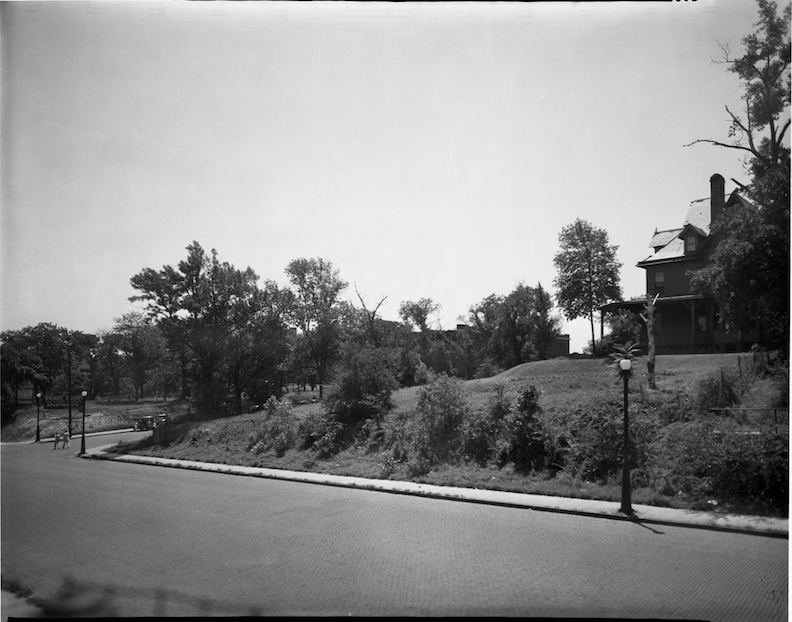
Camera faces southeast angle. Upper right house was the estate of the James Woolworth family, at 2211 St. Mary’s Avenue. The corner in the distance is Twenty-second and St. Mary’s Avenue. Bostwick, Louis (1868-1943) and Frohardt, Homer (1885-1972). The Durham Museum. 1938.
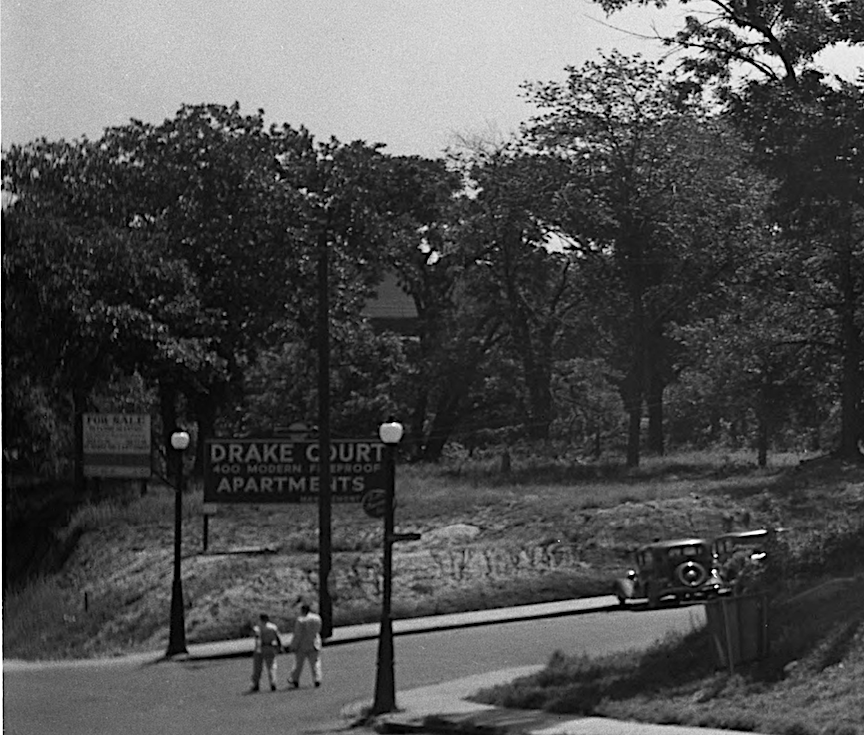
I am obsessed with this image. Let us inspect. The Crary land has both a “For Sale” sign and the Drake Court Apartments are advertising on the corner as well. The Crary lot looks hopefully dry and eroded but those trees! It looks like a park or campground. Enlargement of the previous image by Bostwick, Louis (1868-1943) and Frohardt, Homer (1885-1972). The Durham Museum. 1938.
Introducing Max I. Walker
In October 1948, the renowned Omaha dry cleaner Max I. Walker submitted a building permit for a cement block cleaning facility at 2055 St. Mary’s Avenue. The Cooper Construction Company was a builder. The address of 2155 St. Mary’s had changed, as had the appearance of the entire corner. Max I Walker was a good, solid enhancement to a block that had many nice apartment buildings filled with people who dressed up for work and parties and a good location for those driving west from their downtown jobs. In March of 1957 Bertha M. Walker filed a permit for masonry addition on the east side of the store building, observable in passing. Although no longer open to the public, Max I. Walker maintains its status on this corner as their drapery factory division.
Shown earlier in this tale but interesting to compare to the 1938 photo. Max I. Walker Cleaners store at 22nd and St. Mary’s Ave on the southeast corner. Bostwick, Louis and Frohardt, Homer. The Durham Museum. 1949.
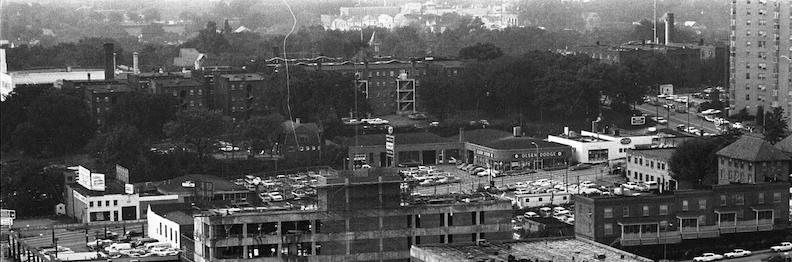
Camera faces south. St. Mary’s is seen in the distance. Twentieth to Twenty-second Streets as anchors. The Rorick Apartment building is seen on the far right hand side (west.) It looked as though the whole of St. Mary’s had become car dealership row.
Let’s bring this into view.
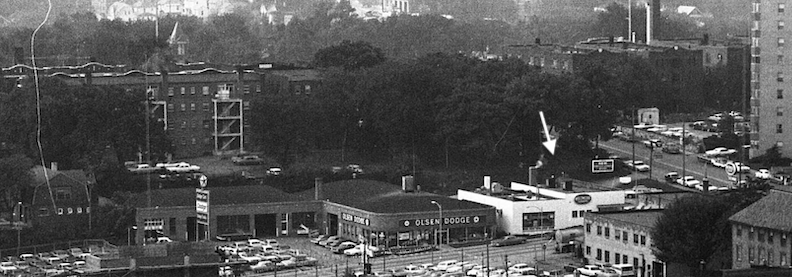
I am not sure why I love this one so much…I like the ones where Omaha is not trying so hard and either is the photographer. Caught unawares. Not exactly beautiful by anyone’s standards in 1968. This is the dirty, odd Omaha that I knew from the 1970s. Ford Dealership and Olsen Dodge car dealership. (Twenty-first and St. Mary’s Avenue). Max I. Walker with the white arrow pointing to it. The Drake Court is seen beyond the trees. The Jones Street apartments to the far right. 1968 Paskach, Robert. The Durham Museum.
There once was a wealthy older woman who lived in solitude whether by choice or circumstance, we might never know. She was tough as nails after turning her back to High Society. She cherished her birds, squirrels, flowers and trees, and her historic home. Her protection of and loyalty to her home and grounds were near unheard of and we observed the town encroaching against it, the roar of the city traffic and advancement. Miss Anna possibly knew all along it would be her own family that took it down, a mansion reduced to a cold underground suite of rooms for her trusted caretaker. I imagine there are many clues deep under the Max I. Walker.
In the meantime, let us not forget, St. Mary’s Avenue was and is untamable.
And there, we will draw a line and part ways for the night. Until next time…
You can keep up with my latest investigations by joining my email group. Click on “Contact” then look for “Sign me up for the Newsletter!” Enter your email address. You will get sent email updates every time I have written a new article. Also feel free to join My Omaha Obsession on Facebook.
Please share this investigation with others.
Extra special thanks to my friends who contributed to this story.
Thank you, Omaha friends.
With love,
Miss Cassette

I welcome your feedback and comments on the fascinating Crary’s Terrace Hill mansion. I would love to hear your thoughts on anything in this area. Please share your additional clues to the story in the “Comments.” Everyone would enjoy reading what you have to say, and it makes the sharing of Omaha history more fun. If you have photos that you would like to share, please make contact. You can use an anonymous smokescreen name if need be. We want to hear from you.
© Miss Cassette and myomahaobsession, 2026. Unauthorized use and/or duplication of this material without express and written permission from this site’s author and/or owner is strictly prohibited. Excerpts and links may be used, provided that full and clear credit is given to Miss Cassette and myomahaobsession with appropriate and specific direction to the original content.
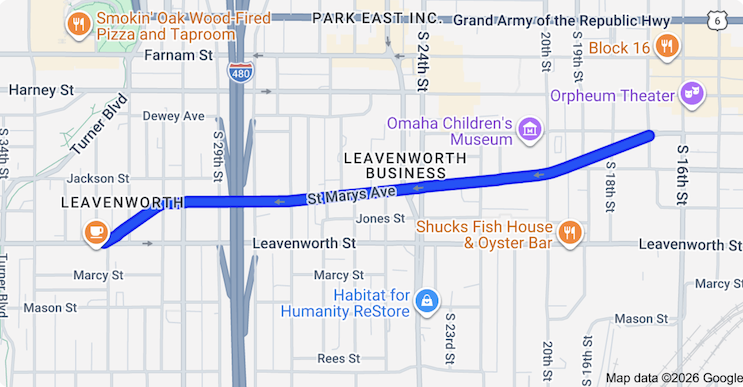
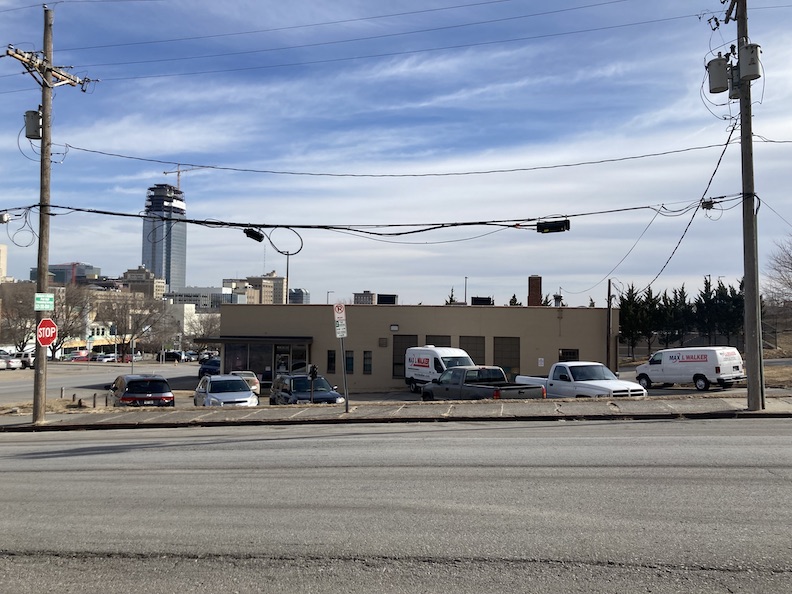
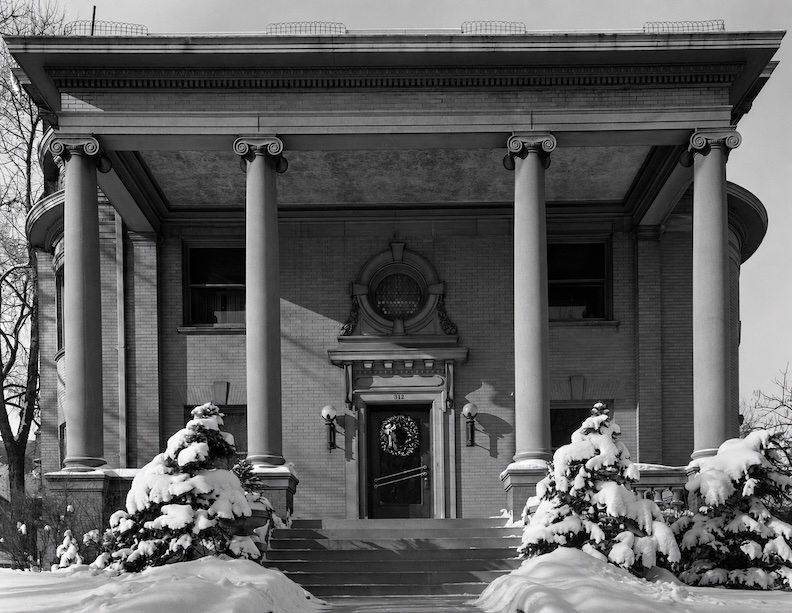
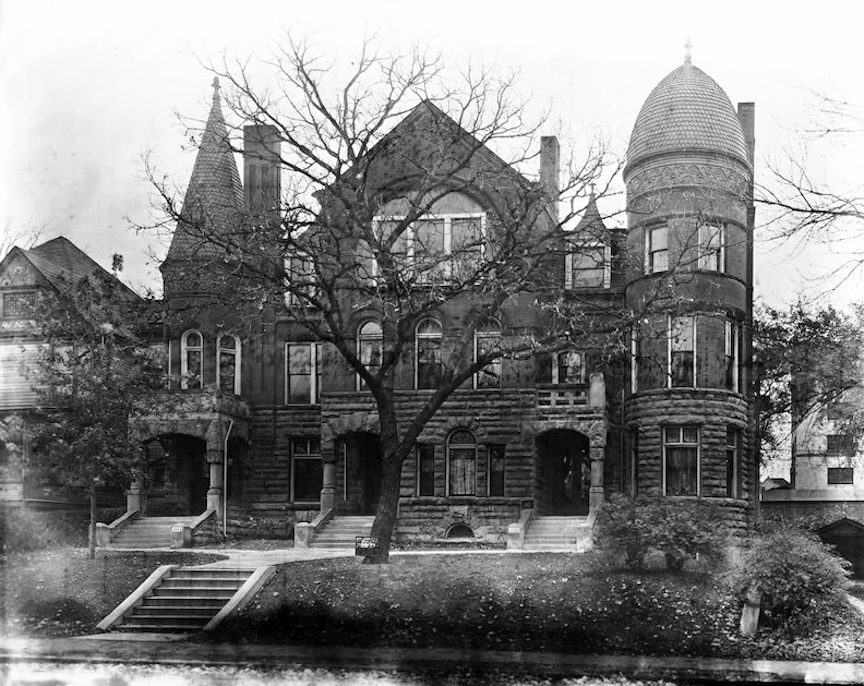
What a great story. Such misfortune that those physical artifacts of earliest Omaha are gone. History lost can never be completely understood. The physicality never experienced.
It’s interesting and strange that so many men made their fortunes in Omaha or began in Omaha, yet it takes a backseat in their lives, and eventually they leave and what they leave behind is dispensed of, abandoned, demolished. Did that happen in other cities?
The term “powder house”: A powder house (also known as a powder magazine or powder tower) is a reinforced historical structure designed to safely store large quantities of gunpowder and munitions. These buildings were typically constructed with thick stone or brick walls and located on the outskirts of towns to minimize damage in the event of an accidental explosion.
Purpose: They were built to secure unstable and combustible materials like black powder, lead balls, and flints used by local militias and the military.
Amana Colonies, IA: A unique 1870 structure used by a pharmacist to produce hog powder (livestock feed additive) rather than munitions.
Google search images and there are photos.
Thank you, Miss Cassette, for your continued investigative work to delight and informed your readers.
You make history so enlightening! I hope Omaha history teachers weave some of your work into their lessons. I really like how you reference other investigations for more reading…I am always glad to know I can read more-and I do! Take care please-you are an Omaha treasure.
Thank you much for sharing all of this history. Amy
What an amazing saga. The research you did and its results are first-rate. Thank you for this. I came to Omaha in 1962 as a college freshman at Creighton and have lived in the area ever since. I’ve knocked around in town a good bit, lived in various areas, and share your love for this fascinating city.
Is the southeast Texas town of Kountze (established 1981 as a railroad center) named for the brothers? It is located north of Beaumont on the edge of the Texas piney woods. Kountze is about 60 miles north of Sabine Pass.
Thanks for doing all of this research. The Drake Court Apartments…I remember them well. As a teen delivery driver, we had several customers there. The apartments were not yet as wild as they became, but delivery drivers, especially ones carrying cash, dislike places where you typically can’t park close and have to run a gauntlet of seedy characters.