
I was in the office when the initial letter informing of the Walter Harkert house clues was delivered by messenger. While organizing file folders, photographs and books and listening to the Enchanted Cottage from another room, I observed the courier from the window, walking the street, scrutinizing postal numbers. He eventually rapped on the office door and presented me with a large blue envelope. The letter was from one Mr. Homeowner of Omaha, informing that he and his wife owned the historic residence of Walter Harkert. Reading the letter aloud, I emitted a giggle of delight for this puzzling case of the Harkert’s Holsum Hamburgers chain had been a thrill to investigate. I distinctly recalled the gorgeous Tudor house from my research, nestled in the picturesque Country Club area, where there is no unfavorable photographic angle. I was eager to receive communication from the homeowners and potentially gain an even better view. The notion of a catalyst letter dispatched to detective offices recurs frequently in classic mysteries and parallels my experiences as an amateur detective, where unsolicited messages and even glorious packages provide enigmatic clues of concealed architecture history and hidden lives. It never ceases to give a thrill.
Mr. Homeowner wrote:
I recently discovered your book, and I am thoroughly enjoying it! I was particularly pleased to see the chapter on Walter Harkert. My wife and I purchased his former house on 55th Street in 2002. You may be pleased to learn that very little has changed since the Harkerts lived here. We are only the second owners since Mr. Harkert sold this house.
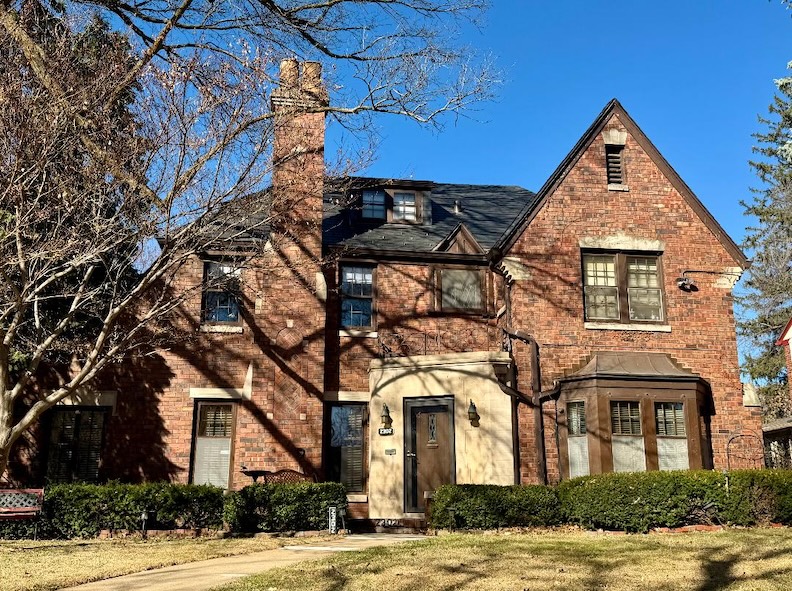
The picture perfect house that Harkert House bought at 2302 North Fifty-fifth Street.
We began a correspondence and Mr. Homeowner was agreeable to a follow up to the book’s chapter The Quest of Harkert’s Holsum Hamburgers with the wonderful interior photographs and information that he sent along. I am so grateful to him for his willingness to share an intimate insight into the Harkert family narrative, something he was not obligated to do. But first, for those who have not read the chapter in my book or for those who have long forgotten, we will engage in a brief review. Certain excerpts that follow are extracted from my book supplemented with photographs, images and annotations that could not be accommodated within the original text.
The Lore of the Soup
Up at my grandmother’s large family home, I remember infrequent mentions of a place called Harkert’s House, a restaurant known for its exceptionally good split pea and bean soups, the checkerboard exterior with stretches of stainless steel and classic white porcelain interiors. As a marginal note Father of Miss Cassette and Grandmother of Miss Cassette remain the only people I’ve known to rave about a good split pea soup. My father claims to have found an incredible bowl “just like Harkert’s secret recipe” in the Chicago area. But there was more to the family tale than just the Harkert soups. As the story goes, my Grandmother, Grandfather and Great Uncle Jimmy were out for a night on the town many moons ago. They had just sat down in a nightclub for a round of cocktails when purportedly a man came over and said, “Mr. Harkert would like to dance with this young lady.” My grandparents were not yet married and I suppose, at this juncture, I should hint at my grandmother’s petite figure, gorgeous, shapely legs and huge brown eyes rimmed with a curious smoky blue hue. Now Great Uncle Jimmy was known far and wide for his good looks, tony style of dress and great sense of humor but equally acclaimed for his bad Irish temper. They say Great Uncle Jimmy told the innocent fellow, “If Harkert had any guts he’d come over and get turned down in person instead of sending a flunky over.” To make matters worse, Jimmy told the messenger, “Beat it back and tell your gutless boss the lady isn’t ever going to be interested!”…or something to that effect. Now is that the God’s honest truth? We will never know and all parties involved have long ago passed away. Let me remind you that this particular side of the family were Irish and were known to put flesh on the bones of a story over time (even within 24 hours!) but this narrative, for what it was worth, really got me wondering about Harkert and the “nothing-fancy, but exceptionally good food” cafe my family couldn’t seem to stop talking about.
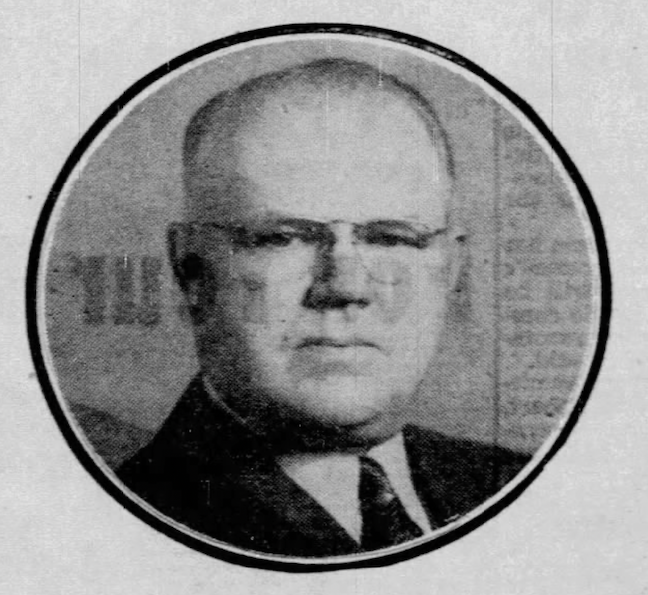
Walt Harkert as photographed in 1943, around seven years subsequent to the dance invitation.
Sidenote–The late hotel tycoon, Eugene Eppley, was said to have had a serious obsession with Harkert’s bean soup. You have no doubt noticed that many a building in Omaha bear the Gene Eppley name. By the mid-1950s, Eppley had established his empire as the largest privately managed hotel business globally at that time. At its zenith, the Eppley Hotel Company owned 22 hotels throughout six states. Eppley later sold the company to Sheraton Hotels in 1956. As for his Harkert’s fixation, Eppley referred to himself as The President of the Harkert Bean Soup Club. Apparently, he requested the recipe from Mr. Harkert and received it; nonetheless, he maintained that his hotel chefs could not replicate the original, leading him to visit Harkert’s often.
It did not take long to find that the classic, easily identified, white enameled, stainless steel “Harkert Houses” once dotted the Omaha streets with what I soon learned was the casual comfort and familiarity of a well-liked neighbor. My mind wheeled over the details. How did Omaha support these twenty-one lunch counters, some within blocks of one another? Long before the enterprising Omaha pioneer of the Quick-Lunch, Dine-For-A-Dime, One on Every Corner concept became a well-known businessman, Walter Elmer Harkert’s story actually began in a small town in Iowa where he owned a dance hall.
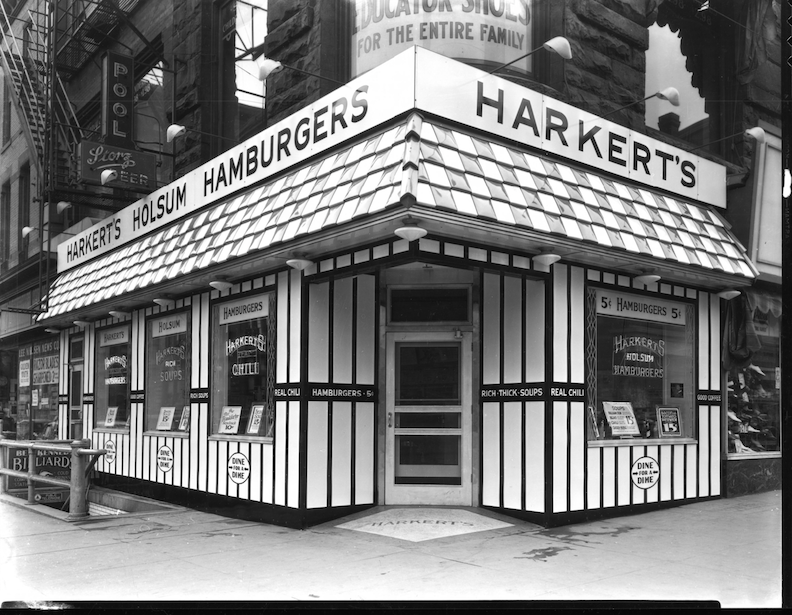
Harkert’s 101 South 16th St. Harkert’s Holsum Hamburgers. Wenworth, William. The Durham Museum. 1935. It is this location that was featured on the cover of my book for its classic, clean look and mysterious end.
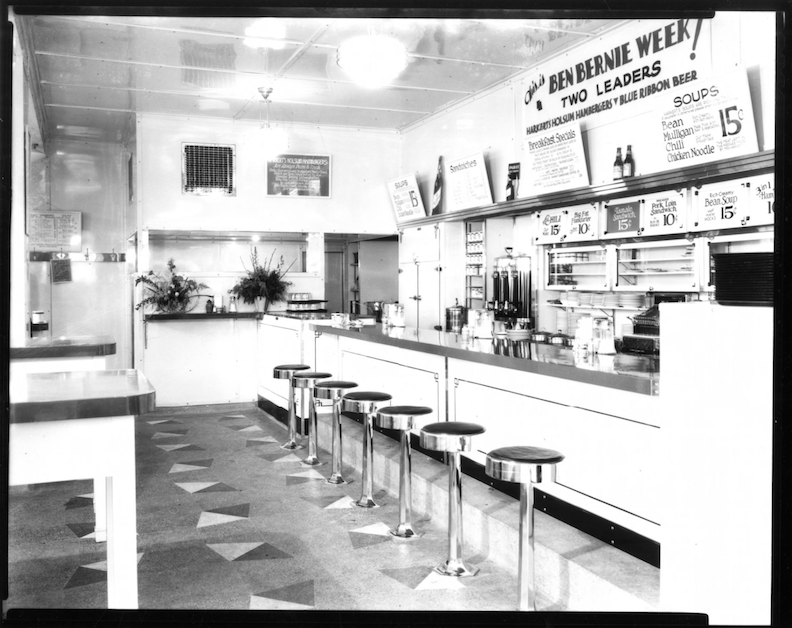
Harkert’s 101 South 16th St. An interior view of Harkert’s. Wenworth, William. The Durham Museum. 1934. If you have followed me a while, you know my obsession with linoleum and terrazzo. I believe this was terrazzo–this flooring was exceptionally modern and would have been considered stylish and pristine for its time.
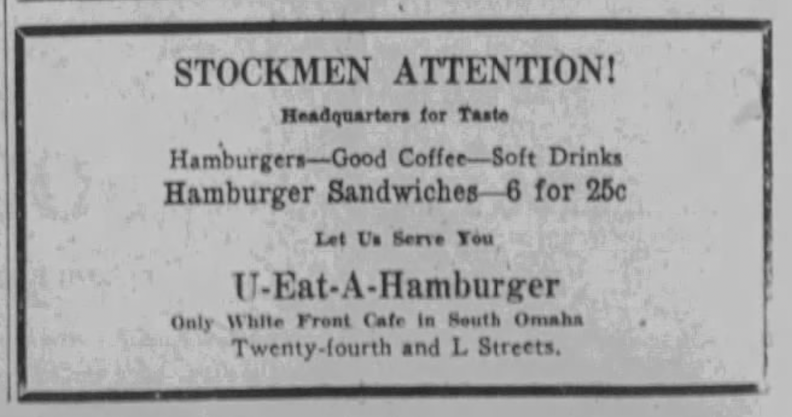
Stockman’s Journal.
It really all began in September of 1925. I uncovered Walter Harkert’s building permit for a “cement-block lunch room at 4633 South 24th Street” for a whopping $1000. This lunchroom venture is unfortunately no longer standing; I found this site currently an empty lot, adjacent to the ever-packed, Jacobo’s Grocery, where Mr. Cassette secures many a vat of divine, spicy tomatillo salsa for special nights at home. Walter would open his first restaurant on November 11, 1925 as a five-stool hamburger joint called “U Eat A Hamburger.” It really had a modern ring to it. I dreamt of making a t-shirt of the name. The menu simply offered hamburgers, coffee and soda. The cheap, delicious meal was soon a huge success. Harkert would later expound on the economics of the budget meal. Hamburgers at that time cost 16 cents a pound and one pound could produce 16 nickel hamburgers: one ounce, one cent. The bun likewise cost one cent. Pickles, mustard, etc came to half a cent. The materials cost 50 percent of the selling price and the rest went for staff, overhead, rent, and profit. Later a 10-cent hamburger would be added—a bigger bun, featuring three ounces of meat. L Street ran just south of the dissolved lunchroom location and I’m sure this busy corner made Harkert a fine profit. Each step of the way, Harkert continued to plan, conserve, and cautiously grow his business as he retained his department shoe store job. During this time, he opened three more “hole-in-the-wall” lunch stops back in Council Bluffs. He was rumored to have managed the four stores “in his spare time, sometimes traveling fifty miles in a day by streetcar, working 16 to 18 hours a day.” I was beginning to see that Harkert had his Own Obsession- the dream of a local chain of counters.
Now it would be many years later but a dear family friend, Carolyn Ireland (RIP) was able to draw a clearer picture of the first Harkert’s albeit from the 1940s. In her words, “I grew up in North Omaha in the Miller Park/Minne Lusa area and I do not remember any Harkert’s in that part of Omaha. However, during the summers of our grade-school years, my sisters and I spent a lot of time at our grandparents’ farm, which was just east of Papillion. Papillion was a very small town in the 1940s. When my Grandparents went shopping, they went to South Omaha, mainly the Phillips Department Store on South 24th St, and those trips always included lunch at the Harkert’s on South 24th. Sometimes they ate with us, other times they sent us off alone, but it was always a treat! I remember Harkert’s as a friendly, bright sunny, small place– a counter and a few booths — and, by our standards, serving delicious food. Although there must have been other items on the menu, we always ordered the same thing: a hamburger and an orange Nesbitt.”
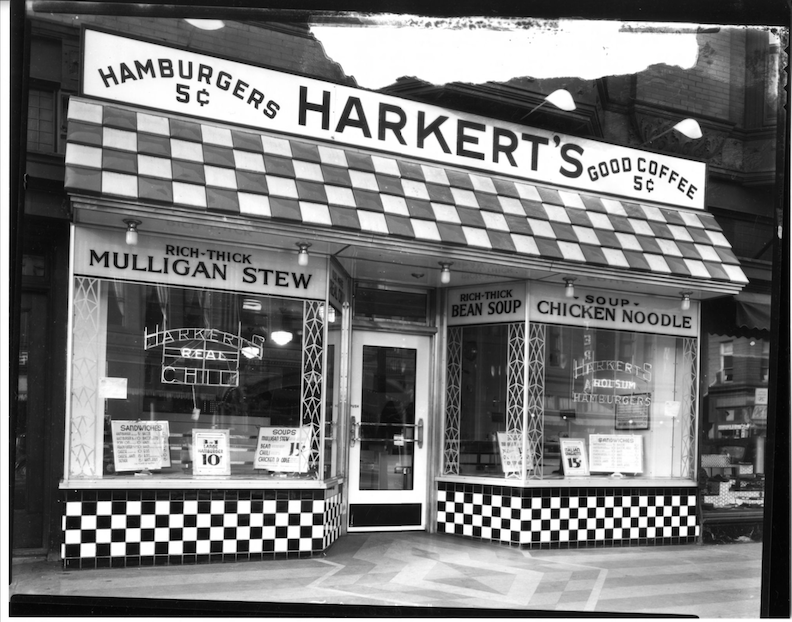
Harkert’s 4819 South 24th Street. An exterior view of Harkert’s advertising “HAMBURGERS” and “GOOD COFFEE”. “Rich Thick Bean Soup.” Wentworth, William (1892-1982). The Durham Museum. Date :1935. Note the elaborate sidewalk design of terrazzo. Just amazing. Terrazzo sidewalks in front of restaurants were a posh 1930s urban design, nodding to Art Deco and Mediterranean movement. These colorful installations were crafted to extend the refined, polished aesthetic of the indoor experience directly onto the public sidewalk, offering an opulent entrance. The care and concern to create a look for one’s patrons–that is what stuns me.
Photographic evidence revealed that Harkert moved his southside enterprise at least once. In October 23, 1936 I discovered Walt had built a new storefront at 4819 South Twenty-fourth Street for $500. William Wentworth captured the scene at 4819 South Twenty-fourth in 1935, although this photograph’s date might have been logged incorrectly. This location would have been about a two-block move into downtown proper of South Omaha. This is most likely where Carolyn experienced her lifelong impression of Harkert’s hamburger and Nesbitt delight.
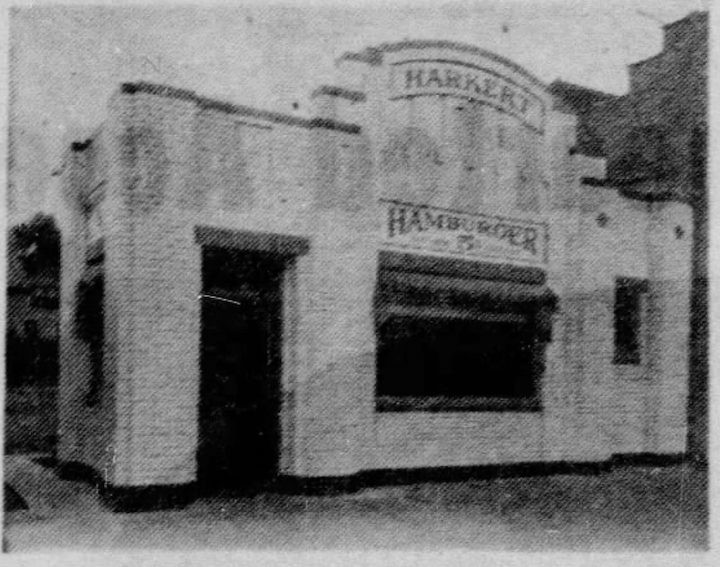
4924 Dodge Street in the Dundee neighborhood was The First of what would be rebranded as the Harkert House and later still, Harkert’s Holsum Hamburgers, previous to the starkly striped and checkered buildings. Omaha World-Herald archive.
Shortly after the book’s release, I corresponded with 89-year-old Reed Belden (RIP), who financed his education by working at Harkert’s at 49th and Dodge (featured above), the Swift Packing Plant in South Omaha, and the Phillips 66 station at 30th and Davenport. Mr. Belden attended Technical High School, Omaha U (as he called it) from 1949 to 1951, and graduated from the University of Nebraska-Lincoln in 1953 with a degree in Organic Chemistry. He went on to a lengthy and prosperous career with Allied Chemical. Mr. Belden retired from Allied in 1986, holding the position of Vice President and General Manager of the Metglas Products division. Upon not receiving a response from him, I discovered his obituary, which touched me. I have been fortunate to hear from so many older Omahans and I connect deeply with their stories–a page from our history books. When I no longer receive communication from them…I never know.
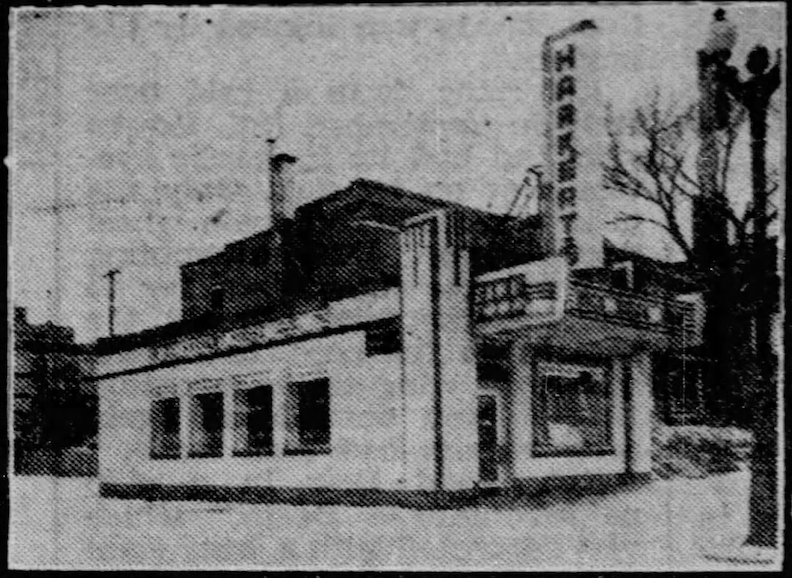
Twenty-fifth and Farnam was another great deco location before the striking branded look of the later 1930s. Omaha World-Herald archive.
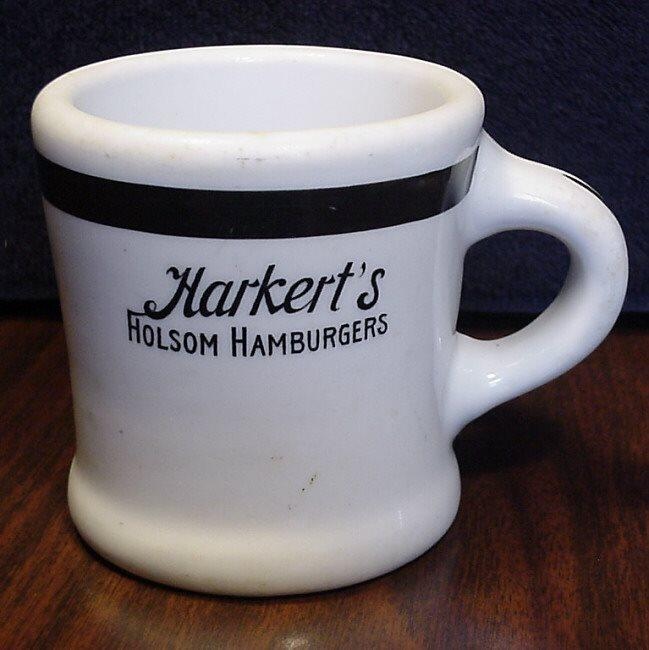
Dear friend of My Omaha Obsession, Bob Wilkerson, sent over this treasure from his incredible collection. “Here is a nice piece in my collection that I have always been proud of. I thought you would enjoy seeing it. I purchased this treasure at the old Kraft Discount on Sixteenth and Leavenworth many years ago. My hands were shaking as I made the purchase. I knew what I had.”
He had found the coveted Harkert’s cup and I was certainly jealous. I look for these frequently at used shops! If you have a Harkert’s stash, please let me know. Kind of a slip-up to spell Holsom here and Holsum elsewhere but possibly even more charming! The quintessential diner mugs of the 1930s, also known as “restaurant ware” or “Victor mugs,” are distinguished by their robust, durable design, intended to endure the demanding, everyday usage in busy American diners and cafes. Decidedly not sexy but cool as can be. I understand heavy vitrified china or porcelain were subjected to high-temperature firing to achieve this non-porosity and exceptionally strong diner products. These mugs were designed to maintain coffee temperature for extended durations, typically showcasing a white or off-white glaze with a traditional tapering “D-handle” configuration. I have a very small 1950s International House of Pancakes bowl made by the Homer Laughlin Company that I treasure. These were made to be dropped in sinks and banged around for a lifetime and I can attest–they keep on tickin’.
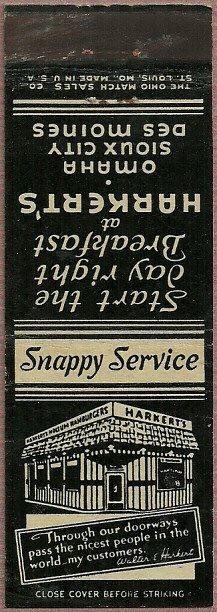
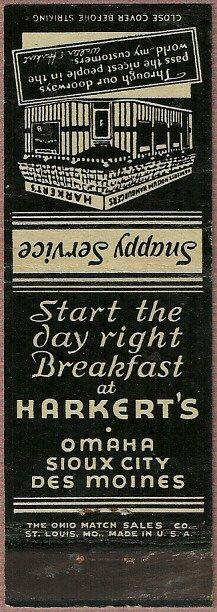
Bob Wilkerson also found these lookers in his collection. The Harkert’s attractive matchbook with Walt’s motto: “Through our doorways pass the nicest people in the world–my customers.”
If you wish to delve deeper into my extensive research on the Omaha Famous quick diner Harkert’s Holsom Hamburgers, the Harkert family and all things Harkert, please refer to my book. Let us focus on the primary purpose of our gathering: the beautiful, drool-worthy Harkert residence—this one with a peek at the Harkert specific markers!
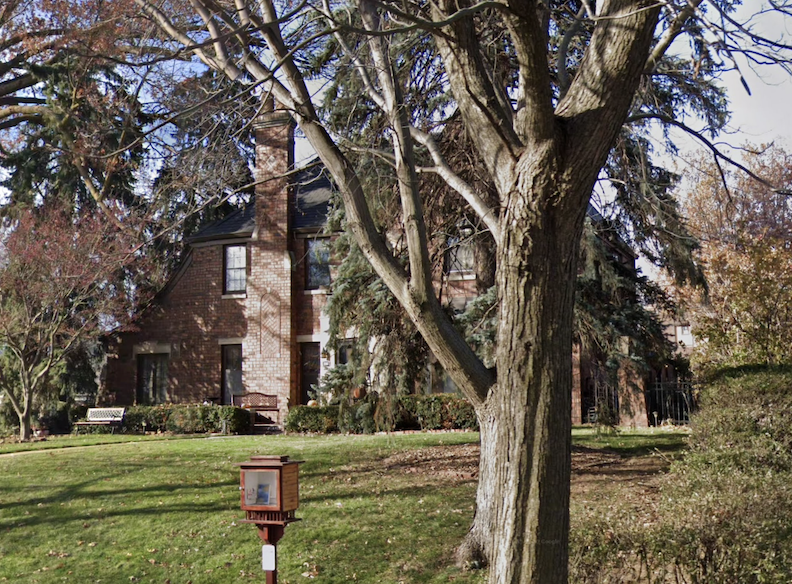
2302 North Fifty-fifth Street in the parklike setting of gorgeous Country Club. The original plans for the County Club development called for “larger than average lots” and “flowering shrubs to be planted on all the parkways.” I grew up in Benson and can assure you, this setting is among the most divine in all of Omaha.
Love Country Club and want to read more about it? Check out this deep dig investigation: Portrait of a Summer Shingle.
These short investigations are nearby:
The Little Stories: 2047 North 54th
2712 Martin Avenue
Previous to moving into 2302 North Fifty-fifth Street, the Harkert family lived in another incredible home. April 12, 1936 announced a development. “The Walter E. Harkert home at 2712 Martin Avenue has been sold to Dr. George H. Boetel, in a deal arranged by the Lippold Realty Co.” The Martin Avenue address purportedly offered “air conditioning equipment,” a modern water softening plant and a recreation room.
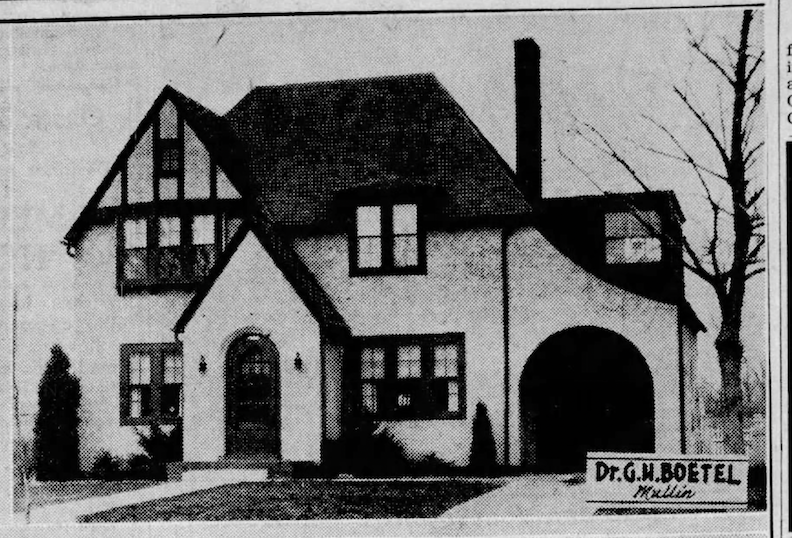
Omaha World-Herald. April of 1936. I LOVE this house. I am weak in the knees for these strong angular gabled entries coupled with a soft, arched door. So Disney. Note the integrated garage, with classic Tudor slope with fairytale arched door. Contrast the addition over the garage with the following photograph taken during the home’s initial construction. I personally like this artistic addition and I find the balance works. Put a pin in this for a bit and we’ll take it up when we review the current day photos.
2712 Martin Avenue was constructed by C. W. Martin. A building permit was issued for the frame and stucco residence at a cost of $6,000. As of January 2, 1927, the beautiful Tudor revival was listed for sale in the Florence Field neighborhood. This house was designated as a Model Home and presented by the Edward T. Slattery Company, consequently outfitted by the upscale Orchard & Wilhelm for optimal appeal. Characterized as a six-room English residence, it featured a heated attached garage, hip roof, an enchanting arched entrance, charming half timbering. The house boasted a living room fireplace crafted from walnut, complemented by quarter-sawn oak flooring. The dining room featured a Spanish arch and was also adorned with quarter-sawn oak floors. The kitchen included built-in amenities, while the breakfast room offers a built-in table and a seating nook at one end. The second floor comprised three spacious corner bedrooms finished in enamel, with birch doors stained in walnut. Additionally, there was a built-in bathroom with tiled flooring, linen closets, and a clothes chute. Clothes chutes are my personal favorite! I keep looking for the one in my house because it should be here somewhere hidden in the walls.
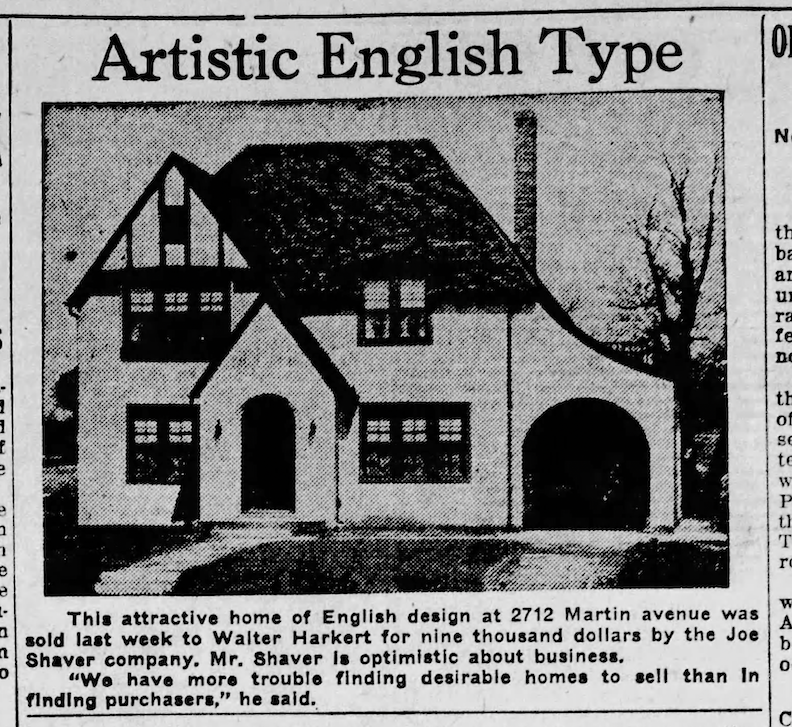
Omaha World-Herald. June of 1927.
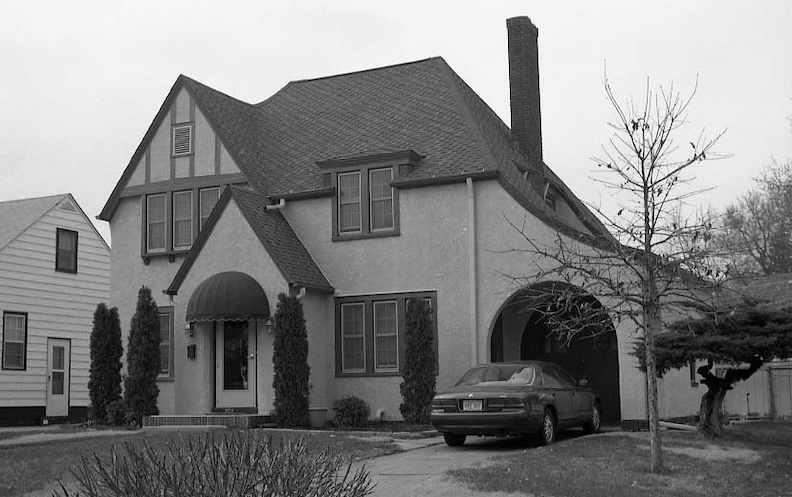
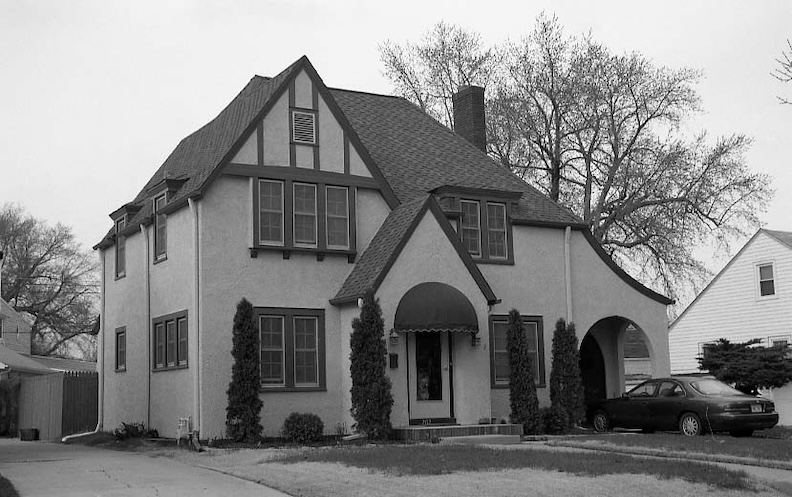
2712 Martin Avenue. These crisp black and whites are from the Historic Properties and Surveys of 2007. Note that the addition over the garage has been removed.
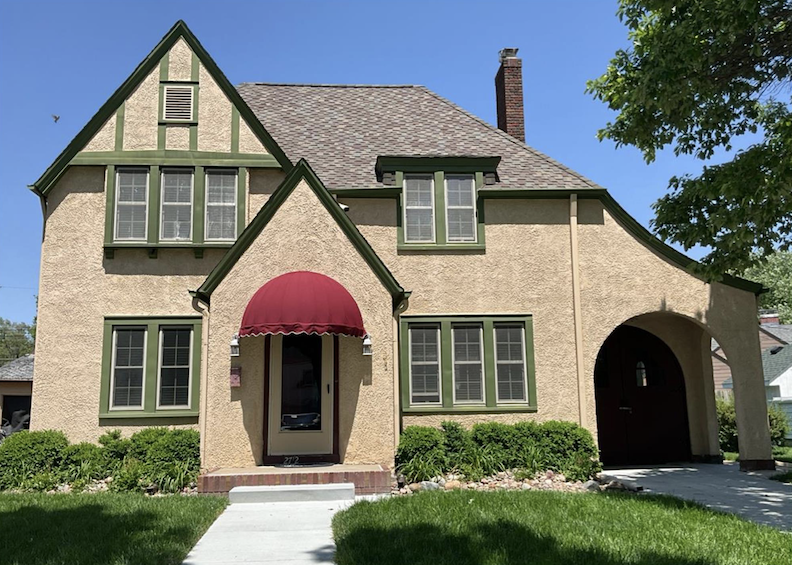
Miss 2712 Martin Avenue photo of borrowed from the Douglas County Assessor site. Photo taken in 2024 highlights the stucco façade, not easily detected in the earlier photos. Long may she reign.
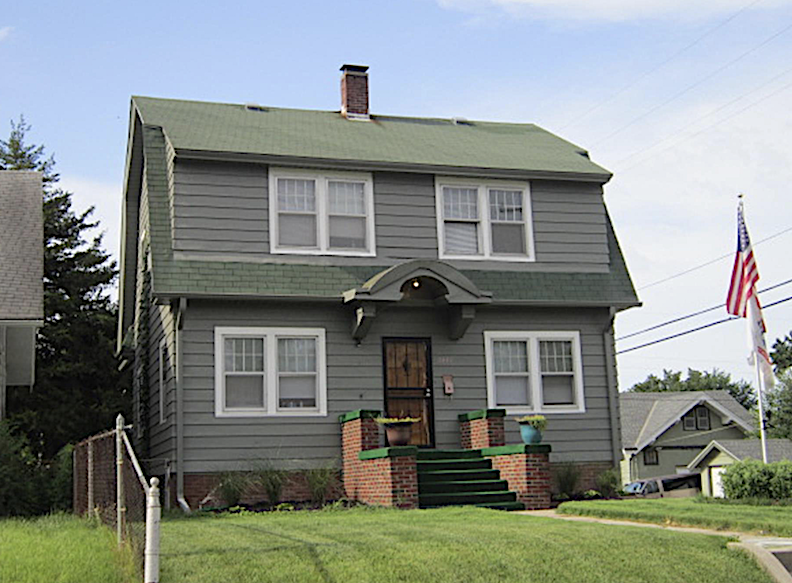
2449 Titus Avenue photograph borrowed from the Douglas County Assessor site.
This just in—after the Harkets sold their 2712 Martin Avenue home, they rented at the 2449 Titus Avenue house. Miss 2449 Titus Avenue is one of my favorite styles—this one a compact–Dutch Colonial. The gambrel roof is what I adore. Said to be “barn-like,” I see this as a very strong, practical building for our Nebraska weather. By September of 1936 the Harkerts moved directly from 2449 Titus Avenue to 2302 North Fifty-fifth Street, according to the Daily Record. Their new home was complete.
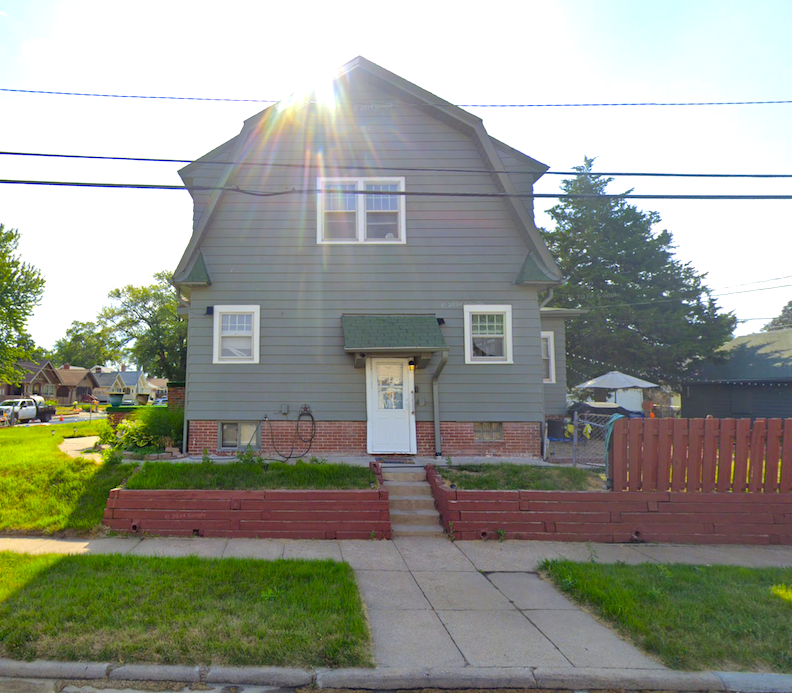
The perspective from North Twenty-fifth offers an appealing glimpse of the flared eaves and barn-like roof structure. I really like and want a home situated on a corner like this to fully appreciate its design from all angles.
2302 North Fifty-fifth Street
By August of 1936 Schroeder Realty Company were wrapping up the finishing details of a new home on the southwest corner of Fifty-fifth and Grant, constructed to the specifications of one W. E. Harkert. Both the collaborative design between new owner and the Schroeder group, as well as the cultural significance of this move to the enviable Country Club Neighborhood heralded a new era for the Harkert family. Harkert Holsum Hamburgers was now earning a solid return and had become an Omaha staple. This afforded Walter and Mercedes new social opportunities, and my detective’s sixth sense believed the move to 2302 North Fifty-fifth in Country Club symbolized the new societal ingress. The United States Censuses throughout the following years showed another change; the family would employ a full-time servant.
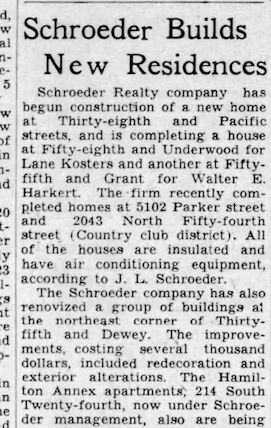
Omaha World-Herald. August 1936.
Theodore Metcalfe had begun developing the Country Club Neighborhood in the late 1920s, focused on creating a beautiful, community environment, with tree-lined streets, decorative streetlights, and picturesque homes. Country Club is roughly Fiftieth to Fifty-sixth Streets, Corby to Seward Streets, “…with dozens of homes built between 1927 and 1949 in the late 19th and 20th Century Tudor Revival styles…”
Upon examining the Country Club Historic District Association website, I observed the early, appealing illustrations included in the original sales literature. These bewitching homes of literature, coupled with the alluring pen and ink drawings would captivate any Amateur Nancy Drewer or Omaha’s Hamburger King. These drawings were frequently found in my research of historic newspapers—the rolling clouds and whimsy is phenomenal. The Country Club was emerging throughout the years the Harkerts resided in Florence Field and they were undoubtedly aware of the plans, drawings and developments. Perhaps an occasional drive-by. Here are several ink drawings that I particularly fell in love with, all from the Country Club site.
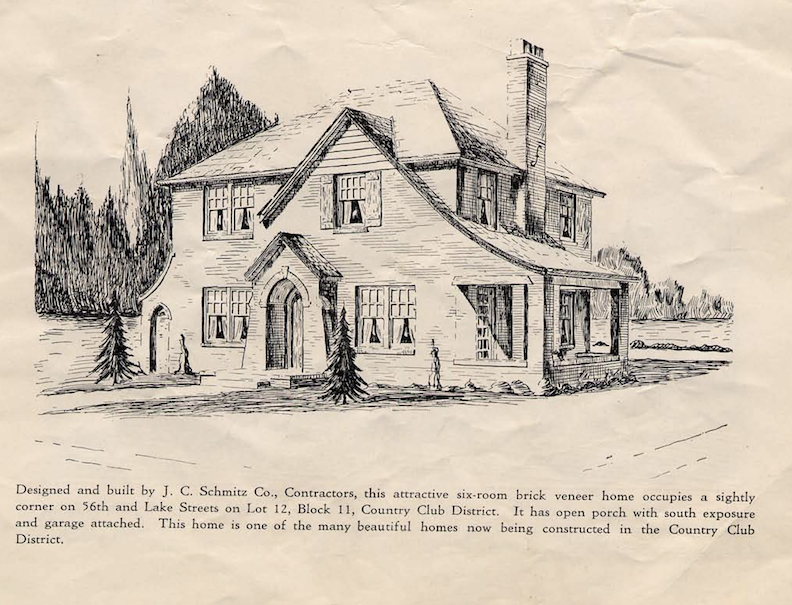
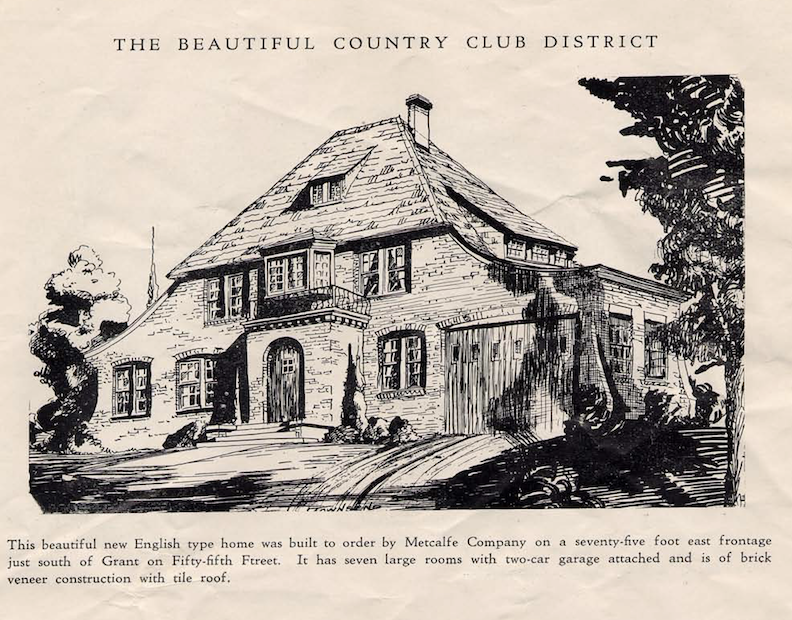
Very near the focus of our inquiry today. I believe that only gnomes should reside here.
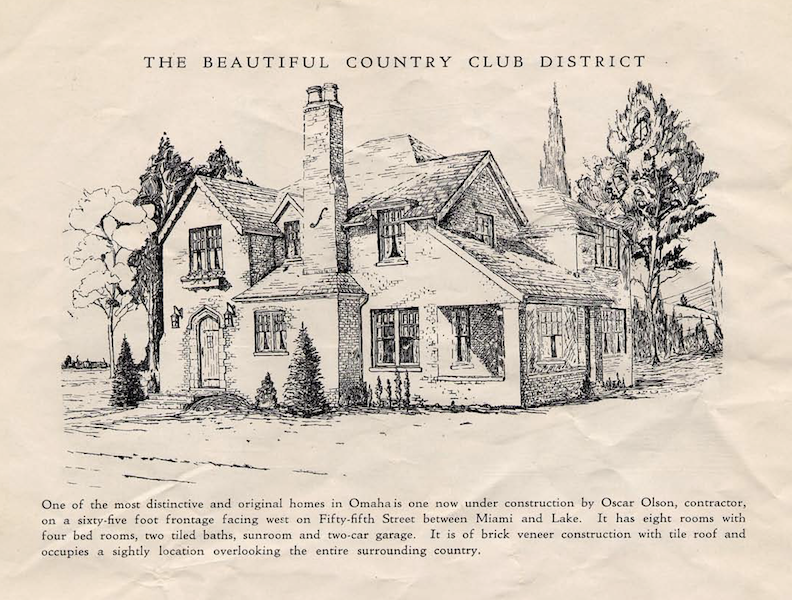
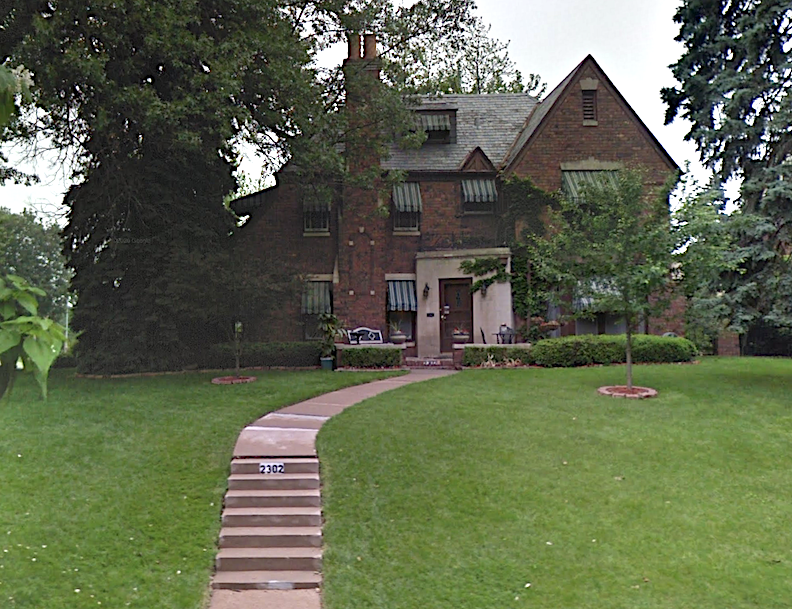
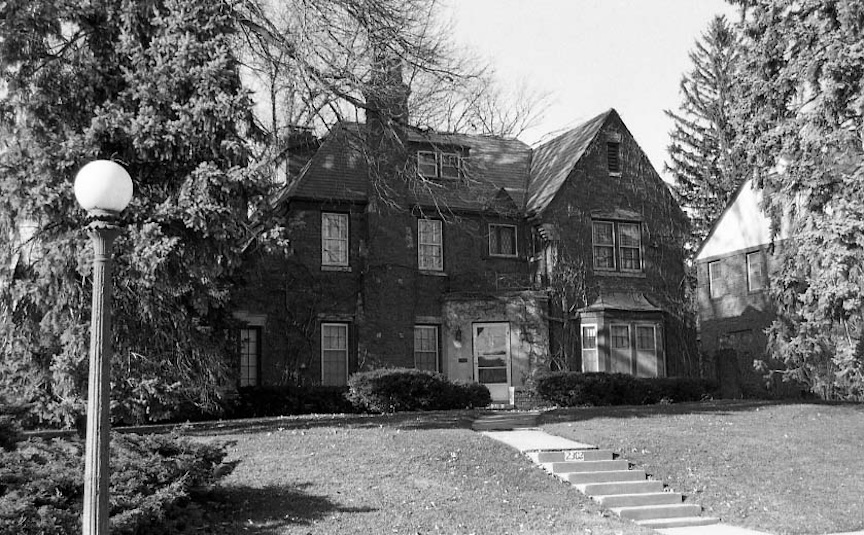
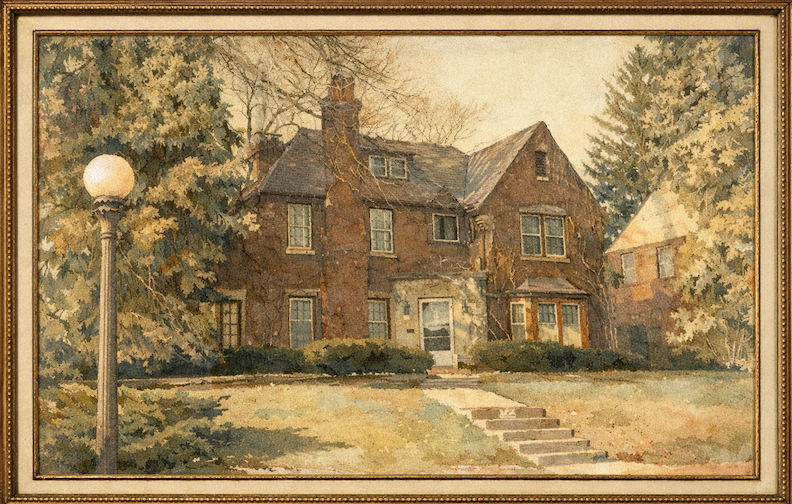
The Harkert’s larger corner lot at 2302 North Fifty-fifth, crossed over by the curvilinear Grant Street, remains a gorgeous to-die-for property to this day. An eclectic mix of European period styles, I would wager it falls predominantly in the Tudor Revival style. Its prominent chimney complete with glorious pots, solid masonry proudly announcing the front door, off-setting its informal patterned brick work, steeply pitched roof, and that perfect spying window seen from the asymmetrical front-gable, handily won my adoration upon first viewing.
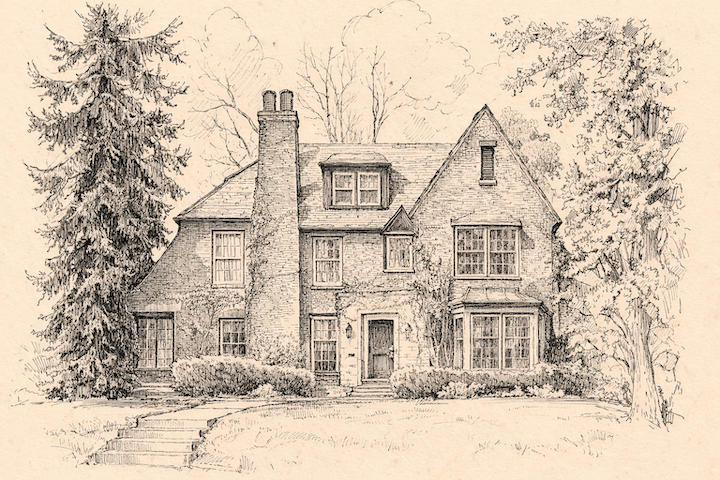
I acknowledge that the date was inappropriate, as the 2302 North Fifty-fifth residence was constructed after the initial promotion of the County Club district; nonetheless, if 2302 North Fifty-fifth had been shown in the whimsical illustrations, I envisioned its advertisement resembling this.
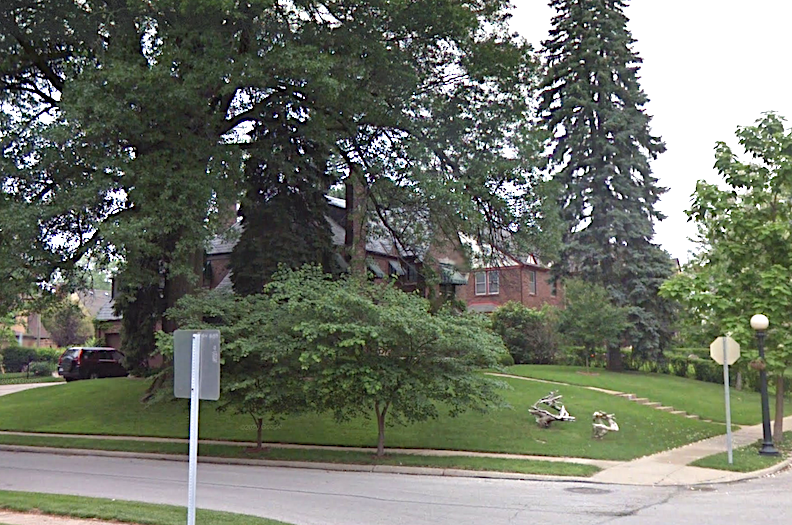
Corner lot– camera oriented at a northwest angle.
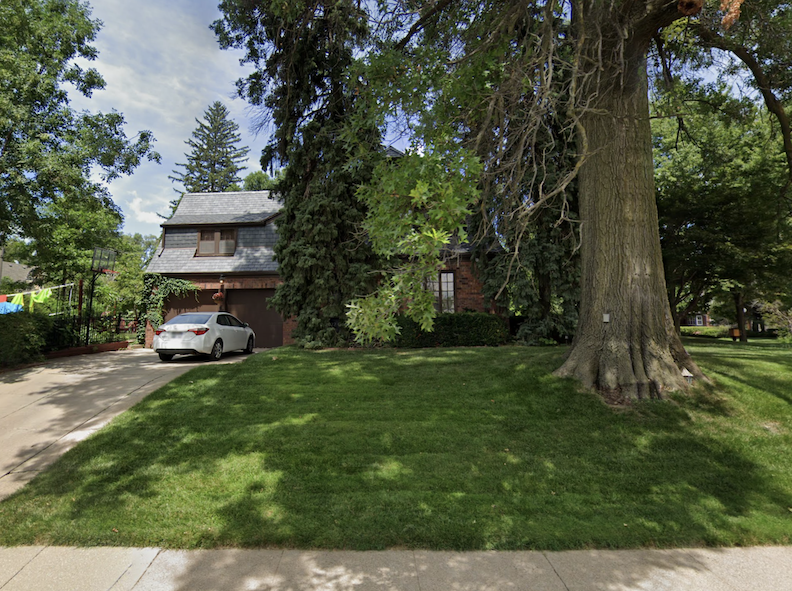
Southern elevation.
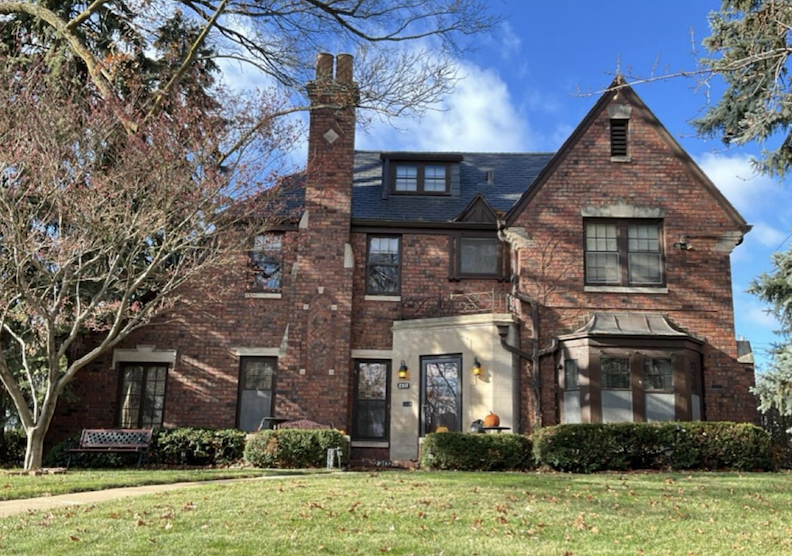
2302 North Fifty-fifth Street photograph from 2024 borrowed from the Douglas County Assessor site.
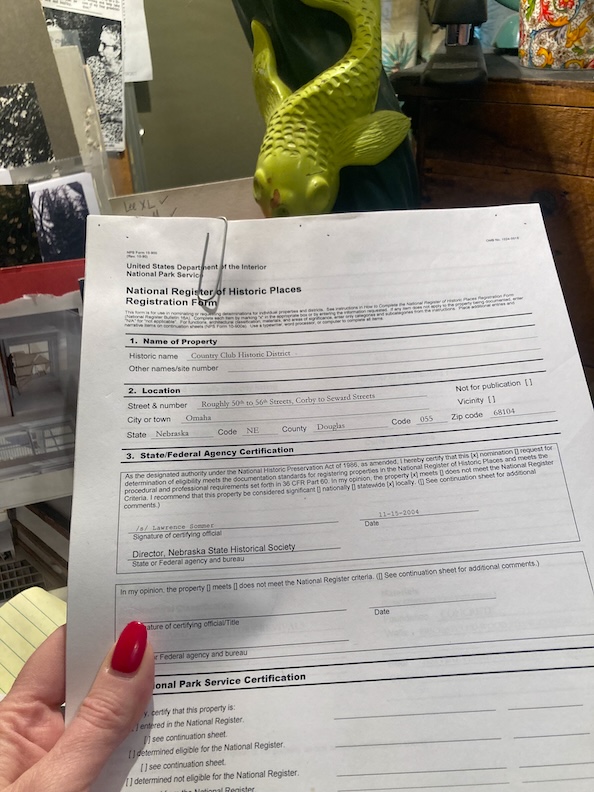
2302 North Fifty-fifth Street can also be found proudly listed in the National Register of Historic Places Registration Form, a 2004 report prepared by Lynn Meyer, Omaha Preservation Administrator of the Omaha City Planning Department, along with Geoff Tripp, Architect and Country Club resident. According to their research, the George Schroeder business was rooted in real estate development and along with Metcalfe, was responsible for the majority of original homes in the neighborhood. Early on Schroeder did not use architects, although later he would employ John Hyde, Jr. for seven homes and Reinholdt Hennig, my architect crush, for one home. The record shows that the Schroeder Investment Company, most likely without the bearing of an architect, designed the Harkert home.* I have since learned this home was builder designed.
At the time of researching my book, I was previously unaware of the information in the subsequent table, derived from building permits and city directory listings by Country Club residents Geoff Tripp and Sarah Ainscow, who undertook the research. This map indicated that numerous real estate developers in Country Club were both designers and builders. Specifically, our 2302 North Fifty-fifth was designed and constructed by Schroeder Realty Company.
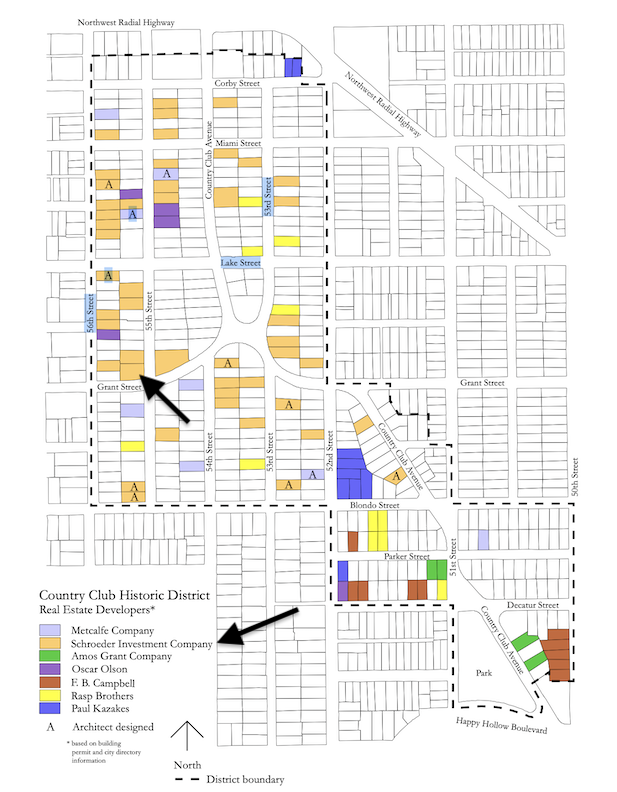
This Real Estate Developers’ map is borrowed from the Country Club Historic District Association site.
What I hope to highlight with the two black arrows is the large corner lot at 2302 North Fifty-fifth in orange, the array of orange lots on the Country Club district map, and the acknowledgement that these great homes were built by the Schroeder Investment Company.
Other Side Notes for Those Who Like to Linger
Also from the County Club Historic District files I found the Metcalfe Company purchased an additional seven acres east of North 52nd Street in 1926 and developed plans for a suburban theater and commercial buildings. The area was to be called the Country Club Plaza and designed in the Spanish Revival style, much like Kansas City’s Country Club Plaza. This part of the development never was completed.
From one of my favorite books Benson, Nebraska: From Buffalo Pasture to City 1887-1987 authored by the Benson Centennial Committee, I learned that in 1927 the Omaha Country Club (the actual private social club) at Fifty-sixth and Maple, for which the neighborhood development was named, moved into new, larger quarters three and half miles north of Benson, just east of Seventy-second Street. This north Omaha site was formerly the Arthur Brandeis farm, known as Olive Crest. The developer Theodore Metcalfe’s intention was to retain the former Country Club clubhouse building at Fifty-sixth as a venue for neighborhood meetings and events, but, a fire in 1925 that affected the roof and upper floor compromised his plan. The structure was ultimately restored and reopened; but, in the 1930s, the formerly splendid haven of Omaha’s elite was demolished.
Interiors of 2302 North Fifty-fifth Street
The World-Herald featured the new Walt Harkert house upon completion. “Harkert Home Featured by a Porcelain Kitchen” claimed to be “the most complete home in Omaha,” phrasing which delighted Miss Cassette, although I promise I did not understand what that could possibly mean. But after poring over the following, it did appear there were a number of features unique to the new house at 2302 North Fifty-fifth Street, especially considering the financial downturn of most of America in 1936. “One of the features is the kitchen, finished in white porcelain and stainless metal. The porcelain manufacturers say there is no other like it in a private home anywhere. Another is the smooth terrazzo floor in the amusement room in the basement. Both of these ideas were borrowed from the chain of restaurants operated by Mr. Harkert. The stainless kitchen sink is seven feet long. Marble steps, once in another building, lead to the basement from the first floor.” I was quite impressed with the fortuitous repurposing of those marble steps and couldn’t help but wonder what building they were from originally.
Also for those who have followed me a while, you might remember my obsession with basement rumpus rooms! The Harkerts’ version was labeled an amusement room and featured terrazzo, not linoleum. My word.
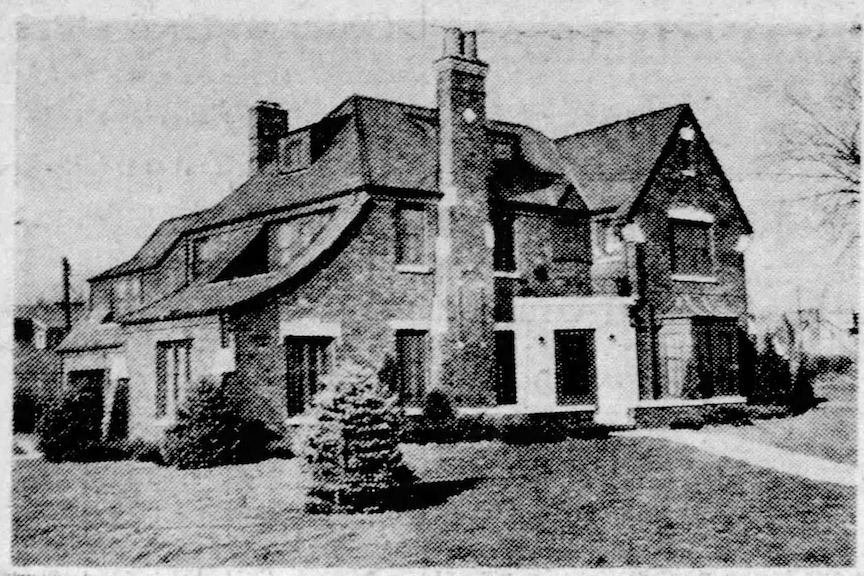
The Omaha World-Herald, on November 8, 1936, presented a fresh and appealing perspective on 2302 North Fifty-fifth, a residence whose distinctive features would gradually get obscured over time. A bit hidden will always be my preference, however the southern elevation all lit up on stage is quite intriguing.
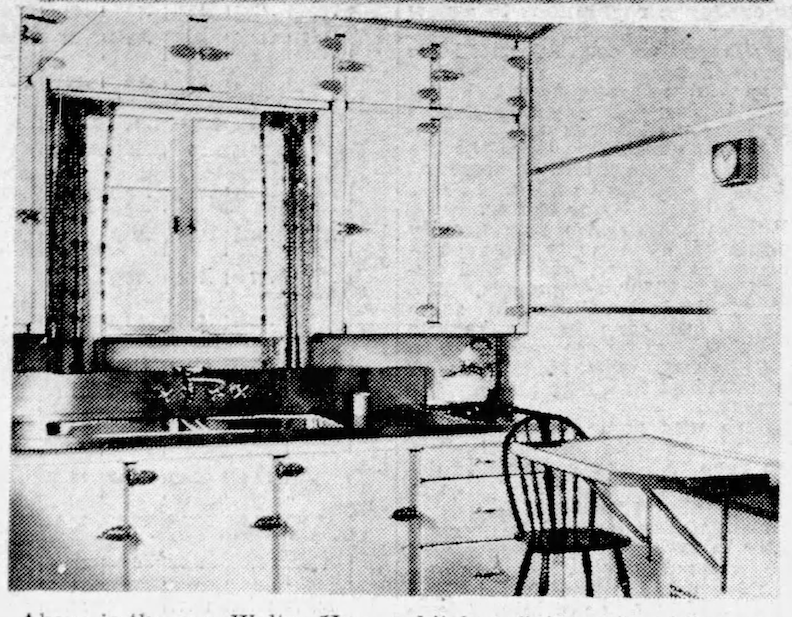
Another fetching photograph was of the Harkert kitchen, where it was “finished in white porcelain and stainless metal. The porcelain manufacturers say there is no other like it in a private home anywhere.” Omaha World-Herald. 1936.
The kitchen is one of the first things that the Homeowner family lit on and shared photos with me. Mr. Homeowner expressed their view: “We have always appreciated the history of this house and tried to make as few changes as possible.” I had to sit down and fan myself. These are the breathtaking string of words we who are gathered here today strive to hear. The “porcelain kitchen remains original, with the original seven foot sink,” with a bathroom adjacent to it, cabinets located in the breakfast room, and an entrance hall.
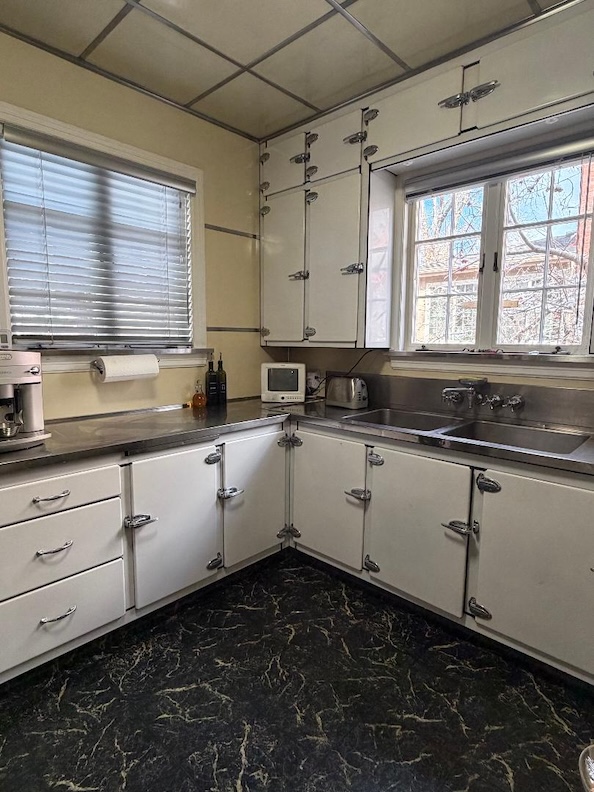
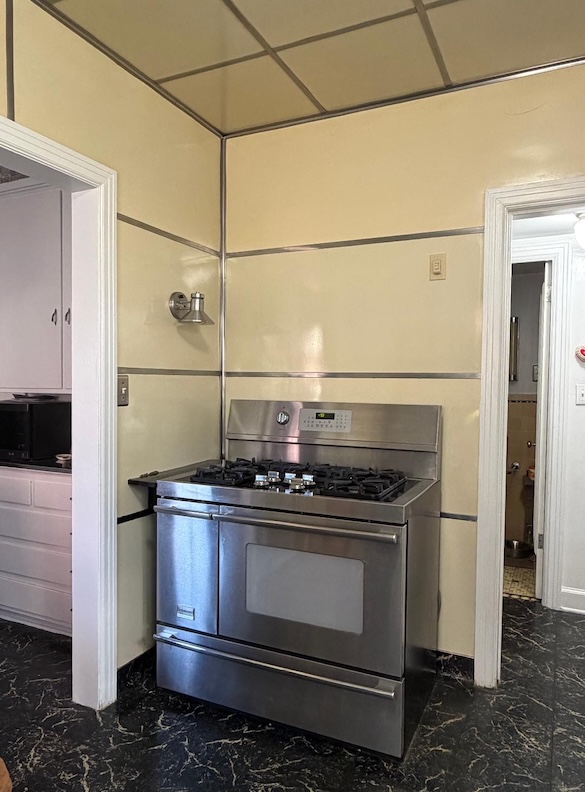
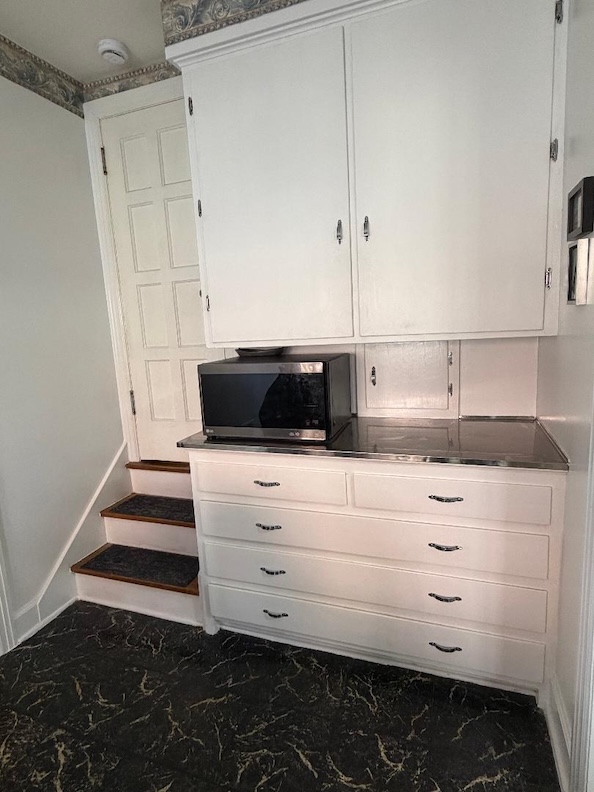
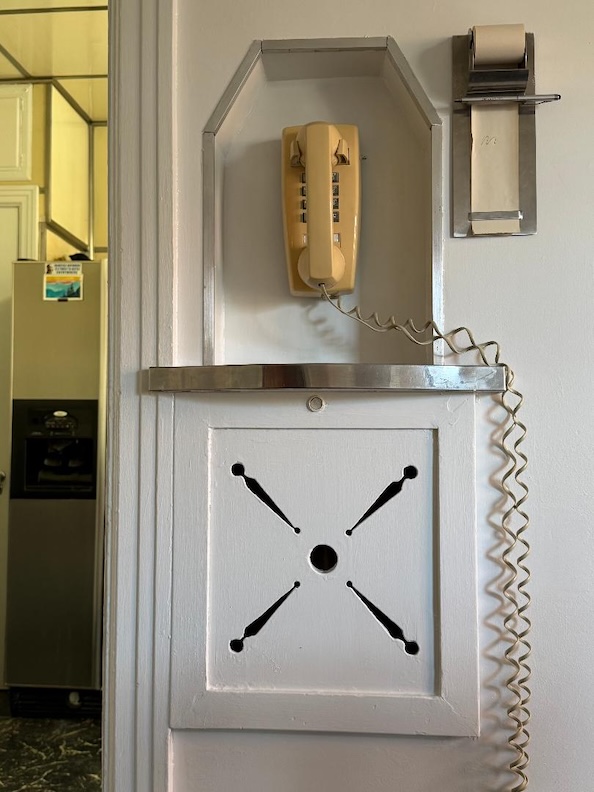
Mr. Homeowner wrote: “A shot of the breakfast room phone niche showing the round button that rings a buzzer in the maid’s quarters, which is our guest room. I still use it to wake house guests.” Now that is funny. We used to have a servant’s buzzer at my old apartment. I could lay in bed and buzz my roommate in his back servant bedroom off the kitchen. It was loads of fun late at night if he had a guest. Also I would find myself writing many more notes to self if I had this fetching metal rolling notepad. That is worthy of a whole afternoon of gazing.
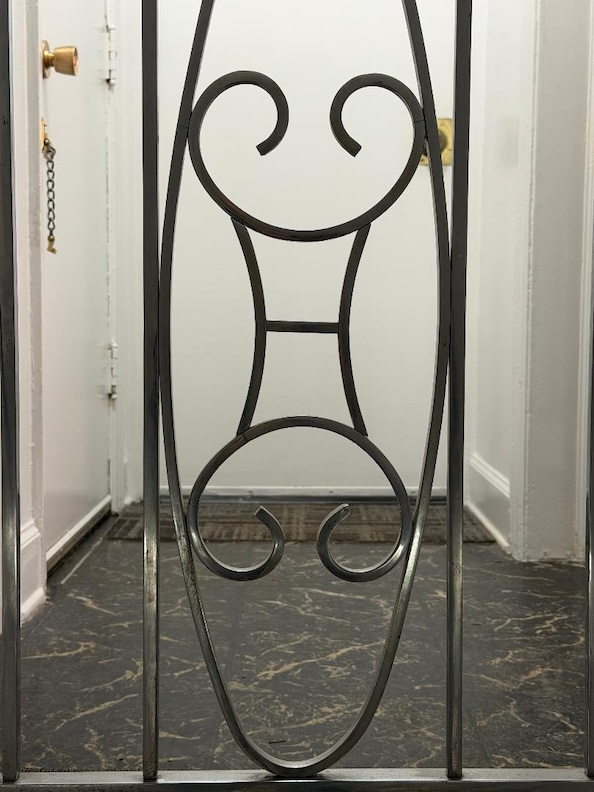
The phone nook, the ironwork “H” for Harkert near the entrance hall, and the porcelain kitchen with stainless metal girding remain unblemished by time. I experienced vertigo. What an exhilarating thrill this was for a purist heart. It has long been my bitter complaint that individuals feel compelled to destroy original kitchens and bathrooms in pursuit of fads and trivial fancies.
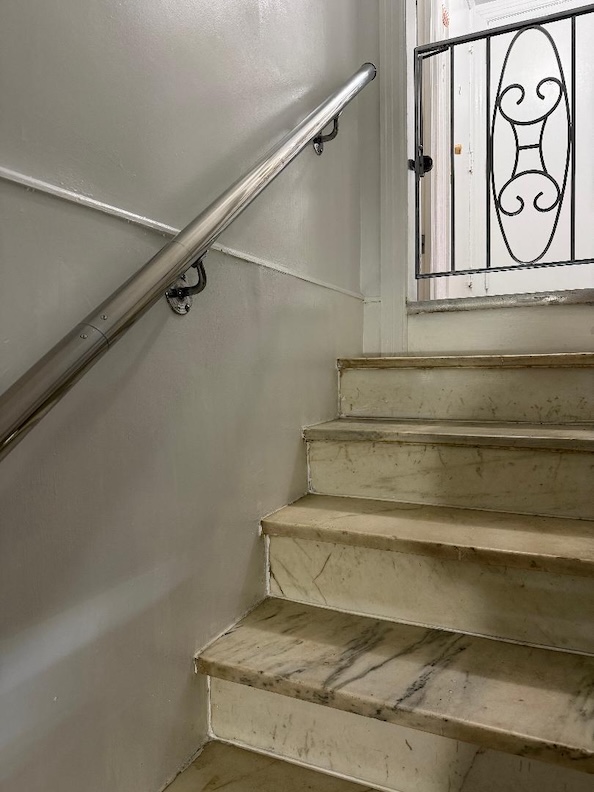
“The marble staircase from the basement showing the custom gate with an ‘H’ at the center.” I was especially excited to see these “marble steps, once in another building, lead to the basement from the first floor.” Still wondering what building they were from originally. The Case of the Mystery Marble Stairs. I’ve only seen such things in photographs.
Also from the World-Herald article, an excerpt from the book: “The house includes ten rooms, four and one half baths. One fireplace is in the basement, another in the living room and a third in the sitting room on the second floor. Downstairs walls are done white and the gum woodwork is stained a chestnut shade, with which carpets and drapes are in harmony. The living room is illuminated solely by sidelights. The main bathroom, orchid and tan, is finished in colored tiles with fixtures to match. The bedroom of Dale, 12, is decorated in a transportation theme, that of Jane, 10, has a ceiling of stars. The house has a circulating water softener. All concealed piping is of copper. The insulation is accomplished with 4,400 square feet of four-inch rock wool. It is air-conditioned and has a gas furnace. To meet any possible future demand, extra heavy wiring is used in the electrical system. There are no unfinished places in the house. The garage is a foot wider and a foot longer than the average.” My oath, Sherlock! This sounded more than acceptable, in any decade.
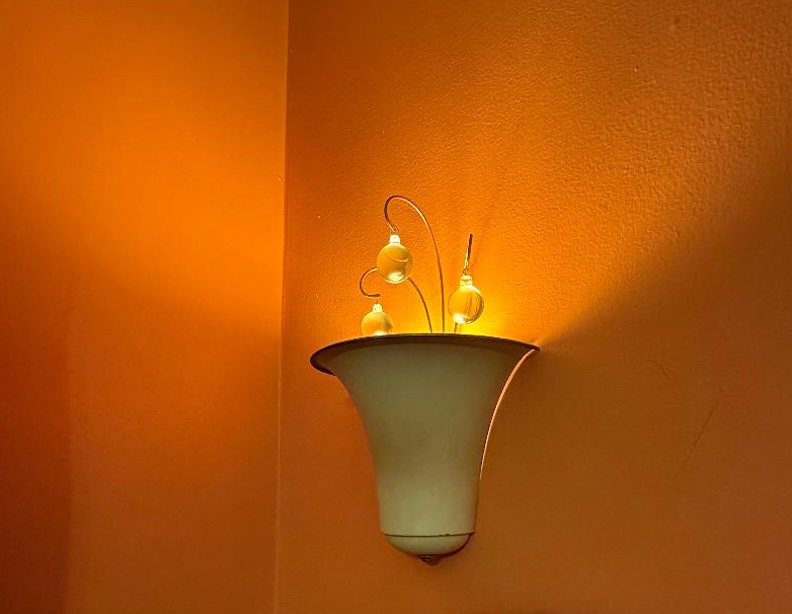
“The living room is illuminated solely by sidelights,” the newspaper reported. This is one of the wall sconces and it appear very futuristic deco. Mr. Homeowner wrote, “The living room is still only lit with side lights. We still have the original sconces.”
The Homeowner family acquired the Harkert residence in 2002. The previous owner claimed that the wall sconces were original. The owner bought the home directly from Mr. Harkert, hence the assumption she possessed the requisite knowledge to make these claims. Mr. Homeowner said they possessed certain documents on the residence that Mr. Harkert provided to the previous owner, who then gave them to the newest Homeowner couple. Mr. Homeowner said he would attempt to locate these papers that included original blueprints drawn up by the Schroeder company. Bated breath, I whisper to the heavens.
I was delighted to hear that all of the bathrooms were kept original to the Harkert vision.
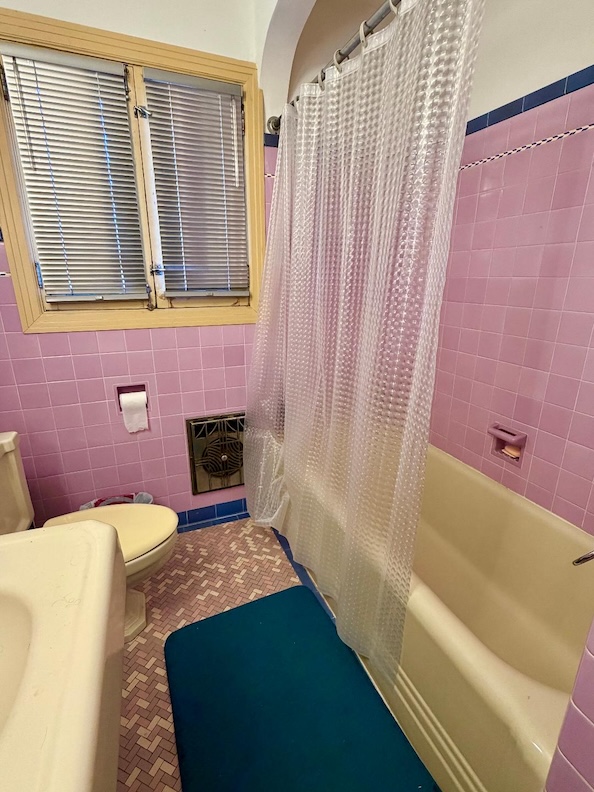
“The main bathroom, orchid and tan, is finished in colored tiles with fixtures to match.” Pale yellow porcelain bathroom fixtures from the 1930s, commonly referred to as “Ivory” or “Old Ivory,” were a favored and “cheerful” selection during the Art Deco period, typically complemented by black or green tiled accents. This orchid and blue tile combination with peach-tan floor tile was quite unusual and just amazing. Manufacturers such as Kohler, Standard, and Crane made these smooth, creamy yellow shade for sinks, toilets, and bathtubs. “Old Ivory” (a pale, creamy yellow) was the predominant favorite of the tie, frequently exhibiting a softer or more subdued quality compared to the vibrant yellows of the late 1950s. Common fixtures were pedestal sinks, built-in bathtubs, and high-tank or early close-coupled toilets, typically made of glossy, durable porcelain-enameled cast iron.
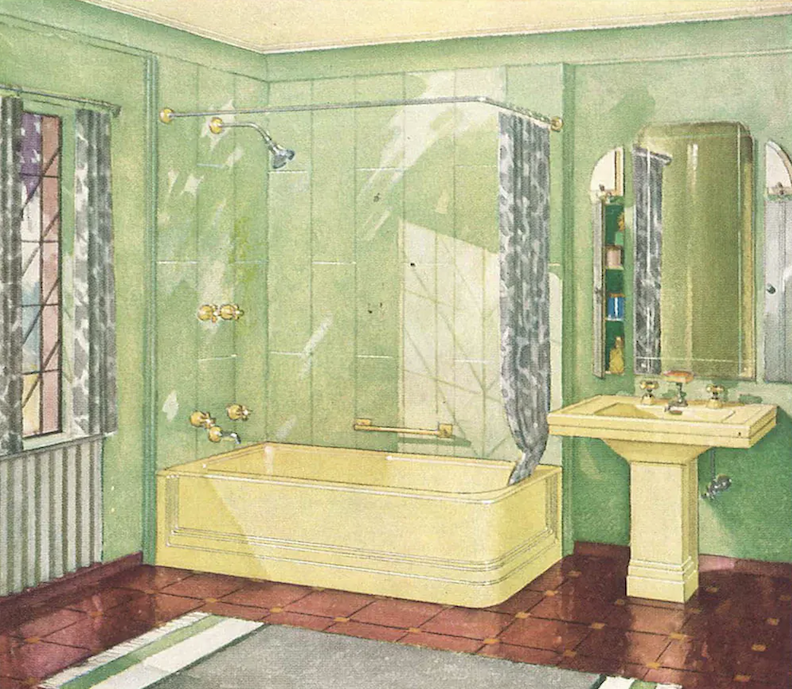
Kate over at Retro Renovation found this great 1930s illustration from an American Standard advertisement called ‘Ivorie de Medici,’ oddly a true pale yellow. Another wild color scheme by today’s standards but I find this drawing glossy and dreamlike.
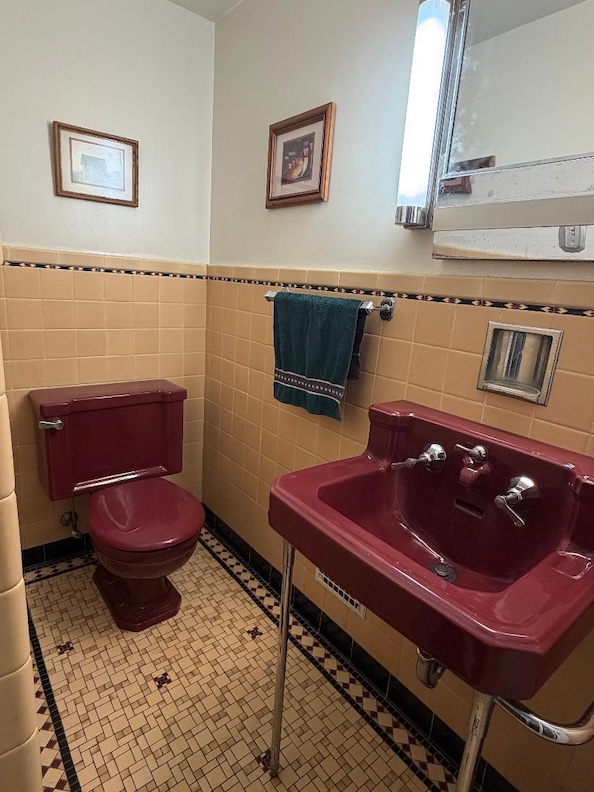
Another one of the four and a half baths–a wonderful time capsule.
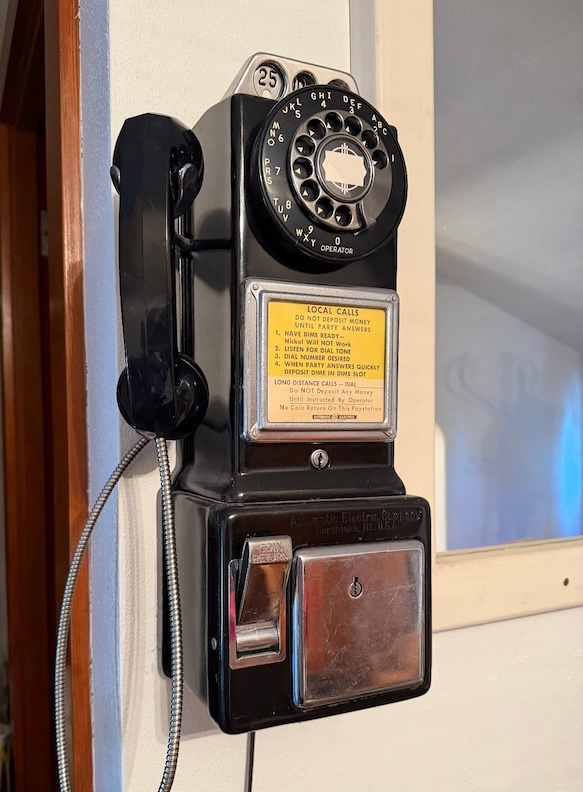
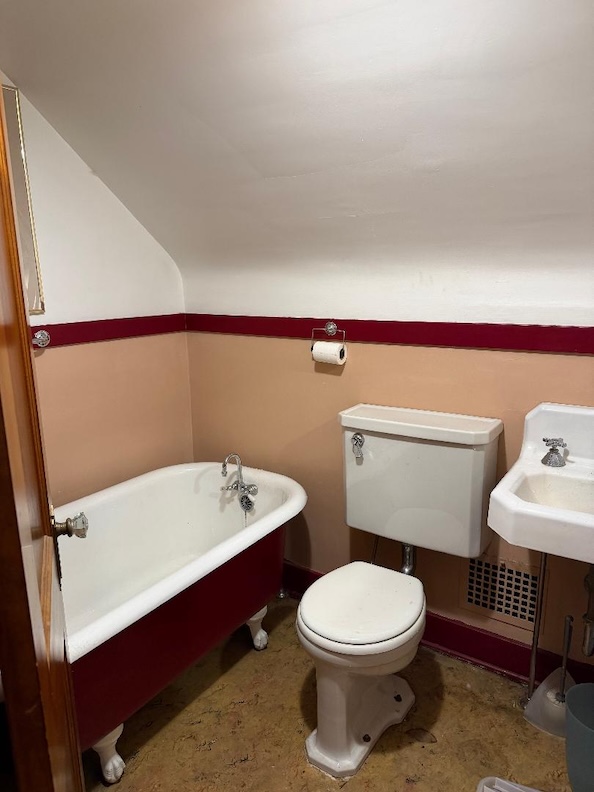
“The payphone in third floor maid’s room. The Harkert’s house had three separate phone lines. The bathroom in third floor maid’s room was rather plain compared to the other bathrooms! Note lack of beautiful tile work in the maid’s bathroom!” I found this no-frills servant bathroom with its linoleum floor a mirror reflection of the bathroom in my grandmother’s family home. There existed a poorly lit, stripped down bathroom nearly identical to this one, situated adjacent to the children’s bathroom for family members, that had elaborate tile work, ample features and a large window. The contrast was stark and illuminated a time that I never knew.
But what of this payphone and the three separate phone lines? Presumably a parents’ line, a teen line and a servant line? Or family line, business line, servant line? A payphone in the servants’ quarters is pretty stone cold, if I do say.
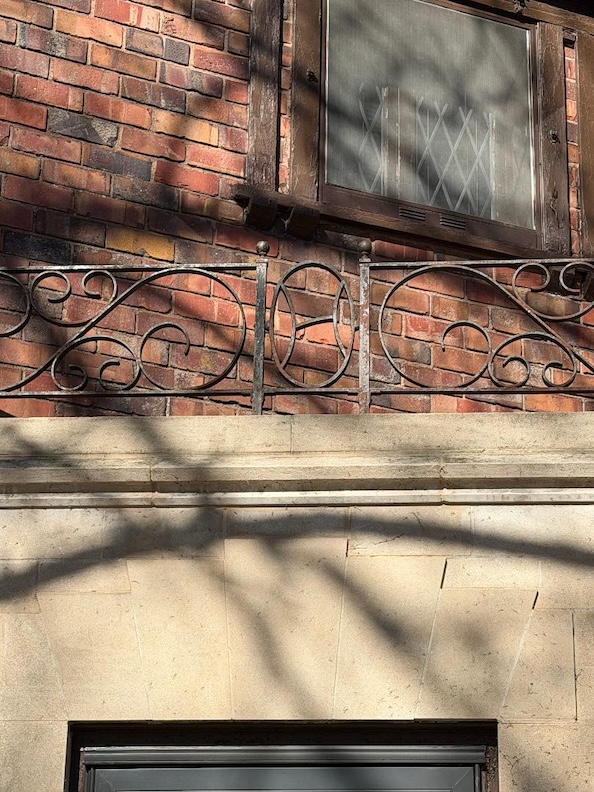
The elegant stone entrance is adorned with ironwork displaying the letter “H” for Harkert.
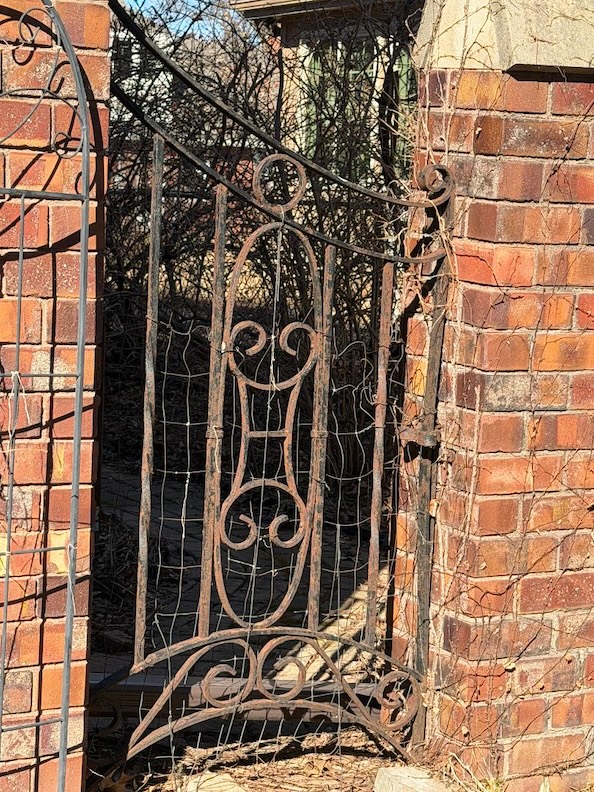
Gorgeous gate with the “H”.
I wish to express gratitude and admiration to Mr. Homeowner for generously sharing their private photos and perspectives on the remarkable Harkert house and for being exemplary stewards of 2302 North Fifty-fifth Street. A delicate role, the task of temporary caretaker can be challenging for those aspiring to manage a historic residence by tearing down walls and creating an open floor plan. Valuing and cherishing original materials—preserving the positive aspects of 2302 North Fifty-fifth while maintaining the home’s historical integrity requires a discerning, loving eye and measured restraint. We salute you.
Also a round of applause for the Country Club Neighborhood on their 100th year birthday this year. Beautiful, beautiful work!! Thank you neighbors.
I leave you with these Historic Properties and Surveys photographs from the Reconnaissance Survey of 2002. Oh yes, to die for.
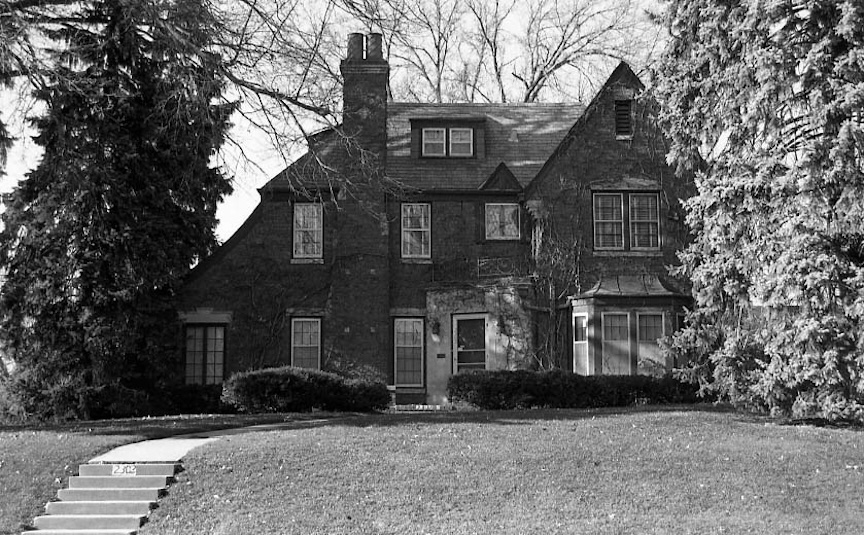
“You have just heard the My Omaha Obsession Architectural Crush Show. Tune in next time for another story or maybe even a deep dig investigation! We are located in Omaha, Nebraska with a studio right around the corner from you. MOO operated on a frequency of 1460 kilocycles under the authority of the Federal Communications Commission. Thank you to all who gathered here this evening. This is Miss Cassette saying goodnight!”
Accept no substitutes. Check back often for the real deal. The Real In-depth Deal. You can keep up with my latest investigations by joining my email group. Click on “Contact” then look for “Sign me up for the Newsletter!” Enter your email address. You will get sent email updates every time I have written a new article. Also feel free to join My Omaha Obsession on Facebook.
Please share this investigation with others.
Extra special thanks to my friends who contributed to this story, two of whom have passed since the original was released. Thank you for your gifts, Omaha.
With love,
Miss Cassette
If you are looking for more architectural and Omaha history sleuthing fun, ask your local or bigbox bookseller for my book: My Omaha Obsession: Searching for the City. Also available everywhere online. Thank you.
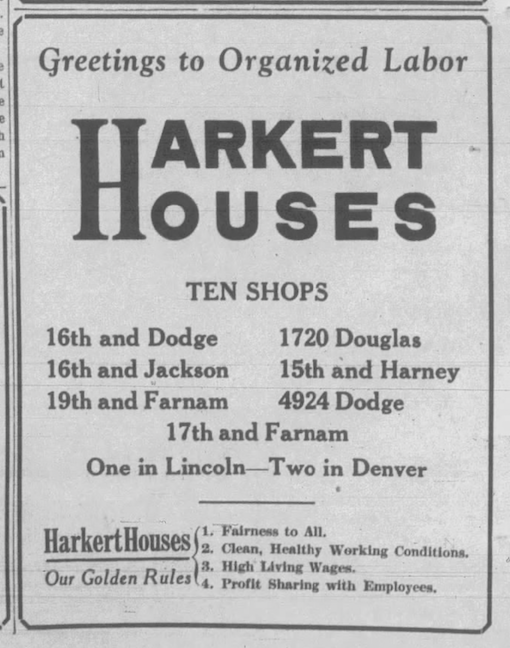
The Unionist. 1936.
I welcome your feedback and comments on the fascinating Walt Harkert family, the Country Club neighborhood, 2302 North Fifty-fifth, original bathrooms, the difficulty and joy of loving an older home. I would love to hear your thoughts on anything in this area. Please share your additional clues to the story in the “Comments.” Everyone would enjoy reading what you have to say, and it makes the sharing of Omaha history more fun. If you have photos that you would like to share, please make contact. You can use an anonymous smokescreen name if need be. We want to hear from you.
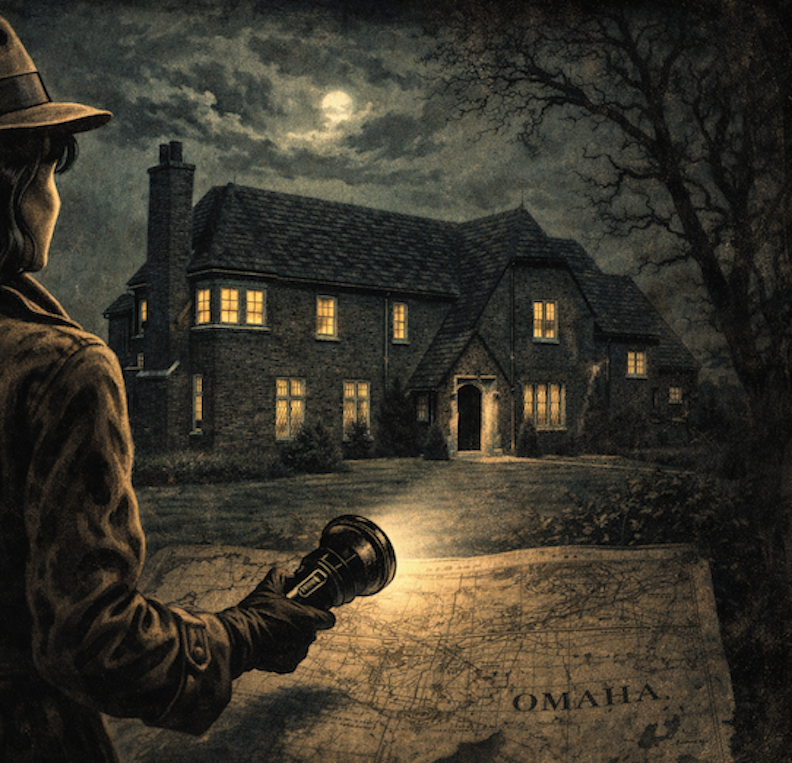
The magnificent Clarence L. Landen residence at 9211 Capitol Avenue (RIP) exemplifies my preferred architectural style. Standing, old, dignified and dream worthy—exactly the type of house that is often demolished in this town.
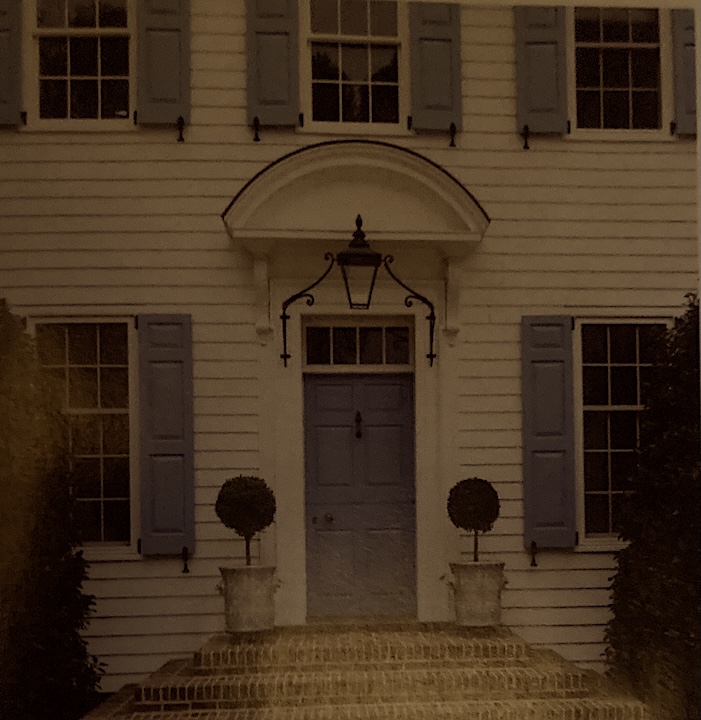
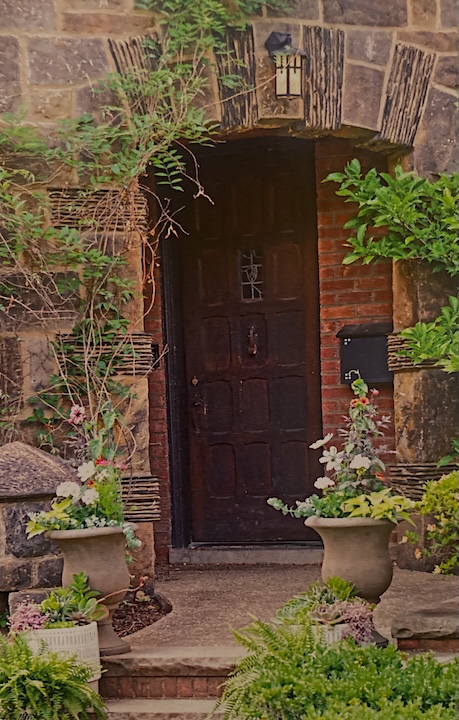
© Miss Cassette and myomahaobsession, 2026. Unauthorized use and/or duplication of this material without express and written permission from this site’s author and/or owner is strictly prohibited. Excerpts and links may be used, provided that full and clear credit is given to Miss Cassette and myomahaobsession with appropriate and specific direction to the original content.
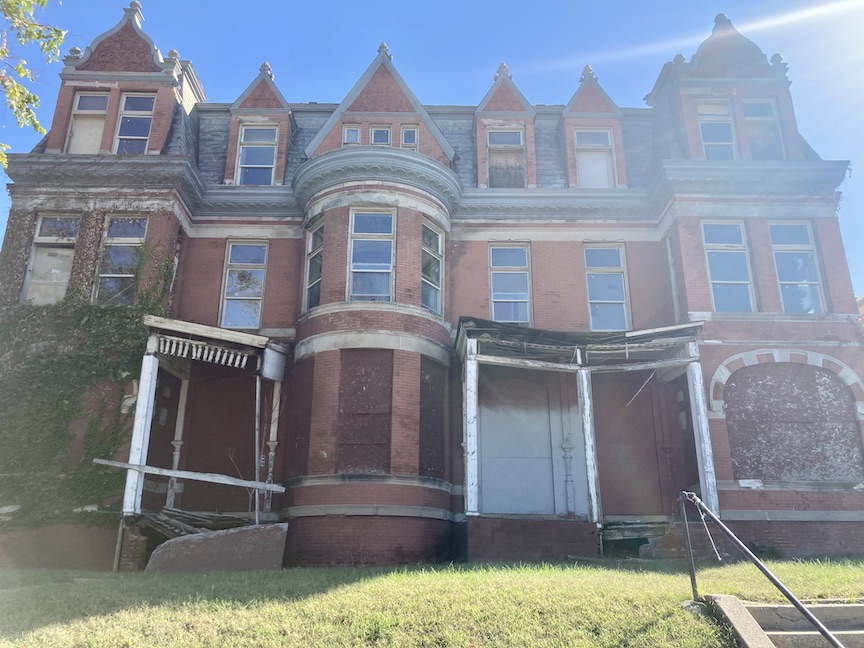
How kind of the Weekleys to share! A thank you to the Wonderful Weekleys for sharing their lovely home.
Miss Cassette, as a curious fan of mysteries, history and architecture, I always enjoy your investigations. I must add that now, in difficult times, your work is a welcome distraction and always leaves me feeling calmer and better about life in general. Thank you for that.
Being a “Central-ish” “South Omaha-ish” girl, it’s nice to see North Omaha homes featured. Certainly not my stopping grounds. Thanks for the lovely article.
Thank you for this wonderful look at one of my favorite homes! It is just so beautiful and to know there are people who like to keep its history is a gift to Omaha.
My favorite parts of my house built in 1940 is all that is original…it is a joy to share the love of houses with you and your readers. Take care and happy spring!
The most endearing aspect of 2302 North Fifty-fifth Street, imho, is the jaunty angle of the entry vestibule which was emphasized by cladding it in limestone as opposed to brick. Without the angle and without the change in masonry, the house would lose a great deal of its magnetic charm and appeal. Brilliant! It takes a lot of confidence for a designer or architect to pull off something this quirky and not only get away with it but have it succeed so admirably. It would have been so much easier to have clad the vestibule in brick or to have squared the entry. Even a forty-five degree angle would have been more conventional, but the house would not be nearly as attractive had these gutsy design choices not been made.
Having spent the bulk of my teenage years in a house built by the same developer, Schroeder Realty, I was excited to see some interior details of Mr. Harkert’s house which were very similar to the ones I grew up with. Our house was quite a bit more ordinary, and very much like the house at 2712 Martin Avenue. I suspect this common floor plan was a published design and built by numerous developers with subtle variations. I had the opportunity to meet Jesse Schroeder in 1974 and thank him for building our house, presenting him and his wife with baked goods (baked by my mom, who had arranged the meeting as encouragement for my interest in architecture, construction and history. Thank you for another delicious investigation!